Dalio’s recurring economic worldview is that economies and world orders operate in repeatable, largely mechanical cycles driven by debt/credit expansion, monetary policy…
Preview how this speaker shows up across market transcripts. Unlock the full archive, AI chat, and the version personalized to your watchlist, followed channels, and favorite speakers.
Ray Dalio is a macro investor and public educator who explains economics through simple causal systems: transactions, credit, interest rates, debt cycles, and long-run state power cycles. Across the supplied material, he consistently frames the economy as a mechanical system that can be studied and managed with principles rather than partisanship. He emphasizes measuring cause-effect relationships, especially around monetary policy, debt burdens, and the interaction between growth and inflation. He also presents himself as focused on passing on what he has learned through books, videos, and platforms built around his ‘Principles’ framework.
Dalio’s recurring economic worldview is that economies and world orders operate in repeatable, largely mechanical cycles driven by debt/credit expansion, monetary policy, productivity, inequality, and geopolitical power shifts. He favors stable, moderate inflation and real rates, and sees central banking as a balancing act: rates should not be so high that they choke activity or so low that they distort returns for lenders. More broadly, he views debt as both a useful engine of spending and a source of fragility when debt service rises faster than income. He repeatedly stresses that long-term stability depends on understanding these cycles, keeping credit productive, and managing the distributional effects of technology and asset-price booms. In his geopolitical work, he argues that reserve-currency and empire cycles rise and fall in recognizable patterns, and that the U.S. and China are now central actors in a changing world order.
Every analyzed appearance we have for this speaker, newest first. Open any transcript preview to read the underlying transcript.

Preview:Ray Dalio shares his "holy grail of investing": find 15 good uncorrelated return streams to reduce risk by ~80% without reducing returns. He recounts his 1982 near-bankruptcy, how it taught him humility and diversification, and how that led Bridgewater to become the world's largest hedge fund. The conversation spans personality tests (he's a "shaper"), the five big forces shaping markets (debt cycle, wealth gaps, geopolitical disorder, nature, technology), his "bubble gauge" currently at ~75% of 1929/2000 levels, and life philosophy: know your nature, learn from pain, and pursue meaningful work and relationships.
Preview:Ray Dalio outlines principles-based criteria for Fed monetary policy: keep inflation near 2%, target a real interest rate around 2%, and use Treasury market signals (breakeven inflation rates, yield curve slope) as guides. He argues the risk-free rate is the most important influence on global economies and warns against partisan decision-making. He frames the task as a mechanical balancing act between debtor and creditor interests.
Preview:Ray Dalio's 30-minute animated explainer on how the economic machine works. He breaks down the economy into three fundamental forces: productivity growth, the short-term debt cycle (5-8 years), and the long-term debt cycle (~75 years). Transactions — exchanges of money or credit for goods, services, or financial assets — are the atomic building blocks. Credit is the most important and least understood component: it creates cycles because borrowing pulls consumption forward but forces austerity later. Dalio explains how central banks steer the short-term cycle via interest rates, and walks through the four levers of deleveraging (spending cuts, debt restructuring, wealth transfers, and money printing), arguing that a "beautiful deleveraging" balances deflationary and inflationary forces. Three practical rules close the piece: don't let debt grow faster than income, don't let income grow faster than productivity, and always work to raise productivity.
Preview:Ray Dalio argues that the US-led world order is quietly but fundamentally shifting, driven by his five-forces framework. He sees rising global perception that America is an unreliable guarantor — weakened by war reluctance, financial constraints, and the painful realities exposed in the Iran conflict — while China ascends. The core argument: China will operate through its ancient "tribute system" and "Art of War" philosophy, a hierarchy-based, war-avoidant model where stronger powers exert pressure through means short of military force. Dalio frames understanding this system as essential, presented as a conceptual framework rather than a near-term trade call.
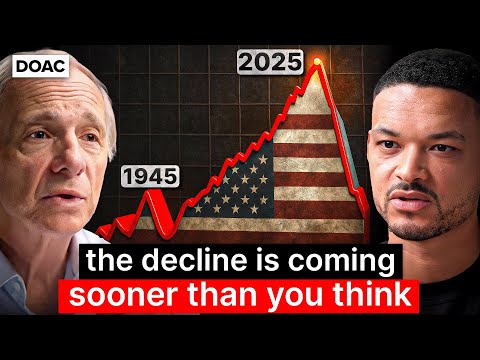
Preview:Ray Dalio presents a distilled version of his "Big Cycle" framework, tracing the rise and decline of empires over 500 years using eight measurable power metrics. He identifies a recurring ~250-year cycle with 10-20 year transition periods that are typically marked by great conflict. The pattern: post-war order leads to peace and prosperity, which breeds borrowing, financial bubbles, wealth gaps, internal revolution, and external war — before resetting with new winners. The implicit present-day application is that the US is in late-stage decline while China is rising, and the transition period is the most dangerous phase.
Preview:Ray Dalio's 2026 commencement speech at Long Island University weaves his personal biography — from a rebellious, poor-performing high school student who entered LIU on probation to building the world's largest hedge fund — into a framework for life's three phases. His core message: success is not money or status but meaningful work and meaningful relationships, and the key to getting there is treating painful mistakes as learning puzzles ("pain + reflection = progress"). He announces a gift of Transcendental Meditation lessons to graduates and his book "Principles: Life and Work." The speech is entirely life-philosophy; there are no market calls, no investment advice, and no discussion of current economic conditions.
Preview:Ray Dalio narrates an 11-day OceanX scientific mission to China, the first for the company's vessel OceanExplorer, conducting water sampling off Hong Kong, Ningbo, and Shanghai. The video emphasizes the value of direct person-to-person contact between American and Chinese scientists and students as a way to build mutual understanding and break barriers that pure scientific-literature exchange cannot. No market analysis, trade ideas, or investment commentary is presented.
Preview:Ray Dalio uses a circulatory-system metaphor to explain how sovereign debt becomes "plaque in the arteries" of the economy. Countries don't go broke by defaulting — they go broke by printing money and devaluing. The US is now at a critical juncture: spending $7T/year while taking in $5T, needing to sell ~$12T in bonds over the next year amidst a supply-demand imbalance that central banks will ultimately resolve by printing money.
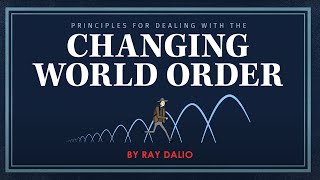
Preview:Ray Dalio presents a condensed version of his "Changing World Order" thesis: empires and reserve currencies rise and fall in ~250-year cycles driven by eight measurable factors. He traces the Dutch, British, US, and Chinese arcs, describing how peace/prosperity sow the seeds of debt bubbles, wealth gaps, internal conflict, and eventual war — from which a new order emerges. This is a framework piece, not a market call.
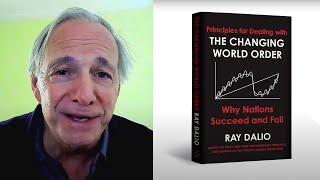
Preview:Ray Dalio discusses his philosophy of passing along knowledge in later-life stages, the mechanics behind his new book, and his approach to decision-making through written principles — a practice he began 35 years ago that became the foundation of Bridgewater Associates. Interviewed by David Rubenstein at the 92nd Street Y.
Preview:Ray Dalio explains the mechanics of austerity in the big debt cycle, walking through why cutting spending paradoxically worsens debt burdens. Falling incomes outpace debt repayment, defaults cascade through the banking system, debt restructuring destroys wealth faster than it helps, and government deficits explode. The cycle culminates in wealth redistribution via taxing the rich, rising social tensions within and between nations, and potential political extremism.
Preview:Ray Dalio presents the "Top Phase" of his Big Cycle framework — the moment when a leading empire appears strongest but the seeds of its decline are already embedded. He outlines five self-reinforcing mechanisms: loss of competitiveness via rising costs and technology copying, cultural decadence as wealth is inherited rather than earned, financial bubbles from complacent borrowing, widening wealth gaps that breed resentment, and reserve-currency overborrowing that weakens long-term financial health. The video uses Dutch and British empire declines as historical parallels.
Preview:Ray Dalio presents a condensed version of his "Changing World Order" framework, tracing the rise and decline of empires over 500 years using eight metrics. He argues that the US is in decline while China is rising, and that the typical empire cycle (~250 years) follows a predictable pattern: peace and prosperity breed borrowing, inequality, financial bubbles, internal conflict, and eventually external war — after which a new world order is established and the cycle repeats.
Preview:Ray Dalio explains the mechanics of short-term and long-term debt cycles. Short-term cycles (5-8 years) are driven by credit expansion/contraction managed by central banks via interest rates. Long-term cycles unfold over decades as debt grows faster than income, creating unsustainable debt burdens that eventually trigger a painful deleveraging when debt repayments overwhelm incomes.
Preview:Ray Dalio opens his "Principles for Success" ultra-miniseries by framing the foundational idea that success comes from knowing how to deal with not knowing, not from knowing everything. He introduces the need to think independently, develop personal principles through mistakes and reflection, and embrace reality. This episode is purely autobiographical and philosophical — no market content, no assets, no trades.
Preview:Ray Dalio recounts the 1971 Nixon Shock — when the US broke its promise to redeem dollars for gold, effectively defaulting on its debts. He draws a parallel to 1933 under FDR, showing that both devaluations led to surging stock markets as paper dollars were printed in greater quantity, diluting their value. The core lesson: when a reserve currency nation runs out of real money, it devalues rather than tightens, and risky assets rally in nominal terms.
Preview:Ray Dalio argues that the U.S. and UK are both under strain from debt, internal division, geopolitics, and technological disruption, and he thinks neither country is in a healthy place right now. His practical advice is less about prediction and more about adaptability: build financial flexibility, keep moving toward better environments if needed, learn from history, stay open-minded, and make work align with purpose.
Others tracked across the same asset focus or market thesis.
Unlock every transcript this speaker appears in, compare them with your other followed voices, and ask the agent for the bull, bear, and consensus read in one workspace.
Type a question. Create a free agent to send it and keep the answer linked to this speaker.
Your question is preserved across sign-in.
Free. No card. Takes about a minute.