Martin’s recurring worldview, as reflected here, is bullish on tangible resource assets—especially gold projects with strong permitting, clear economics, and jurisdictional…
📈 See how Jay Martin's thesis changed over time →Preview how this speaker shows up across market transcripts. Unlock the full archive, AI chat, and the version personalized to your watchlist, followed channels, and favorite speakers.
J Martin appears to be a resource-sector interviewer/host rather than the company executive in the transcript context. In the provided material, he frames U.S. Gold and its chairman Luke Norman around permitting, feasibility, financing, and mine development milestones, and he emphasizes market valuation versus asset value. Because the evidence is limited and mostly from one conversation, there is not enough here to build a robust personal biography; the safest read is that he is a commodities/investing commentator who focuses on mining project economics and capital-markets execution.
Martin’s recurring worldview, as reflected here, is bullish on tangible resource assets—especially gold projects with strong permitting, clear economics, and jurisdictional advantages. He seems to value shovel-ready development, feasibility-study validation, disciplined capital strategy, and the ability to convert reserves into production. The framing also suggests skepticism toward market prices that understate asset value, and attention to macro drivers such as liquidity cycles, central-bank demand, and renewed U.S. appetite for domestic resources. Overall, his lens appears pro-development, pro-hard-asset, and focused on execution rather than abstract commodity narratives.
Every analyzed appearance we have for this speaker, newest first. Open any transcript preview to read the underlying transcript.
Preview:VRIC Media host Jay Martin interviews Jim, CEO of Coutney Silver, reviewing the company's transition from explorer to developer. The flagship Las Cigara PEA delivered strong economics (14-year mine life, 4.5M oz/yr average, $18/oz AISC, $763M NPV at $50 silver). Meanwhile, the Colomba high-grade asset continues a 60,000m expansion drill program targeting 100M oz. With ~$34M in treasury, Coutney is funded for at least 18 months. Jim frames silver as in the early innings of a multi-year bull market akin to 2002-2012, with the current $60-70 range serving as a base before the next leg higher.
Preview:Jay Martin argues the world is moving through a cyclical decline of American financial dominance, with U.S. debt funding becoming more fragile as foreign holders are forced to sell Treasuries and even gold to cover energy shocks. He sees the Strait of Hormuz conflict as an accelerant of an existing debt spiral, not a root cause, and says gold/silver miners look attractive even after recent volatility.
Preview:An interview about Oceanic Iron Ore makes the case that a structural supply shift in high-grade iron ore is creating a favorable setup for a Quebec project that avoids rail dependence. The guest argues the company is moving toward a refreshed PFS, permitting work, and a strategic partner/offtake deal that could re-rate the story.
Preview:This is an interview about Ranj Pillai’s move from Yukon politics into Seva Mining, a Fiore-backed vehicle around the Cameron Lake gold project in northwestern Ontario. The core pitch is that Cameron is a proven, underappreciated gold asset with existing infrastructure, a stockpile, and a potential direct-shipping ore (DSO) path that could lower capex and create near-term optionality while the team drills and deepens community agreements.
Preview:This interview is a bullish update on Gold X2’s Ontario gold project, framed around a recently released conservative PEA, a large strategic investment from AngloGold Ashanti, and a very large drill program meant to prove the deposit is bigger than the initial model. The speaker argues the project already has strong economics at conservative gold assumptions, and that ongoing drilling is likely to add ounces, extend mine life, and potentially reveal underground potential beneath a large open pit.
Preview:The video argues that the copper shortage has worsened because geopolitics, supply-chain fragmentation, and industrial inputs like sulfuric acid are tightening at the same time. The host and Ian Harris frame Copper Giant as a way to capture value from a structural copper cycle, with the near-term focus on a Q4 preliminary economic assessment, an active 23,000-meter drill program, and Colombia’s upcoming political transition.
Preview:Interview about US Gold Corp’s CK Gold project: the company says it has completed a conservative feasibility study, has major permits in hand, and is now focused on project financing and eventual construction. The guest argues CK is one of the rare fully permitted U.S. gold development assets, with strong economics, low permitting risk in Wyoming, and potential M&A appeal.
Preview:Jim of Kootenay Silver argues the company is entering a major rerating phase as silver strength makes its projects more valuable and more financeable. He says the near-term focus is a PEA on La Cigarra, continued drilling and resource growth at Columba, and maintaining a strong treasury so the company can advance regardless of volatility.
Preview:A copper bull thesis presentation arguing that structural supply constraints (declining grades, permitting difficulties, ~20-year mine development timelines) combined with new demand from AI/data centers (~2M tons/year incremental) make higher copper prices inevitable. The speaker sees copper at $6/lb as undervalued given its essential role in society. He contrasts young vs. old conference attendees: older hands seen calling this "just another cycle," while younger voices argue "this time is different" due to unsustainable US debt levels — a backdrop he sees as structurally bullish for gold as well.
Preview:Jay Martin argues that the gold bull market is still early, driven by central-bank buying, distrust in the U.S. dollar, and rising geopolitical unpredictability. He also says silver, copper, and mining equities should benefit as capital rotates from physical metal into miners and then into broader commodities.
Preview:This is an interview focused on Visa Copper’s acquisition of the Palmer copper project in Alaska and the speaker’s broader thesis that a major mining boom is starting. He argues Palmer is a cheap, high-grade, near-surface asset in a strategic U.S. jurisdiction, and that policy support plus looming copper deficits should drive both drilling upside and sector revaluation.
Preview:A bullish silver/gold panel on VRIC Media argues that silver has broken out of decades of suppression and may be entering a “new reality,” with triple digits and even $200/oz floated as possible over the next 6 months. Both guests tie the move to a broader breakdown in fiat currencies, rising bond yields, central-bank and Asian demand, and a coming asset-class shift away from equities and toward precious metals.
Preview:Jay Martin argues gold is still in the early-to-middle stages of a methodical bull market, not near a top, with central bank buying, de-dollarization, and geopolitical uncertainty keeping the thesis intact. He says silver offers the biggest upside for 2026, while copper is a slower, higher-conviction multiyear story tied to underinvestment in supply, and he sees rising interest in juniors and the Vancouver Resource Investment Conference as evidence the sector is drawing more capital.
Preview:Jay Martin argues gold is still in an early-stage bull market because central banks and institutions are buying it for structural reasons: a weaker future dollar and less predictable U.S. geopolitics. He expands that thesis into a bigger view that globalization is over, state capitalism is rising, commodities are underinvested, and the U.S./China competition is reshaping trade, mining, and monetary alliances.
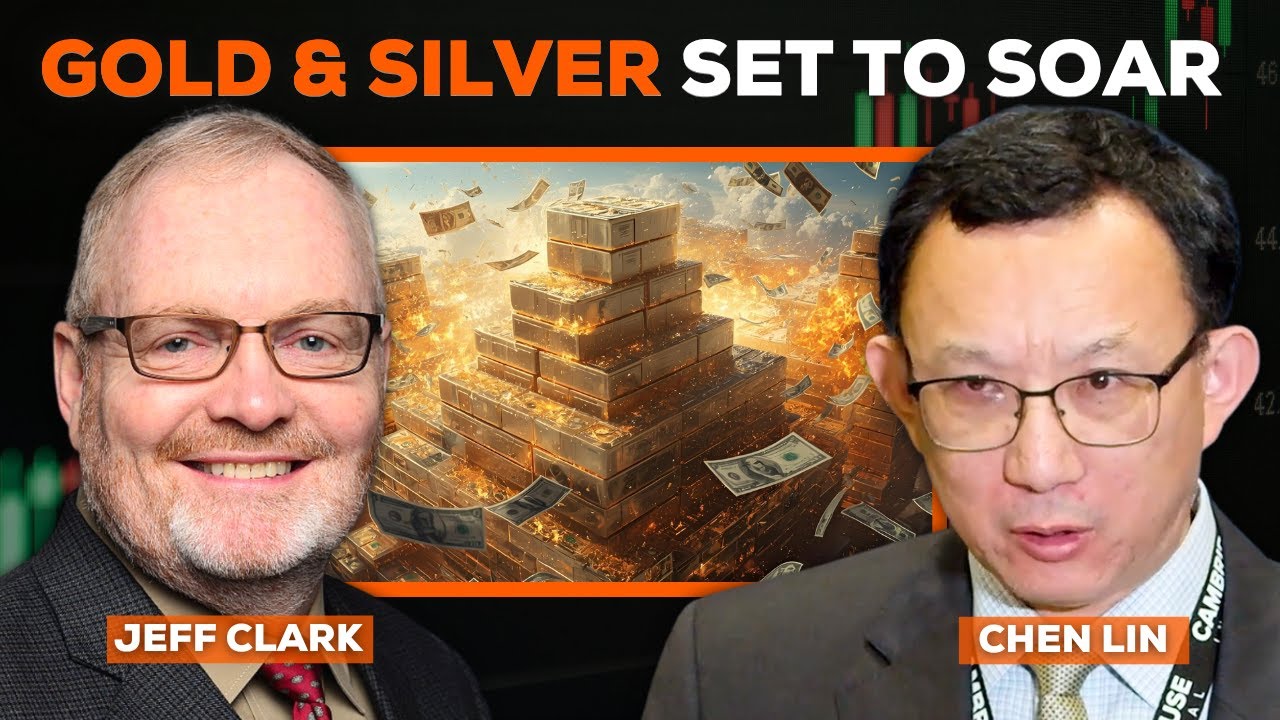
Preview:A panel on VRIC Media argues that gold and silver are in a confirmed bull market with the main drivers still unresolved. Jeff Clark sees $4,000 gold and $50 silver as new floors, while Chen Lin thinks silver is entering the second half of its bull run and could see another move higher into year-end and early 2026, especially around Chinese physical demand and potential policy shocks. Both favor buying dips and prefer miners with leverage to rising metal prices, with Chen highlighting select producers and juniors and Jeff emphasizing juniors, new names, uranium, copper, and companies with strong fundamentals.
Preview:Jay Martin argues Canada has been mismanaged for years but is somewhat improving under Mark Carney, especially if the state now actively supports mining and other resource projects. He is broadly bullish on commodity investors and precious metals, saying government intervention, fiscal expansion, and devaluation are increasingly pushing capital toward hard assets, though he still sees Canada as uncertain and remains personally hedged.
Preview:A uranium-focused panel argues the sector has entered a more constructive phase: spot and term prices have started to move higher, utilities are still under-covered, and production misses across the supply chain are reinforcing a structural deficit. The speakers say Trump administration support for nuclear adds demand optionality, but the main thesis is still supply scarcity and delayed contracting, not AI or SMR hype.
Preview:Jay Martin argues that commodities are entering a broad secular bull market, led by gold, industrial metals, and critical minerals, with central-bank gold buying, de-dollarization, and Western re-industrialization all supporting the thesis. He is bullish on gold as the best long-horizon hedge, but he also warns that the more speculative junior miners should be de-risked into strength because volatility and even a recession are plausible near-term setbacks.
Preview:Jay Martin argues the gold bull market is real, still early, and likely part of a multi-year secular trend driven by central-bank buying, dollar devaluation, and rising geopolitical uncertainty. He urges investors to take profits in speculative juniors after the recent surge, while preferring cash-flowing majors and royalty names for longer-duration exposure.
Preview:This panel argues that Trump’s 50-year mortgage idea and $2,000 tariff-funded stimulus talk are signs of policy gimmickry, not durable solutions. Melody Wright and Jack Gamble say both the real-estate market and the AI boom are built on extension, leverage, and “pretend,” with institutional investors, mortgage finance, and AI firms all increasingly exposed to bad economics.
Preview:A gold-and-silver panel with Jesse Day, John Fenick, and Don Durret argues that the current pullback is a consolidation, not a trend break. Both speakers remain broadly bullish on gold, but they are especially constructive on silver and silver miners, with Durret calling for silver to outperform gold and for inventory tightness to intensify over time.
Preview:A VRIC Media panel on gold and silver argues that the rally is being driven by a mix of geopolitical de-dollarization, physical tightness in silver, and a broader loss of confidence in the fiat system. Eric Young says LBMA silver is effectively unavailable, lease rates have spiked, and banks are trying to pull metal through ETFs and futures mechanics; Mario Inko says the only real fix is much higher prices. They also frame gold as benefiting from U.S.-China tensions, central-bank demand, and the possibility that gold becomes collateral for international trade.
Preview:A VRIC Media panel argues that gold’s surge above $4,000 and silver’s breakout are signals that fiat confidence is eroding and that the market is entering a late-stage monetary reset. Jesse Day frames the discussion around whether gold is returning to mainstream recognition as money, while Rafie Farber and Lynette Zang both say the move is less about a temporary hedge and more about a shift of purchasing power out of credit, dollars, treasuries, and into precious metals.
Preview:Jay Martin argues the current gold and silver rally is not just another momentum trade, but a signal that the global monetary and geopolitical system is being repriced. He links the move to de-dollarization, geopolitical realignment, state intervention in strategic industries, and central-bank demand for gold, while repeatedly urging investors to take profits and de-risk into stronger balance sheets rather than chase speculative juniors.
Preview:Jay Martin argues the gold bull market is still healthy and methodical, but the junior/speculative end is already frothy enough that investors should de-risk into larger producers rather than chase further upside. He is bearish on broad U.S. equities because a few mega-cap tech names carry the market, while geopolitical fragmentation, currency devaluation, and industrial policy are pushing capital toward hard assets and resource equities.
Preview:Jay Martin argues the macro backdrop is increasingly supportive of gold and select hard assets because geopolitics are fragmenting, states are intervening more directly in commodity markets, and the U.S. dollar-centered order is becoming less predictable. He is constructive on gold and silver, cautious but positive on miners after a huge run, and especially bullish on nickel over a 3-5 year horizon.
Others tracked across the same asset focus or market thesis.
Unlock every transcript this speaker appears in, compare them with your other followed voices, and ask the agent for the bull, bear, and consensus read in one workspace.
Type a question. Create a free agent to send it and keep the answer linked to this speaker.
Your question is preserved across sign-in.
Free. No card. Takes about a minute.