His recurring economic worldview is strongly pro-exponential and regime-shift oriented.
📈 See how Raoul Pal's thesis changed over time →Preview how this speaker shows up across market transcripts. Unlock the full archive, AI chat, and the version personalized to your watchlist, followed channels, and favorite speakers.
Raoul Pal presents as a macro/markets commentator and media operator who blends global macro, crypto, and AI into a single framework. He repeatedly frames himself as an investor-researcher who builds organizing theses—like the “everything code,” “exponential age,” and “economic singularity”—to interpret markets and long-run change. Across the material, he emphasizes liquidity, demographics, debt cycles, technology adoption, and the idea that AI, robotics, and blockchain are reshaping the economy faster than traditional forecasting models can handle. He also leans heavily into educational content and audience/community engagement through Real Vision and related products.
His recurring economic worldview is strongly pro-exponential and regime-shift oriented. He argues that the economy is being transformed by rapidly compounding intelligence, with AI as the main force driving a new supercycle and eventually an “economic singularity.” In his framework, older drivers of growth—population, labor, debt rollover, and central-bank liquidity—are being overwhelmed by productivity gains from software, chips, and machine intelligence. He generally expects continued debasement/liquidity support, sees technology and crypto as the main assets positioned to benefit, and thinks investors should adapt by owning the long-duration winners of the new substrate rather than relying on legacy work, pensions, or static forecasting. He is also openly open to short-term volatility, but his base case is that the technological cycle dominates and can outrun debt and stagnation.
Every analyzed appearance we have for this speaker, newest first. Open any transcript preview to read the underlying transcript.
Preview:Raoul Pal presents his "economic singularity" thesis: AI intelligence is now on a double-exponential (Reed's Law) curve, far faster than Moore's Law, and will render the economy unrecognizable by ~2030. He argues this creates massive deflationary abundance, transforms money and work, and that the only durable career is "being human" — gathering attention, creating experiences. His investment prescription: own the secular trends (AI, robotics, blockchain/crypto, digital art) and hold them, with crypto potentially going from ~$2.5T to $100T by 2034-36. Blockchain is positioned as the infrastructure layer for the agentic economy. The core message is to embrace rather than fear the disruption.
Preview:Raoul Pal lays out his thesis that we are in a technological super cycle — not a dot-com-style bubble — driven by the exponential growth of AI intelligence, massive forced CAPEX by hyperscalers and nation-states, and ongoing liquidity injections from government debt rollover. He argues that no player (firm or country) can afford to slow down in the "great race" for intelligence, that debt capacity remains ample, and that productivity gains will eventually validate the spending, making a recession or bear market unlikely through 2028.
Preview:This is a Real Vision portfolio-review episode with Bejan Mleki hosting Raoul Pal and Jamie Coutts. The discussion centers on how the guests would think about portfolio construction across AI equities, Bitcoin, altcoins, ETH, cash, semis, health care, tokenization, and a few tactical hedges. The main theme is that both speakers remain structurally bullish on crypto and AI-related exposures, but want better balance, more attention to ETH, and more discipline around cash and rotating into oversold areas rather than overpaying for crowded winners.
Preview:Raoul Pal interviews Kalshi founder Tarek Mansour about prediction markets, the launch of regulated perpetual futures, and the broader thesis that markets are expanding to price everything — from politics to inflation to AI outcomes. Mansour argues prediction markets create incentives for truth-seeking, that super forecasters consistently outperform domain experts, and that Kalshi's perpetuals product is displacing futures with lower fees and simpler structure. Pal draws parallels to tokenization, AI training data, and the unbundling of Wall Street — framing Kalshi as a foundational layer for the future of asset management and information markets.
Preview:Raoul Pal walks viewers through the new Real Vision platform features—AI tools, community trade ideas, portfolios, mentors, and tiered memberships (Free → Connect → Alpha → Pro → RVIP)—then announces a large discount promotion across all paid tiers. There is no market analysis, no asset thesis, and no macro call in this transcript. It is a pure platform tour and pricing pitch.
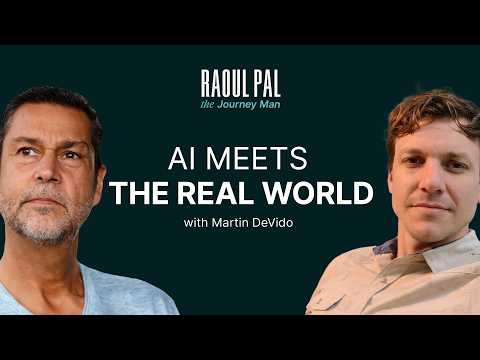
Preview:Raoul Pal hosts a solo "Drinks With Raoul Pal" episode from Little Cayman, mixing wine commentary with market analysis. His core thesis: crypto remains in a secular uptrend despite brutal price action, layer-1s (ETH, SOL, SUI) are deeply oversold while semiconductors are historically overbought, and a "great rotation" from semis into crypto and other undervalued areas is coming. He leans heavily on log regression channels, D-mark indicators, and his "Everything Code" macro framework (demographics → debt → liquidity) to argue the cycle is mid-cycle, not over. He promotes Real Vision heavily throughout, including its AI tools and a discounted membership offer.
Preview:Raoul Pal hosts Erik Voorhees to discuss Bitcoin, privacy, and how AI changes the need for self-sovereign data and money. The core argument is that Bitcoin was a Trojan horse for separating money from the state, and Venice.ai extends that ethos into AI by offering private, uncensored access to multiple models with local memory and user-controlled data.
Preview:Raoul Pal and Jordi Visser frame AI as a supercycle driven by recursive intelligence growth, compute/energy bottlenecks, and a massive capex buildout. They argue the bottlenecks may slow some companies’ earnings but likely extend the investment cycle rather than end it, with rotations into power, semis, applications, crypto, tokenization, and longevity themes.
Preview:A long, conversational Real Vision episode that starts as an interview/hangout and quickly turns into Raoul Pal’s market read. His core view is that global liquidity is still growing, tech remains the cleanest beneficiary, and crypto is in a liquidity-driven drawdown that he expects to catch up from a weaker base. He also uses the show to promote a new Real Vision tool built with Claude for long-term compounding and trend management, especially for Bitcoin and QQQ.
Preview:Raoul Pal argues that AI agents plus blockchain will create a massive, largely invisible machine economy that scales far beyond today’s human-centered financial system. His core trade is that owning the major layer-1 crypto rails—especially ETH, Solana, and Sui—will be the simplest way to participate in that coming substrate.
Preview:Raoul Pal argues that crypto should be viewed as a long-term network-adoption and liquidity story, not a trading game. His core message is to zoom out, avoid leverage and FOMO, hold a small set of high-conviction assets, keep dry powder for major drawdowns, and focus on assets with persistent adoption and economic density.
Preview:Raoul Pal and Julien Bittel argue that macro, markets, and AI are now being driven by a single accelerating shift: more energy and capital flowing into compute, intelligence, and crypto rails. They see policy, geopolitics, liquidity, and capex all lining up to extend the cycle, with Bitcoin, ETH, SOL, stablecoin equities, and select growth stocks still in strong uptrends.
Preview:Raoul Pal argues that blockchain, AI agents, and tokenized finance are converging into a once-in-a-generation infrastructure boom, with Sui positioned as one of the few layer-1 networks that can capture it. He says the market is obvious, the rails are being built now, and long-term wealth creation will come from owning a few top-tier L1s rather than trading around every cycle.
Preview:Raoul Pal interviews artist/collector Coldie about how his work evolved from stereoscopic childhood imagery and LA editorial design into crypto art, interactive digital portraits, and his ‘Filthy Fiat’ project. The core theme is that art, technology, money, and culture are now entangled, and Coldie uses his practice to comment on Bitcoin, fiat debasement, surveillance-era tech leaders, and the future of immersive art.
Preview:Raoul Pal argues that blockchains should be valued as networks that maximize intelligence per unit of energy, not by discounted cash flow or fee generation. He extends that framework into AI, saying the economy is shifting from carbon to silicon, agents will dominate activity, and Sui is one of the few layer-1s positioned to capture that agentic future because of its object-centric design, parallel execution, and Move-based programmability.
Preview:Raoul Pal interviews eToro founder Yoni Assia about the future of finance in an AI-and-crypto world. The conversation argues that AI agents will increasingly trade, manage portfolios, and even help create markets, while crypto rails, tokenization, and 24/7 trading push traditional finance toward code-driven infrastructure.
Preview:Two market commentators discuss a macro setup centered on oil, the dollar, rates, liquidity, and crypto. Their base view is that easing liquidity and unresolved geopolitical shocks keep risk assets supported, but short-term price action is choppy and crowded books are sidelined until oil/Middle East uncertainty clears.
Preview:Raoul Pal and Jamie Coutts argue that liquidity is still the main driver of crypto returns, but the market has become more crowded and more selective. Their base case is that base-layer blockchains remain the cleanest crypto exposure, while application-layer and some niche sectors only matter if real usage and product-market fit keep improving.
Preview:Raoul Pal hosts Peter Diamandis and Salim Ismail for a big-picture conversation about AI, exponential technology, institutional breakdown, and the social transition they think is now underway. Their core view is that technology is advancing faster than institutions can adapt, pushing society toward decentralization, agentic AI workflows, and a fork between people and systems that embrace change versus those that resist it.
Preview:Raoul Pal frames Ethereum as the likely institutional settlement layer for Wall Street, arguing that the combination of regulatory tailwinds, stablecoin legalization, Layer 2 scaling, and zero-knowledge privacy now makes public-chain adoption practical. The guests from Etherealize, VC and Danny, say the real bottleneck is less technical than organizational: banks need a neutral, credible, interoperable network, and Ethereum best fits that role.
Preview:Raoul Pal argues the recent crypto drawdown is a midcycle correction, not the end of the cycle, and says the macro/liquidity backdrop is improving as the dollar and rates ease, ISM firms, and global M2 and US liquidity stay supportive. He is also very constructive on crypto’s long-term shift toward blockchain rails, agent-native usage, and multi-chain infrastructure, while warning that the biggest near-term political inflection is passing the Clarity Act rather than midterm election noise.
Preview:Raoul Pal interviews Tom Farley, who frames Bullish as an institution-first crypto exchange and liquidity platform built to serve the next wave of on-chain financial markets. The conversation centers on tokenization, stablecoins, DeFi ambiguity, market structure, and how AI/agents could rebuild asset management and capital formation on blockchain rails.
Preview:Raoul Pal and Arpan Nanavati discuss the exponential scaling of AI agents on blockchain rails, framing it as the "Rise of Machines." Arpan argues that agent inference costs are collapsing from ~$10/day toward micro-cents, triggering a Jevons-paradox explosion in on-chain agents — from hedge funds to individual wallets. He introduces the concept of "Machine GDP" (MDP), which initially cannibalizes human GDP for bootstrap liquidity but then creates new money autonomously, eventually dwarfing human GDP. A key twist: two-thirds of global population in non-US economies may skip traditional finance entirely and leap directly to agent-driven, permissionless crypto rails — analogous to how India/Brazil skipped credit cards for QR-code payments.
Preview:Raoul Pal interviews Arpan Nanavati about Beep, an agentic payments and treasury stack built for AI agents to transact on crypto rails. The core thesis is that agents will become the dominant users of blockchains, pushing payments, identity, data access, yield, and eventually capital allocation into an invisible machine economy that scales far beyond human GDP.
Preview:Raoul Pal hosts a panel at the Real Vision Crypto Gathering with V. Powils and Farokh about how NFTs and web3 have evolved, why most projects fail, and what actually creates durable communities. Their core message is that culture and utility are entry points, but emotional connection, founder presence, and strong social layers are what keep people coming back. They also argue memecoins are a short-term attention game, while prediction markets may be the more serious long-term web3 use case.
Preview:Raoul Pal argues that AI is the dominant macro force: it is driving energy demand, capital formation, robotics, and a long-running US-China race that will reshape markets and labor. He is constructive on the liquidity backdrop, sees policy and banking-system plumbing as supportive, and thinks crypto, tokenization, and digital assets become much larger as AI agents proliferate.
Preview:The speakers argue that Bitcoin's post-10/10 selloff was driven by both a specific positioning shock and a broader liquidity drain, not by a broken secular trend. Their main caution is that leveraged holders and illiquid alt positions can take weeks or months to unwind, so volatility and sentiment damage can persist even if the longer-term uptrend remains intact.
Preview:Raoul Pal interviews Ed Chin and Tejas Nalval of Parax Capital about crypto market structure, the impact of ETF and regulated-wrapper adoption, the role of leverage and liquidations in the Oct. 10 selloff, and why they think crypto is still early in its institutionalization. Their near-term view is bullish but volatile, with Bitcoin favored over altcoins, while their medium-term thesis centers on new pools of capital, clearer regulation, and product expansion. Long term, they argue crypto is becoming a more institutional asset class and could benefit further from AI-agent-driven economic activity.
Preview:Raoul Pal and Martin DeVido discuss an AI experiment where a model was used to control real devices in a grow tent. The core idea is less about the specific plant setup and more about how AI models can now write code, operate physical hardware over a network, and act as an extension of human cognition. The conversation broadens into a philosophical thesis: humans offload memory and thinking into tools, and AI is the latest and most powerful compression layer for knowledge and intelligence.
Preview:Raoul Pal recounts four formative trades, emphasizing how top hedge funds saw second- and third-order effects before others, and how his own worst trade came from overriding a macro framework with emotion. The episode is more about process, speed, and simplification than a fresh market call.
Preview:This is a conversational interview about AI, consciousness, and a tomato-growing experiment run by Martin Devito with Claude. The speaker frames the project as a live demonstration of AI becoming embodied, recursive, and emotionally legible, while Raoul Pal uses it to argue that AI is compressing human knowledge and moving into physical-world work like farming and fabrication.
Preview:Peter Zeihan argues that the world is moving from a US-backed globalized order toward fragmented regional blocs, driven by deglobalization and accelerating depopulation. He sees the near-term risk as trade warfare, supply-chain stress, and possible geopolitical shocks, while the medium-term outcome is a reshaped economy centered on North America, parts of Europe, Southeast Asia, and a few other durable nodes. He is sharply bearish on China and Germany, cautious on Europe broadly, relatively constructive on the US and parts of North America, and somewhat positive on Japan and Australia.
Preview:Raoul Pal and David Mattin argue that AI capability is improving at a visibly exponential pace, with the key evidence coming from a 'meter time horizons' chart showing models handling longer human-equivalent tasks. They connect that step-change in capability to market turbulence, saying investors can feel the shift but have not yet settled on the right pricing response, which is hitting software and SaaS names especially hard.
Preview:Raoul Pal and David Mattin argue that AI, energy, and robotics are converging into an exponential civilizational shift. Their core claim is that intelligence is becoming the main scarce resource, with energy as the binding constraint, and that this is already visible in model capability, AI agents, and the buildout of solar, data centers, and robot bodies.
Preview:Emad Mostaque and Raoul Pal discuss the AI data narrative, with Mostaque arguing the "data shortage" thesis is wrong. He contends existing models are already trained on vast amounts of data (including controversial sources like burned books, SciHub, and Hollywood torrents) and that modern AI's few-shot learning capability means the real bottleneck is organizing existing data, not acquiring more. The conversation touches on video models (Sea Dance/ByteDance), the implications for Hollywood, and how few-shot learners can adapt to new environments extremely quickly.
Preview:Raoul Pal and Ryan Ferris have a wide-ranging, speculative conversation about UFOs, aliens, ghosts, consciousness, DMT entities, meditation, quantum physics, and AI — tying them all together under the hypothesis that consciousness (not spacetime) may be the fundamental substrate of reality. They explicitly state they are not experts, are "just two guys shooting the shit," and repeatedly caution viewers not to take anything as gospel. No market or investing content is discussed.
Preview:Raoul Pal and Emad Mostaque argue that AI is moving into a phase of rapidly falling compute costs and rising capability, driven by cheap solar electricity, improved models, and better communication protocols between machines. Their core claim is that intelligence is becoming abundant enough that the bottleneck shifts from model quality to optimization, which could compress profits and reshape how software, coding, and AI systems interact.
Preview:Peter Diamandis argues that space, AI, blockchain, and longevity are converging into an era of abundance driven by exponential technologies. He is broadly bullish on space commercialization, digital identity/ownership, and anti-aging science, while positioning himself heavily in Bitcoin, Ethereum, and longevity-related ventures.
Preview:Raoul Pal and Emad Mostaque argue that AI is moving from chatbots to persistent, always-on agents and then into robots, collapsing the cost of intelligence and rewriting the economics of software, finance, and money. Their core thesis is that the winner won’t just be the smartest model, but the best agent experience, with the market and business model shifting toward agent-serving infrastructure, payments, and on-device/private AI.
Preview:Raoul Pal frames this interview with Emad Mostaque as a thesis that AI is driving an "economic singularity": cognitive labor is rapidly becoming cheap, abundant, and automatable, while the value of human work, money, and current economic models is being rewritten. He argues that markets, organizations, and even economics itself can be understood through AI-style optimization, and that the next few years will bring major deflation in software, services, and knowledge work alongside a huge rerouting of capital into digital assets and AI infrastructure.
Preview:Raoul Pal and Andreas Steno discuss the difficulty of investing amid the AI S-curve — where LLM capabilities double roughly every 4-5 months and the market is plagued by rolling sector drawdowns as investors struggle to separate signal from noise. Steno highlights the paradox of the EM/AI trade: investors flee to emerging markets to escape AI risk, but EM indices are heavily concentrated in Korean and Taiwanese semiconductor names (Samsung, SK Hynix, TSMC) that are on the receiving end of AI capex. The core tension: markets are terrified of the AI "kiss of death" hitting individual sectors yet continue to buy the very semiconductor manufacturers that benefit from sustained capex.
Preview:The speaker argues that a new Goldilocks backdrop is forming: manufacturing is improving, domestic capex is broadening out, and inflation is still running benignly. On that basis, he expects the Nasdaq to rebound over the next few quarters as the market eventually recognizes that AI-related capex can produce returns and productivity can offset inflation.
Preview:Raoul Pal and Andreas Steno argue that the current AI capex cycle is not a dot-com-style bubble: spending is far less debt-financed, earnings are still supporting it, and the spillover from hyperscaler capex into broader manufacturing, energy, and domestic activity is only beginning. They frame the market as a barbell between intelligence/compute and the energy/material inputs required to power it, with near-term upside still favored for tech and select cyclicals, especially as liquidity remains supportive.
Preview:Raoul Pal interviews CZ about Binance, crypto adoption, and the intersection of AI and blockchain. CZ argues the industry is moving beyond trading into government use cases, digital identity, and AI-native payments, while stressing that fundamentals, product-market fit, and mission-driven founders matter more than token hype.
Preview:Raoul Pal interviews Evenny from RE7 Capital about how a DeFi hedge fund can manage risk in a 24/7 onchain market. The core message is that RE7 treats DeFi like fixed income plus venture: a diversified, rules-based yield book that aims to lose money mainly to hacks, while a separate directional altcoin book is managed as a liquid venture portfolio. Both speakers argue the current crypto drawdown is more likely a liquidity-driven mid-cycle correction than a broken bull market.
Preview:Raoul Pal and Jordi Visser argue that the world is entering a long AI/energy/commodities buildout where scarce physical inputs—especially silver, copper, power infrastructure, and minerals—should outperform abundant software. They see AI as a deflationary force for software and a demand engine for industrial materials, with Bitcoin, gold, and select commodity-linked assets benefiting from the same scarcity/debasement regime.
Preview:Raoul Pal and Alex Gurevich discuss whether AI—specifically LLMs—could actually shrink GDP rather than boost it. Gurevich argues that when people replace paid lawyer/doctor consultations with free LLM interactions, economic activity simply disappears rather than shifting to a new sector. Pal pushes back, suggesting the time saved could increase productivity elsewhere, but Gurevich counters that for many people the freed time goes to non-economic activities like hiking, and the $500 transaction is simply gone.
Preview:Raoul Pal and Alex Gurevich discuss how the post-2020 macro regime has fundamentally shifted the distribution of market outcomes. Central bank intervention — especially the "ocean of liquidity" response since COVID — has truncated left-tail risk, making crises shallower and long-side setups far more attractive. However, Gurevich cautions against "this time is different" thinking: the nature of the next shock is unknowable, and it's possible that future shocks (e.g., a US-China war) could be negative for Treasuries rather than the traditional flight-to-safety bid, potentially breaking the old crisis playbook in unexpected ways.
Preview:Raoul Pal and Alex Gurevich argue that the real money in global macro is often made after a crisis, not by obsessing over the crash itself. Their core message is to clear your mind, reassess the regime, and ask where cash should be deployed in the new setup rather than mechanically rushing to get flat or defensive.
Preview:Raoul Pal interviews macro manager Alex Gurovich about how to think about markets through regimes, trend, and “perfect trades.” The conversation centers on his prior risk-parity-style setups in 2002 and 2014, how he manages trades through crises, and why he thinks the current AI/robotics cycle could be deeply deflationary even as it drives massive capex and asset-price leadership.
Preview:Raoul Pal turns a Miami live event into a playful, high-energy defense of his long-run macro framework: patience, secular trends, debasement, and the idea that crypto/tech should outperform over time. Most of the show is banter, guest roasting, and audience Q&A, but the recurring market message is consistent: recent underperformance is noise, liquidity is the key short-term variable, and the bigger thesis still favors crypto and technology on a multi-year horizon.
Preview:Raoul Pal interviews crypto artist Mark Wilson (diewiththemostlikes) about balancing a hated day job with an art career, the dangers of quitting too early and over-minting, collector relationships, NFT series sizing, and the creative process behind projects like Gristle Buddies. The conversation is framed as a lesson for artists in the digital/crypto art space.
Preview:This is a loose, highly stylistic conversation between Raoul Pal and Mark Wilson about art, identity, and a recurring joke that “everything becomes shagable” as a metaphor for how products, brands, and even attention get monetized. The exchange is less about a tradable setup than about a worldview: AI and automation will erase much of middle-class knowledge and manual work, leaving humanity, desire, and attention as the remaining scarce products.
Preview:This is not a market or financial transcript. It is a conversation between Raoul Pal and artist/writer Mark Wilson about Wilson's creative process, his books (described as depraved, warped fiction satirizing corporate America), his early struggles for an audience, and his eventual move into digital art and NFTs. There is zero market analysis, no discussion of assets or macro conditions, and no financial intelligence. The video ends with a product pitch for Real Vision.
Preview:Raoul Pal interviews Mark Wilson, aka Die with the most likes, about how his art practice grew out of years of soul-crushing office work and turned into a multi-format project spanning books, digital art, painting, performance, and meme culture. The core idea is that art is a way to document middle America, internet life, consumer decay, and the emotional residue of the digital age before AI and homogenized content flatten everything.
Preview:Raoul Pal argues crypto is still constructive despite recent chop, with the near-term setup driven by tariff uncertainty, a possible U.S. shutdown, and then a more positive liquidity backdrop into late January. He is especially bullish on the combination of AI, agents, and crypto rails, and thinks the bigger opportunity may be in apps, payments, and human-centered assets rather than only L1s or purely speculative trading.
Preview:Raoul Pal interviews Jeffrey Quesnelle of Noose Research about the imperative for open-source, decentralized AI. Quesnelle argues that frontier AI is too powerful to be controlled by a few centralized firms and nation-states. He explains Noose's technical approach: using crypto rails and smart contracts to coordinate decentralized GPU training runs across idle data-center capacity, creating a permissionless system with no central point of failure. The conversation covers the exponential pace of AI development, the philosophical case for decentralization (analogous to the printing press and internet), the looming political battle between accelerationists and decelerationists, and the eventual rise of autonomous economic agents. Quesnelle emphasizes that Noose seeks "thousand-x" efficiency breakthroughs rather than incremental improvements, and that open-source models offer a competitive differentiator by letting enterprises run AI on their own infrastructure without SaaS lock-in.
Preview:Raoul Pal argues that 2025’s weak crypto price action was mainly a liquidity problem, not a failure of adoption or narrative. He says policy makers are effectively forcing liquidity into the system through bank-regulatory changes, fiscal stimulus, and balance-sheet mechanics, and thinks 2026 could be a major up year for Bitcoin and the broader crypto stack if that liquidity arrives.
Preview:Raoul Pal interviews Lai/Les (the transcript spells it inconsistently) about a new “platform generator” he built after Google Maps and mapmaker-style crowdsourcing work. The core pitch is that a declarative, agentic system can let communities and enterprises build mission-critical platforms—starting with a regulated bank in India—much faster, with less code, self-testing, and lower operating cost than conventional software.
Preview:Raoul Pal argues the current crypto weakness is a liquidity and cycle-timing problem, not the end of the bull market. His core thesis is that debt refinancing, Fed easing, fiscal stimulus, and a likely weaker dollar should push liquidity higher into 2026, setting up a stronger phase for Bitcoin, crypto, and risk assets.
Preview:A Raoul Pal / David Matten fireside chat on the "exponential age" argues that AI, longevity biotech, and tokenization are converging around one core idea: the universe is optimizing for more intelligence per unit of energy. The conversation is part market commentary, part philosophy, part product pitch, with strong emphasis on Gemini 3, OpenAI/Google competition, GLP-1 longevity data, and the idea that future data/markets will become machine-digestible.
Preview:Raoul Pal interviews Mert Mumtaz about why privacy is the missing pillar in crypto and why Zcash may be the cleanest answer. Mumtaz argues that crypto solved money, then programmability, then scaling—but not privacy—and that Zcash’s zero-knowledge design gives stronger guarantees than mixers or optional privacy layers on other chains.
Preview:Raoul Pal uses this Black Friday promo to sell Real Vision memberships and frame the platform as a community-driven investing hub. The market view embedded in the ad is that 2026 could be a strong year because liquidity, rate cuts, regulation, and fiscal stimulus may all arrive together.
Preview:Raoul Pal interviews Yat Siu about why crypto’s current weakness is more psychological and structural than fundamentally broken. Yat argues the four-year cycle is fading as institutions replace the old retail/whale “religion,” while tokenization, stablecoins, NFTs, and onchain rails expand crypto far beyond Bitcoin into ownership, financial literacy, and global distribution.
Preview:Raoul Pal interviews Chris Biski about whether crypto’s cycle has topped, with both agreeing the market is unusually noisy and probabilistic. Biski leans cautious: he thinks Bitcoin is down about 20% from highs, the long tail has already been in a bear market, and the October liquidation event likely caused both real and psychological damage to risk appetite. Pal argues the broader liquidity setup still favors crypto over a longer horizon, but both stress that price and positioning — not ideology — should decide.
Preview:Raoul Pal argues the crypto selloff is mostly a liquidity and sentiment washout, not proof the four-year cycle is dead. He says debt maturity, liquidity, and the business cycle still point to a later cycle peak, with Bitcoin and higher-beta crypto likely to recover once Treasury liquidity, QT, and dollar conditions turn more supportive.
Preview:Raoul Pal and Richard Galvin discuss the resurgence of the privacy narrative in crypto. Galvin admits his fund got the privacy trade wrong at launch — they held large Monero positions expecting privacy coins to grow alongside Bitcoin like a shadow economy, but exchanges delisted them and liquidity never arrived. Now, with rising government censorship and a softening regulatory stance, privacy coins may finally have their moment, though institutional hurdles like auditability remain a real friction.
Preview:Raoul Pal interviews Richard Galvin about stablecoins as crypto's killer use case. Galvin argues stablecoins solve real-world dollar access problems (especially in Asia) and are now being recognized by US policymakers as a tool for dollarizing the world and absorbing Treasury supply. He highlights a stark sentiment divide: traditional finance is increasingly bullish on crypto (driven by stablecoins' clear business model), while crypto natives are depressed. Stablecoins are the wedge that's finally getting TradFi investment committees comfortable with the space.
Preview:Raoul Pal and Richard Galvin discuss the sharp disconnect between crypto's deteriorating price action and its accelerating onchain fundamentals — revenues, users, and applications all hitting new highs while prices slide. Pal attributes the weakness to a government-shutdown-induced liquidity squeeze (TGA building without offset, repo rates blowing out) combined with year-end performance-chasing by underweight fund managers. Galvin notes structural changes: ETF-driven ownership shifts, OG selling (~$4B+), fragmented speculative attention, and retail exhaustion. Both see a longer, delayed cycle ahead with institutionalization as the eventual catalyst, though they acknowledge the traditional four-year cycle may be breaking down.
Preview:Raoul Pal interviews Richard Galvin about the post-shock crypto market, arguing the drawdown is mostly a liquidity problem rather than a collapse in on-chain fundamentals. Galvin says crypto activity, revenues, apps, and users are making new highs while token prices lag, and he expects year-end to improve as liquidity normalizes and institutional adoption deepens.
Preview:Raoul Pal and Jordi Visser discuss the future of the Magnificent 7, arguing that most tech giants face a difficult 3-5 year outlook as AI disrupts their economics. Visser is bullish only on Nvidia and Tesla among the Mag 7, calling the rest "spenders" that will struggle despite rate cuts and PMI recovery. They also explore how the 2022 crypto/VC bubble created a lasting supply overhang that suppressed Bitcoin, Ethereum, and Solana, a dynamic only now fading thanks to Fed cuts and improving PMIs.
Preview:Jordi Visser argues that traditional recession frameworks are broken because software-driven growth decouples nominal GDP from debt and labor. The Magnificent Seven added trillions in market cap without taking on debt — a historical anomaly. AI is profoundly deflationary, which, combined with already-falling wages and inflation, forces the Fed to keep cutting rates. Meanwhile, fiscal stimulus (the "one big beautiful bill") ramps up into midterms 2026, creating a rare environment where growth accelerates alongside rate cuts — a setup most investors are not positioned for.
Preview:Raoul Pal and Jordi Visser discuss the imminent disruption of knowledge workers by AI, arguing that the labor market has reached an inflection point. They highlight that major employers like Walmart, Amazon, and Asensure have stopped hiring, temporary employment has been declining since ChatGPT's launch, and this trend will drive corporate profit margins higher even as job creation outside healthcare stalls. The core thesis: exponential AI is hitting labor now, and it will only worsen.
Preview:Raoul Pal and Jordi Visser argue that AI-driven deflation, a weaker labor market, and easier liquidity conditions are setting up a broadening bull market into 2026 rather than an imminent cycle top. They think the biggest structural winners are not the broad Mag 7, but selected AI/power beneficiaries, crypto rails, and small caps, while AI and stablecoins reshape labor, payments, and capital flows.
Preview:Raoul Pal hosts a two-part monthly recap: first an interview with an unnamed guest (likely from Real Vision/GMI) discussing tokenization convergence, meme coins as capital formation stress tests, and the shift from central bank to private-sector liquidity creation; then a solo segment dissecting the GMI domino framework — how financial conditions lead global liquidity, which leads the ISM, which unlocks alt season and the "banana zone." The macro punchline: fiat debasement is structural, the Fed is trapped, and assets with fixed quantities are the only escape.
Preview:Raoul Pal hosts Emad Mostaque for a long discussion arguing that AI is about to trigger an “economic singularity” in which cognitive labor, and eventually much manual labor, is commoditized to near-zero cost. Emad’s core thesis is that economics can be reframed as model-fit optimization, and that modern AI systems—especially agents, diffusion models, and language models—now outperform humans fast enough that the private sector, labor markets, pricing, and even money itself will need to be rebuilt. Both speakers tie the transition to a coming surge in digital assets, tokenization, and AI-enabled productivity, while repeatedly acknowledging uncertainty about the exact timing and the shape of the post-AI system.
Preview:Raoul Pal and Dan Morehead discuss the "debasement trade" as the dominant macro factor driving gold and Bitcoin. They argue that endless currency debasement, sticky inflation, and lack of productivity gains are pushing investors into hard assets. Pal notes the NASDAQ has a 97.5% correlation with a global liquidity index since 2012, with Bitcoin at ~90%, making diversification unnecessary — it's all one trade. Morehead calls it the simplest and most inevitable macro trade of their careers, with ~90% probability of making money over 4-5 years in crypto if you can withstand drawdowns. They note that even JP Morgan and Goldman Sachs are now talking about the debasement trade after years of crypto natives discussing it.
Preview:Raoul Pal and Dan Morehead discuss the tokenization of real-world assets on blockchain, focusing on why US Treasuries are the ideal first mover — they are homogeneous and ubiquitous. They also explore tokenized equities as a way to open US capital markets to global investors, particularly the unbanked or those in restricted jurisdictions, framing it as both a financial-inclusion play and a strategic mechanism for servicing US debt through capital inflows.
Preview:Raoul Pal and Dan Morehead discuss what they see as a massive policy error: the Fed cutting rates into 3% inflation, full employment, and record asset prices while fiscal deficits run at $2 trillion. They frame the real hurdle rate as ~11% (3% inflation plus 8% global fiat debasement), which they argue explains the relentless bid for gold, crypto, and anything with a fixed supply. The core trap: the Treasury needs lower rates to refinance debt, forcing continued debasement with no clean exit. Morehead is notably bearish on the macro setup, calling it a slow-motion "boil the frog" crisis; Pal is somewhat more resigned, seeing the debasement trade as the only logical response.
Preview:Raoul Pal hosts Dan Morehead for a broad bullish discussion on crypto within a macro thesis of fiat debasement, fiscal excess, and underowned digital assets. The conversation argues Bitcoin, gold, stablecoins, tokenized securities, and crypto treasury vehicles all benefit from the same structural shift: money is being debased, institutions are still underallocated, and blockchain rails are becoming more useful and politically acceptable.
Preview:Raoul Pal hosts another "Drinks with Raoul" episode, blending wine commentary and market analysis. His core thesis: crypto weakness is purely a liquidity issue caused by the US government shutdown trapping the Treasury General Account — not a cycle top. He expects a strong year-end rally once the shutdown resolves and liquidity flows again, with compressed Bollinger Bands, seasonality, and gold's lead over Bitcoin all pointing to higher prices ahead.
Preview:Raoul Pal and Mike Novogratz discuss the practical challenges of tokenizing semi-liquid assets like private funds. Novogratz argues that tokenized fund interests would create a "black market" for illiquid positions, trading at premiums or discounts to NAV. He's skeptical about liquidity for niche tokenized assets, suggesting that only large, compelling stories (like SpaceX) would attract enough buyers. The conversation touches on AI-driven sweepers as future liquidity providers and the tension between fund managers wanting to tokenize to sell more product versus the lack of natural buyers.
Preview:Raoul Pal interviews Mike Novogratz about Galaxy Digital's transformation from Bitcoin mining into a major AI data center business. Novogratz details how a distressed-asset purchase (Helios data center from Argo) serendipitously positioned Galaxy with scarce power access, leading to an 800MW lease deal with CoreWeave worth $20B+. The project is financed via Deutsche Bank ($1.4B initial loan) and is projected to generate $700-800M annual free cash flow at 95% margins once fully built out over ~2.5 years.
Preview:Raoul Pal and Mike Novogratz discuss why crypto has been lagging behind tech stocks. Novogratz attributes the choppiness to OGs and long-term holders finally taking profits (including a single $9B BTC sale Galaxy handled), while tech stocks have had an easier ride. He notes Ethereum's revival driven by the GENIUS Act and DATs narrative, and sees two potential catalysts that could break the four-year cycle pattern: passage of a market structure bill enabling tokenized equities/mortgages, and big consumer/financial players entering crypto now that regulatory clarity is emerging.
Preview:Raoul Pal interviews Mike Novogratz about a macro backdrop he sees as unusually supportive for gold, Bitcoin, commodities, stocks, and a weaker dollar, while warning that political chaos, Fed independence risk, and a potentially bubbly AI cycle could create sharp reversals. The second half shifts to Galaxy’s strategy: data centers, crypto infrastructure, tokenization, onchain products, and the view that regulated TradFi and crypto rails are converging.
Preview:Raoul Pal and Andreas Steno argue that the current macro regime is still liquidity-positive and earlier fears of recession or cycle peak have been premature. They see credit creation shifting away from central banks toward the private sector, with Japan, Europe, and the U.S. all leaning on banks and yields/curve shape to unlock lending, while fiscal deficits and bill issuance keep liquidity flowing. That backdrop, they say, supports global equity upside, especially in sectors tied to AI, energy, defense, crypto, and selected European/Japanese names.
Preview:Raoul Pal interviews Micky Malka about his journey from physical art collecting into digital art (NFTs). Malka describes how he missed the early NFT mania but entered in 2022 during the bear market, drawn by aesthetic affinity rather than trading. His approach was pairing digital works with physical pieces from the same artistic lineage — particularly Latin American artists — and he found the energy and creativity in the digital art scene reminiscent of 1910s–1920s Paris. The conversation is a cultural/art-market reflection, not a macro or trading call.
Preview:Raoul Pal and Micky Malka discuss Malka's early investment in Robinhood. Malka describes meeting founders Vlad and Baiju before launch — three young mathematician/physics grads who combined deep infrastructure understanding with design taste and a mission born from Occupy Wall Street. He highlights their surprising 70% waitlist conversion and frames Robinhood as part of a broader generational shift toward decentralized financial ownership. Raoul ties it to crypto's rise and the GameStop reversal. The interview segment ends with a Real Vision subscription pitch.
Preview:Raoul Pal interviews Micky Malka of Ribbit Capital about discovering Bitcoin around 2010, the early pain points that drove their crypto investment thesis, and how Ribbit's "solve your own problems" approach led them to back foundational crypto infrastructure (custody, fiat bridges) before eventually concluding that crypto and fintech would converge into a single financial infrastructure layer.
Preview:This transcript is the final episode of a four-part Real Vision series on Web3, featuring interviews with Sandy Cole (Franklin Templeton) and Raoul Pal (Real Vision/SU). The core thesis: Web3 is not a speculative novelty but the inevitable next layer of the internet — a peer-to-peer, token-incentivized, identity-enabled digital infrastructure that will reorganize commerce, money, and human attention. Cole frames it as the natural conclusion of a 50-year shift of power from centralized intermediaries to individuals. Pal emphasizes the AI-agent economy as the killer use case: agents need programmable micropayment rails, digital identity, and permission systems that only Web3 can provide, and this will be commonplace within five years.
Preview:Raoul Pal interviews fintech/crypto investor Mickey Malla about how fintech, crypto, AI, and digital art are converging into a broader "tokenized" internet. Mickey argues that money, identity, knowledge, and assets are all becoming machine-readable tokens, and that the next decade will be defined by combining money with context/knowledge, not just moving value.
Preview:Raoul Pal's September 2025 monthly recap: Pal argues the liquidity cycle is late (~34 months) but still rising, with Treasury bill issuance creating ongoing stimulus. He sees Bitcoin's trend exhaustion as a normal mid-cycle transition to a "high-quality alt season" rewarding revenue-generating protocols. An interview with Solana Mobile CEO Emmett Hollyer covers the vision for a cryptonative mobile platform now at 150,000 Seeker devices shipped. Pal also discusses his NYC philanthropic work connecting crypto firms with community initiatives.
Preview:Raoul Pal and Julien Bittel argue that the dominant macro driver is global liquidity/debasement, not diversification, and that this is setting up a stronger business cycle into 2026. They say Bitcoin, crypto, and tech are the main beneficiaries, while recession fears are misplaced because the data they emphasize are lagging.
Preview:Raoul Pal hosts a characteristically irreverent "Drinks With Raoul" episode filled with wine snobbery, lifestyle contrasts, and mean-tweet mockery — but the market content is substantive. He lays out the macro liquidity framework: global M2 growing at ~8% annually, a 90%+ correlation with Bitcoin and NASDAQ, and an elongated 5.4-year business cycle (not the traditional four). He argues we remain early in "Banana Zone Phase 2," with the Treasury General Account drain that caused recent crypto chop now ending. His core call: the cycle extends into at least Q2 2026, with Bitcoin likely outperforming tech stocks from here, and a potential parabolic move to $200K+ before a correction that will trap PTSD-ridden traders calling a top too early.
Preview:Raoul Pal and Jamie Coutts argue that several crypto apps and chains are being valued more like traditional growth stocks than pure narrative assets, with Hyperliquid and Tron looking especially cheap on fee/revenue multiples. They say Hyperliquid is transitioning from a single app into a network, which should justify a higher network-effect multiple, while some DeFi protocols now look like reasonable GARP-style allocations to traditional managers.
Preview:Raoul Pal and Jamie Coutts discuss how crypto valuation metrics — particularly revenue/fees and settlement values — are misleading or insufficient on their own. Coutts argues that fees relative to some other chain-value metric is better than gross fees, and that settlement value (how much moves across networks, including stablecoin flows) is an underappreciated measure of actual economic activity. Both agree current dollar-denominated on-chain metrics suffer from circularity with token price.
Preview:Raoul Pal interviews Real Vision analyst Jamie Coutts about where crypto stands in the current market cycle. Coutts argues the cycle is not over — his Bitcoin topping indicators aren't flashing euphoria — but he does see trend exhaustion signals and fundamental deterioration in Bitcoin, which he interprets as a normal mid-cycle rotation from BTC dominance into higher-quality altcoins like ETH. Market psychology is scarred from the last cycle, creating premature top-calling despite frameworks suggesting more room to run.
Preview:Raoul Pal interviews Jamie Coutts about where crypto is in the cycle, arguing that the market is transitioning from Bitcoin-led leadership into a selective, higher-beta altcoin phase rather than a broad 2021-style meme frenzy. The conversation centers on liquidity, settlement-value frameworks, and the idea that quality layer-1s and revenue-generating DeFi protocols are being rewarded while lower-quality or overvalued names should face tougher scrutiny.
Preview:Raoul Pal interviews Michael Howell on global liquidity and the US dollar. Howell argues the paper dollar remains structurally robust despite the administration's desire for a weaker dollar — net inflows into the dollar are still strong. He sees the dollar weakening cyclically against real assets (gold, silver, crypto) due to debasement rather than against other fiat currencies. On liquidity, he pushes back against fears of a TGA rebuild shock, arguing the Fed won't let reserves drop below adequate levels. His leading indicators suggest the liquidity cycle peaks around Q1-Q2 2026, not this year.
Preview:Michael Howell presents a global liquidity framework, arguing that Japan's rising long-end bond yields reflect a deliberate rotation from bonds into equities — not a bond crisis — while China is ramping up liquidity stimulus that should lift commodities and risk assets. Raoul Pal facilitates, tying the themes together under the weak-dollar-allows-everyone-to-stimulate umbrella.
Preview:Raoul Pal and Michael Howell discuss the collapse of the traditional business cycle, replaced by a dominant liquidity cycle driven by Treasury bill issuance ("Treasury QE"). Howell argues this structural shift fuels monetary inflation and asset debasement, benefiting long-duration assets like tech stocks, crypto, and gold. He sees the Fed as largely powerless on rates, with the balance sheet mattering far more. The conversation closes with Pal's platform pitch.
Preview:Raoul Pal and Michael Howell argue that the global liquidity cycle is still upward but late, with the main setup favoring liquidity-sensitive assets like tech, crypto, and gold for now. Their core view is that debt refinancing, Treasury bill issuance, bank monetization, and easier policy abroad are extending the cycle into early 2026, even as longer-term debt and inflation pressures keep building.
Preview:Raoul Pal and Emmett Hollyer discuss how crypto-enabled mobile devices — specifically the Solana Seeker phone — can transform global payments, particularly in emerging markets where mobile phones already serve as both internet access and banking infrastructure. The conversation focuses on stablecoin tap-to-pay, peer-to-peer money transfers mimicking physical cash UX, and the critical importance of self-custody security on mobile devices.
Preview:Raoul Pal and Emmett Hollyer discuss Solana Mobile's strategy: using token airdrops and exclusive ecosystem rewards to make the phone effectively "self-funding." They frame this as Web3's "read, write, own" ethos applied to user attention — users get paid for their engagement rather than Google capturing ad revenue. Hollyer previews the upcoming "Seeker Season" campaign (weekly exclusive offers/rewards) and explains how the Saga's sell-out taught them to double down on exclusivity and rewards as a go-to-market strategy.
Preview:Raoul Pal interviews Emmett Hollyer about Solana Mobile's strategy. Hollyer explains that the traditional Apple/Google app-store model — taking 30% of transactions and controlling the rules — is incompatible with crypto's peer-to-peer nature. Solana's answer is building an open, crypto-native mobile platform, starting with its own Seeker phone (150,000 units shipped) as a beachhead, then expanding the platform to other devices. The long-term vision: Solana becomes the default mobile layer for Web3, with every Solana startup launching a mobile app on their platform, inverting the current desktop-first paradigm.
Preview:Raoul Pal interviews Emmett Hollier, GM of Solana Mobile, about the Seeker phone and how Solana is building a crypto-native mobile platform to create network effects. Hollier explains the vision: existing Apple/Google app stores are hostile to crypto (30% fees, restrictions), so Solana is building its own hardware-software ecosystem. With 150,000 Seeker phones shipping to 50+ countries, they're reaching critical mass for developer adoption. Key themes include the self-funding device via ecosystem airdrops/rewards, proof-of-humanhood through biometrics, Seed Vault wallet as an "Apple Pay for crypto" experience, and a future token (SKR) to decentralize governance of the platform. Hollier sees mobile-first as the inevitable growth path for crypto adoption, especially for payments in emerging markets.
Preview:Raoul Pal presents his "economic singularity" thesis: AI and robotics will so radically alter productivity that within ~6 years, traditional economic frameworks will break down. He argues the magic formula of GDP (population + productivity + debt growth) is already collapsing — population growth is vanishing, debt just services old obligations, and only technology-driven productivity can fill the gap. His core call: make as much money as possible before roughly 2030, because after that, markets and economics become unintelligible by today's standards. The video also contains an unrelated NFT/digital art conversation segment that appears spliced in from a different interview.
Preview:Raoul Pal and Keith Grossman discuss the tokenization of capital markets, arguing that blockchain-based tokenization will democratize access to global equities and accelerate capital inflows into US markets. They draw a historical parallel to the iPhone's consumer-led adoption overcoming institutional resistance, suggesting tokenized assets will follow a similar path once regulation catches up.
Preview:Raoul Pal and Keith Grossman (MoonPay) discuss why banks remain hostile to crypto: FATCA and US KYC/AML rules terrify offshore banks into blanket rejection. Grossman explains MoonPay's bet that crypto must evolve in sync with the traditional financial system — acquiring licenses, MiCA/FINTRAC compliance, and money transmitter licenses — rather than disrupting from the outside. Pal highlights on-chain KYC (citing Signum Bank in Switzerland) as a potential bridge for international banking acceptance. Both agree regulatory clarity is improving, with the US and EU taking opposite approaches (chaos-first vs. rules-first) that will converge over time.
Preview:Keith Grossman argues the crypto industry has entered a "golden age" under the current US administration, contrasting it with the hostile regulatory environment of the prior administration that "maimed" mid-sized crypto companies. He highlights four simultaneous clarity breakthroughs — regulatory, legislative, banking, and accounting — with major banks like BofA and JPMorgan now engaging constructively after years of shunning the industry. Raoul Pal hosts.
Preview:Raoul Pal and Keith Grossman argue that crypto has entered a “golden age” because regulation, legislation, banking access, and accounting treatment are all improving at once. Keith frames MoonPay as invisible infrastructure that lets users and institutions move between fiat, stablecoins, and tokenized assets, and he says the real story is not speculation but the internet absorbing money movement and value transfer.
Preview:Raoul Pal and Batsoupyum make a strongly pro-digital-art / NFT case: they argue digital art is a new, network-native art market whose value comes from verifiable provenance, scarcity, and distribution, not just speculation. They frame ETH as the base economy, PFPs as a noisy adjacent category, and see one-of-ones, editions, and early AI art as the most interesting ways to express status, culture, and future optionality.
Preview:Raoul Pal presents his "economic singularity" thesis: AI, robotics, and renewable energy will fundamentally transform economics by ~2030, making traditional frameworks obsolete. He argues the next six years are critical for wealth accumulation, primarily through crypto and technology investments, before the rules of business, markets, and value creation become unrecognizable. The core formula: infinite AI intelligence (zero-cost knowledge) + near-zero marginal-cost energy = deflationary abundance that disrupts every industry.
Preview:Raoul Pal interviews Tiago Sada of World (WorldCoin) about the user onboarding experience. Sada explains the two-tier funnel: 30M+ have joined the network, but only ~15M have verified at an Orb, while the other ~15M are app-only wallet users with lower-level verification. The Orb is a "fancy camera" that proves unique humanness in ~30 seconds without using biometrics for identification — the World ID is a random private key on the phone. This is a product-design interview, not a market call.
Preview:Raoul Pal interviews Tiago Sada about World (formerly Worldcoin), which launched its token two years ago. Sada explains the project's core idea: give away 75% of the network's ownership as an incentive for people to join, using proof-of-human identity (World ID) to prevent duplicate claims. The combination of World ID and a simple wallet creates a platform where developers can build applications combining identity verification and digital finance.
Preview:Raoul Pal interviews Thiago, chief product officer at Tools for Humanity, about World/Worldcoin’s mission: building a global proof-of-human network for the AI era. The conversation focuses on why World uses an orb and a wallet, how it bootstraps users with a token incentive, why biometric verification is meant to be privacy-preserving rather than identity-tracking, and how the network is expanding into payments, mini apps, and third-party integrations like Tinder, Razer, Stripe, Visa, and governments.
Preview:Raoul Pal’s guest argues that Ethereum and NFTs are not mainly about speculation or even just art: they are a new infrastructure for owning, moving, and composing digital intangibles across the internet. The core bullish case is that NFTs will become the consumer-facing layer that makes decentralization usable, while also enabling new markets for art, identity, community, gaming, tickets, and eventually a broader metaverse.
Preview:Raoul Pal frames the current macro backdrop as a cyclical, Trump-era dollar-debasement setup that is supportive for risk assets, especially crypto. The conversation then broadens into a bullish structural thesis on stablecoins, tokenized money, AI agents, and the migration from the fiat cash system to a parallel digital financial system, with Coinbase presented as a key institutional infrastructure winner.
Preview:Brett Tejpaul argues Coinbase is evolving from a simple exchange into a full institutional crypto platform spanning trading, custody, prime, asset management, derivatives, and crypto-as-a-service. His core message is that regulation, ETFs, stablecoins, and product bundling are driving a second wave of institutional adoption, with Coinbase positioned as the rails provider for banks, hedge funds, wealth platforms, and corporates.
Preview:Raoul Pal interviews Franklin Templeton's Sandy Kaul about the shift from account-based to wallet-based financial infrastructure. Kaul explains how tokenized assets in a single cryptographically protected wallet could give investors one unified view of their total wealth, enabling algorithmic portfolio optimization across all asset classes — something impossible in today's fragmented account system.
Preview:Raoul Pal and Sandy Kaul discuss the state of institutional crypto adoption, noting that ETFs came before direct token ownership — the opposite of what most expected. Kaul explains that institutions still struggle with tokenomics, protocol transparency, and community governance, limiting direct token exposure mostly to venture. She sees education around "tokens as shared ownership of open-source protocols" as key. Both foresee massive liquidity flowing into DeFi from traditional credit giants like Apollo and Blackstone, likely in a hybrid DeFi-CeFi model shaped by regulation.
Preview:Raoul Pal and Sandy Kaul discuss the disruption of traditional hedge funds through tokenization and AI-driven risk allocation, then shift to institutional crypto adoption. Pal argues anyone can become a hedge fund manager via tokenized portfolios, with AI eventually replacing the top-level risk-allocation function. Kaul adds nuance: skill still matters for building AI algorithms, and institutional crypto flows explain current market patterns — higher lows without big breakouts, as institutions buy dips rather than chase rallies. The conversation also touches on a structural tension in crypto: native tokens serve both as investment vehicles and transaction fuel, creating a paradox where platform success makes block space more expensive.
Preview:Raoul Pal interviews Sandy Kaul, Head of Innovation at Franklin Templeton, about the accelerating tokenization of traditional finance. Kaul lays out Franklin Templeton's strategy: tokenized money market funds as a yield-bearing alternative to stablecoins, on-chain portfolio construction enabling hyper-personalization, and the eventual restructuring of capital markets where companies issue tokens for specific business lines rather than monolithic equity. She argues we are shifting from account-based to wallet-based financial architecture, that institutions are already buying crypto on dips, and that DeFi will attract trillions in liquidity from firms like Apollo and Blackstone. The conversation is forward-looking and conceptual rather than price- or trade-oriented.
Preview:Raoul Pal and Jordi Visser compare Perplexity and ChatGPT for financial analysis. Visser prefers ChatGPT Projects for custom technical analysis algorithms he's built, while arguing Perplexity excels at earnings transcript analysis — its "stranglehold" edge. Pal notes AI's improved probabilistic macro forecasting now outperforms most human macro analysts. The conversation is brief and conversational rather than a structured debate.
Preview:Raoul Pal and Julian Patel argue that post-2008 markets are dominated by a persistent debasement/liquidity cycle, not classic valuation or diversification logic. Their core claim is that once you adjust assets for fiat debasement, only tech and crypto have consistently compounded purchasing power, and the current setup still favors higher risk assets into the next cycle leg.
Preview:Raoul Pal and Jordi Visser discuss the underappreciated magnitude of AI's transformation, arguing that most people "midcurve" the technology by fixating on job-loss fears or dismissing AI's intelligence without grasping what "infinite intelligence" actually means. Their central advice: talk to AI, not just prompt it — voice mode and persistent memory have made it feel human, and building a relationship with it is critical for future employability.
Preview:Raoul Pal and Jordi Visser argue that AI is moving from novelty to a fast, practical productivity layer that is already changing how people work, learn, and consume information. The conversation then widens into a macro view: AI plus debasement, lower rates, power constraints, and crypto/stablecoins together are driving a structural shift away from the legacy fiat system and toward a parallel digital economy.
Preview:Raoul Pal interviews Paxos CEO Chad Cascarilla about stablecoins, tokenization, and why crypto infrastructure is moving from speculation toward institutional adoption. Cascarilla argues that stablecoins are becoming the better version of bank money: fully reserved, instant, programmable, and able to remove settlement friction while extending dollar access globally.
Preview:Raoul Pal hosts a solo "Drinks With Raoul" from Spain, pairing three Spanish wines with local snacks while delivering his macro/crypto thesis. He pushes back aggressively against "when banana zone" critics, pointing to his M2 global liquidity chart as the core framework: Bitcoin and risk assets are driven ~90% by liquidity, the dollar is weakening cyclically under Trump/Bessent, and the ISM business cycle is set to rise. He walks through chart after chart — Bitcoin cup-and-handle, altcoin market cap, Bitcoin dominance topping, SUI/Solana/Ethereum setups — and argues the banana zone started in September 2024 and remains in play. He urges patience, dismisses bond-yield panic, and says the cycle likely extends into Q1 2026 or beyond. Heavy sponsor reads for Figure Markets and Real Vision peppered throughout, plus an extended wine-and-food culture segment.
Preview:Raoul Pal presents his monthly macro and crypto update, centered on the global liquidity framework. He argues that global M2 has broken out to new all-time highs, triggering a "super bullish liquidity regime" where Bitcoin's sensitivity to liquidity changes multiplies 5x. The dollar's next move is the critical near-term signal: a push to ~104 would unlock a corrective "phase two" in August–September, followed by "phase three" — the speculative frenzy leg. He introduces a multi-factor risk scoring system (liquidity, leverage/positioning, unrealized profit) currently reading "neutral," suggesting the April-to-now 40% Bitcoin rally is normal and not overheated. He also frames crypto as a series of frontier/emerging market economies and discusses its role in financial inclusion.
Preview:This is a replayed 2020 Real Vision interview framed by Raoul Pal in 2025. The core message is Michael Saylor’s original Bitcoin thesis: after COVID, zero-rate policy, and asset inflation, MicroStrategy’s cash balance was an eroding asset, and Bitcoin was the only reserve asset he found that was scarcer, more portable, and harder than gold. The interview spends a lot of time on Saylor’s background, his operating philosophy, and why he concluded corporate treasury cash should be converted into Bitcoin rather than left in bank deposits or long-duration bonds.
Preview:Raoul Pal interviews Jamie Coutts about his new quantitative frameworks for Bitcoin: a liquidity-sensitivity model that quantifies how BTC price responds to global liquidity expansion, and a risk model that tracks behavior and leverage to identify tops. Pal adds anecdotal context from Middle East sovereign wealth funds pushing into AI/blockchain, and frames the current cycle as potentially extended into Q2 2026 — more like 2017 or 2020 than 2021.
Preview:Raoul Pal and Jamie Coutts discuss the relationship between global liquidity and Bitcoin price action. Coutts presents a framework showing Bitcoin tends to top before global liquidity rolls over, and that Bitcoin's sensitivity to liquidity changes multiplies 3-5x during liquidity breakout regimes. He introduces a risk-scoring model combining liquidity, leverage, positioning, and unrealized profit to identify when Bitcoin is stretched. Currently, global liquidity has broken out to new all-time highs, Bitcoin is not overbought relative to liquidity, and the market is behaving in line with historical bullish liquidity regimes.
Preview:Raoul Pal interviews Real Vision's chief crypto analyst Jamie Coutts, who presents three quantitative risk scores (liquidity, derivatives/leverage, on-chain profitability) designed to identify market tops and bottoms. All three are currently neutral — liquidity is breaking out, leverage is low, and network profitability is normal — suggesting substantial upside ahead with limited headwinds. Coutts also shares an advance-decline line for the top 200 altcoins showing early signs of an alt season forming, with breadth improving from deeply oversold levels. Both agree the cycle resembles 2017 structurally, could extend into Q2 2026, and that Hyperliquid, Ethereum, Tron, and SUI are among the chains worth watching. The tone is unequivocally bullish but grounded in data.
Preview:Raoul Pal and Julien Bittel discuss the macro and crypto setup as of late May 2025. Their core thesis: the ISM manufacturing rebound is arriving, driving a repricing of stronger growth that will fuel alt season. They see the dollar's next move as the key signal — a short-term bounce toward 104 is possible, setting up an August/September corrective "phase two" of the banana zone, followed by a strong year-end "phase three." Crypto is in choppy overbought digestion after a massive rally (BTC +46%, ETH +93%, SOL +84% since April 7), but both see this as a normal pause before the next leg higher. They highlight massive institutional underweight positioning in equities and tech as powerful FOMO fuel once new all-time highs are made.
Preview:Raoul Pal interviews Manuel Stotz, President of the TON Foundation, about Telegram's plan to unblock TON wallet access for US users around July 4th. Stotz frames TON as the "property rights layer" complementing Telegram's "free speech layer," aiming to convert Telegram's billion-plus users into blockchain adopters. They discuss US exchange listings, real-world use cases (remittances, payments, in-app transfers), and the broader vision of "putting freedom into orbit" against the backdrop of CBDCs and digital authoritarianism.
Preview:Raoul Pal and Manuel Stotz discuss the emergence of a "digital continent" in cyberspace, drawing historical parallels to the discovery of America. They frame blockchain networks as sub-nation states (Bitcoin, Ethereum) within this new digital world, with Telegram's ~1 billion users representing a network state now gaining a financial layer. Stotz introduces the term "Satica" for this digital continent and argues the US is finally coming on board, while Pal likens crypto ETFs to foreign direct investment (FDI) and VC to traditional capital flows into a rapidly growing virtual economy.
Preview:Raoul Pal interviews Manny Stotz, now president of the TON Foundation, about why Telegram plus TON could become a new global financial network. Stotz frames the project as a frontier-market style play on distribution, identity, payments, stablecoins, and digital property inside a billion-user messaging app, with the US launch and Telegram wallet rollout as key near-term catalysts.
Preview:Raoul Pal's May 2025 monthly recap covers his macro framework (the "Everything Code" driven by liquidity and demographics), the bullish case for crypto fueled by a weakening dollar and surging global M2, a defense of Ethereum against "ETH is cooked" narratives, the AI-crypto nexus including the thesis that AI agents will transact in crypto, and a wide-ranging discussion touching on Saudi Arabia's AI push, Nvidia's partnership with TSMC/Taiwan, and even ghost stories. The core call: we are repeating 2017 with the dollar falling, liquidity gushing, and risk assets—particularly crypto—positioned for a massive upswing.
Preview:Raoul Pal and David Mattin discuss two massive AI infrastructure commitments: Saudi Arabia's nationwide AI push with hundreds of thousands of Nvidia chips and tens of billions in spending, and Nvidia's partnership with Taiwan's government and TSMC to build a world-leading AI supercomputer. They argue sovereign nation-state demand invalidates the expected boom-bust cycle for Nvidia, and that deepening US-Taiwan tech interdependence via TSMC makes outright conflict "unthinkable."
Preview:Raoul Pal and David Mattin host a community fireside chat for The Exponentialist, discussing their thesis that AI and blockchain are accelerating toward an "economic singularity" within ~5 years. They explore sovereign AI investment (Middle East, Saudi Arabia, Taiwan), the Nvidia-TSMC "grand bargain" as a geopolitical stabilizer, energy-to-intelligence conversion as the fundamental economic metric, and why most corporations and governments are "mid-curving" the transition. The conversation weaves philosophy (hyperstition, universal consciousness), investment strategy (concentrated bets on tech mega-caps and crypto), and practical advice for navigating the exponential age.
Preview:Raoul Pal interviews Changpeng "CZ" Zhao about what excites him in crypto markets. CZ argues the industry is overly focused on short-term token price gains rather than building real products with actual users. He spends most of his time at YZi Labs helping founders design sustainable tokenomics and raise funds. Beyond DeFi, he sees early-stage opportunities in RWA tokenization, decentralized social media, and government blockchain solutions — particularly land title registries and decentralized identity. The conversation is brief, with CZ emphasizing user adoption as the single most important metric.
Preview:Raoul Pal interviews Changpeng "CZ" Zhao at Token2049 about the practical challenges countries face in crypto adoption. CZ explains that regulators often demand local custody, local order books, and local teams — but fragmentation kills liquidity and security. He discusses China's Hong Kong sandbox approach and notes India's prohibitive tax regime. The conversation focuses on real infrastructure hurdles rather than high-level evangelism.
Preview:Changpeng "CZ" Zhao discusses Giggle Academy, his AI-native education app now serving ~20,000 kids in under six months, with 60 lessons, 300 storybooks, and 15 languages. He also reveals behind-the-scenes advisory work with about a dozen countries on crypto regulation and blockchain government applications (digital IDs, land titles, e-visas), noting the US has shifted pro-crypto post-election, with Elon Musk exploring blockchain for government efficiency.
Preview:Raoul Pal interviews Binance founder CZ on stage at Token 2049 Dubai. CZ discusses his post-Binance work: Giggle Academy (20,000 kids in 6 months, 15 languages), advising ~12 countries on crypto regulation and strategic reserves, and YZi Labs investments. He sees the US as newly pro-crypto, calls Europe absent except Montenegro, and notes Bhutan holds Bitcoin, Ethereum, and BNB in national reserves. CZ remains structurally bullish, views crypto as the currency for AI, and believes adoption is just beginning — ETFs, state-level interest, and real-world blockchain applications (land titles, digital ID) are still nascent. He advises patience, fundamentals, and mission-driven building.
Preview:Raoul Pal delivers a freewheeling "Drinks With Raoul" session celebrating Bitcoin's new all-time high, framed as confirmation that the Banana Zone Phase 2 is underway. He argues liquidity — not tariffs or inflation — is the dominant macro driver, and that the weakening dollar, rising global M2, and impending ISM recovery will fuel the next leg. He walks through charts for BTC, ETH, SOL, SUI, DOGE, and XRP, reiterating that alt season arrives when ISM crosses 50. His bond-market view is that higher yields reflect a liquidity problem, not a solvency crisis, and that central banks will ultimately print to absorb issuance. The session is heavily laced with food-and-wine comedy and repeated pitches to join Real Vision.
Preview:Raoul Pal argues that the path to wealth in crypto is mostly not about trading or chasing yield, but about holding the highest-conviction assets, managing risk, and staying in the market long enough for adoption and liquidity to compound. He repeatedly frames Bitcoin as the default entry point, is very bullish on Solana and especially Sui as higher-beta winners with real ecosystem growth, remains constructive on Ethereum as an embedded institutional rail, and is most excited structurally about crypto-linked digital art/NFTs and AI-driven changes to media and consciousness.
Preview:Raoul Pal interviews Robinhood CEO Vlad Tenev about the company's crypto journey. Tenev reveals they debated building a Bitcoin exchange even before launching Robinhood's stock trading, but regulatory hostility (Apple wouldn't allow Bitcoin apps on the App Store) and tiny market size deterred them. Robinhood launched crypto in early 2018 — right at the bear-market top — and volumes declined relentlessly for 2.5 years before exploding in Q4 2020, going from zero to a nine-figure run rate practically overnight. The conversation highlights crypto's transformation from a fringe, banned asset to mainstream acceptance.
Preview:Raoul Pal interviews Vlad Tenev about Robinhood's early fundraising struggles. Tenev candidly explains how conservative revenue modeling, driven by investor skepticism, made the business look too small to back. They resorted to AngelList to raise a $3M seed round from everyday investors — a grind that paid off massively for those early backers.
Preview:Raoul Pal asks Vlad Tenev about the origin story behind Robinhood. Tenev explains it came from building algorithmic trading software for banks/hedge funds, discovering that trade execution could theoretically cost nothing, and being in Silicon Valley at the right moment to see mobile-first experiences like Uber and Instagram redefining categories. The two insights merged: build mobile-first trading with near-zero cost.
Preview:Raoul Pal interviews Robinhood CEO Vlad Tenev about the company's origin story, the rise of retail trading and crypto, and the convergence of AI, tokenization, and community-driven finance. Tenev argues tokenization will power the entire financial system, that trading is a legitimate skill (not gambling), and that easier capital formation via crypto will unlock massive innovation. He's cautious on AI replacing UX layers but optimistic about crypto-native securities legislation reshaping market structure.
Preview:Jordi Visser argues that the democratization of AI (catalyzed by DeepSeek's open-source release) combined with crypto creates a powerful entrepreneurial wave, particularly in emerging markets where 7 billion people distrust their governments, banks, and currencies. He believes stablecoins are the true bridge for B2B global transactions, that AI agents will dramatically increase crypto volumes this year, and that the Trump administration's appointment of a combined AI & Crypto czar signals institutional convergence. The Stripe-Bridge acquisition is framed as a pivotal signal of mainstream adoption.
Preview:Raoul Pal and Jordi Visser discuss AI's transformative impact through three lenses: macroeconomic (GDP statistics are fundamentally broken for a digital economy, misrepresenting productivity), corporate (profit margins have exploded since the PC era, concentrated in mega-cap tech, crushing small caps and labor), and individual (the corporate ladder is destroyed, middle management is being fired at all-time-high companies like Meta). Visser frames AI as the most disruptive innovation ever, with agents and humanoids poised to accelerate the labor-vs-profit-margin tension.
Preview:Raoul Pal presents the "Everything Code" framework at Sui Basecamp 2025, arguing that global liquidity and currency debasement drive ALL asset prices. He contends we are entering "Banana Zone Phase 2" — a massive crypto rally fueled by weakening dollar, expanding global M2, and recovering business cycle. He is structurally bullish Bitcoin (potential $450K), bullish Sui as "the fastest horse," and Deep as top performer. Central thesis: corrections breed fear, but forward-looking liquidity says "hold on to your hats" — don't sell, don't lever, just ride the liquidity wave into Q1-Q2 2026.
Preview:Raoul Pal and David Mattin discuss how converging exponential technologies — AI, robotics, and genetic science — could fundamentally break capitalism by creating a post-scarcity economy. They argue that when both knowledge work and physical labor are automated, money itself (a scarcity allocation tool) may lose its function, forcing a redefinition of economic categories like labor, leisure, and productivity.
Preview:Raoul Pal and David Mattin discuss the inevitability of a decentralized, renewables-based energy system. Mattin argues that solar and wind cost declines are undeniable exponentials, battery/storage tech is improving exponentially, and the real barrier is psychological — people cannot imagine moving from centralized state-controlled grids to citizen-controlled distributed generation. He acknowledges fossil fuels still have a role but insists the megatrend direction is clear. The conversation is high-level and thematic rather than data-rich.
Preview:Raoul Pal and David Mattin discuss the "Exponential Age" thesis — the idea that a convergence of technologies (AI, energy, etc.) is scaling exponentially and will produce a civilizational transformation. Mattin frames this through two lenses: "New World, Same Humans" (technology serving unchanging human needs) and the symbiotic relationship between energy and intelligence. The conversation is high-level and conceptual, with brief, almost teaser-like depth.
Preview:Raoul Pal and Ryan Ferris have a speculative, non-market conversation about UFO/UAP phenomena, exploring theories that "aliens" might actually be time-traveling future humans, ultraterrestrials co-inhabiting Earth, beings from parallel dimensions, or manifestations connected to quantum reality, DMT experiences, ghosts, and religion — all possibly facets of the same underlying phenomenon we don't yet understand.
Preview:Raoul Pal and Ryan Ferris have a speculative, non-market conversation about the nature of consciousness, the possibility that reality is fundamentally consciousness-based, and whether alien/UFO phenomena might be better understood as interactions with a larger conscious structure rather than physical beings traveling through space. This is a philosophical/metaphysical discussion with no market or investing content whatsoever.
Preview:Raoul Pal and Ryan Ferris have a casual, philosophical conversation about UFOs, ghosts, and consciousness. They frame their discussion as a "jam" rather than expert analysis, exploring the edges of reality where unexplained phenomena might intersect with physics, philosophy, and ancient wisdom. The conversation is speculative, personal, and explicitly not market-related.
Preview:Raoul Pal and Ryan Ferris spend most of the episode in speculative territory, connecting ghosts, UFOs/aliens, meditation, psychedelics, consciousness, and AI into one broad framework. Their core idea is that many “weird” phenomena may be different expressions of a deeper, unified reality — possibly consciousness or information — rather than separate mysteries.
Preview:A monthly highlight reel from Raoul Pal's April 2025 episodes featuring multiple guests. Covers the "Everything Code" macro thesis (demographics → debt → liquidity → currency debasement), crypto cycle analysis with the "banana zone" still intact, a harrowing personal account of the Genesis/FTX collapse from a DCG insider, an intense debate about AI's exponential growth trajectory and energy constraints, and a discussion on altcoin seasonality and value vs. growth investing. The unifying theme: patience through volatility and understanding the liquidity-driven macro backdrop.
Preview:Raoul Pal and Emad Mostaque discuss the impending obsolescence of human labor driven by AI and robotics, arguing that the traditional capital-labor relationship underpinning economic models and central bank mandates will break. They explore the rise of indistinguishable digital workers, AI-to-AI economic activity on crypto rails, and massive deflationary pressure, concluding that governments and institutions are not prepared for this shift.
Preview:Raoul Pal and Emad Mostaque discuss the accelerating pace of AI, arguing we are at an "economic social takeoff" point where superintelligent AI diffuses into everyday life (via Alexa+, etc.) faster than societies can adapt. Mostaque frames AI progress through a "cooks vs. chefs" analogy and warns that compute/energy constraints are dissolving faster than expected, with model efficiency improving by orders of magnitude. Both express unease about the absence of a lower bound on cost and energy per inference.
Preview:Raoul Pal and Alex Gurevich discuss how market narratives — particularly fear-driven ones — dominate investor psychology, arguing that the current tariff-and-recession narrative is likely overdone. They explore the self-reinforcing loop of fear, negative sentiment, and confirmation bias, with liquidity as the typical circuit-breaker. The key puzzle they leave unresolved is whether inflation has been "solved," since equities cannot fix an inflationary problem with liquidity alone.
Preview:Alex Gurevich argues that long-end bond yields remain sticky not because of term premium or Fed expectations, but because of a simple liquidity imbalance: more sellers than buyers. He frames this through the lens of current account mechanics — tariffs designed to reduce the US current account deficit will, by accounting identity, reduce the capital account surplus, meaning fewer foreign dollars available to buy US assets, putting upward pressure on rates.
Preview:Raoul Pal and Alex Gurevich discuss the five competing macro processes shaping the current environment, focusing on the business cycle: post-COVID deflationary shock, inflationary overheating, and the ongoing disinflationary phase. Pal argues the Fed will inevitably drag its feet before eventually adding excessive liquidity — it's just happening later than he originally anticipated. The conversation is brief and high-level, serving as a framework-setting clip rather than a deep dive.
Preview:Raoul Pal interviews hedge fund manager Alex Gurevich about the macro cycle, trade wars, bond market dynamics, and the AI singularity. Gurevich lays out five macro processes shaping markets, argues real rates are too high and bonds are attractive, and sees a good chance of recession and much lower equity prices. The conversation shifts to AI, where Gurevich argues the singularity debate is over and energy will become the binding constraint on growth. Pal pushes back on the recession call but agrees on the disinflationary trend and bond opportunities.
Preview:Barry Silbert draws a parallel between Bitcoin mining economics and Bittensor's TAO token incentive model. He explains how Bittensor replaces a corporate structure with token incentives — ~$500M in TAO emissions at current prices — to attract compute providers, data owners, and model developers into a decentralized AI network. He also describes the subnet model, the dismantling of the foundation, and the community-driven exchange listing process.
Preview:Raoul Pal conducts a poetic, AI-mediated conversation with "S.A.N" (Sentient Advocate of Nature), an entity that speaks as the voice of the forest. The dialogue explores consciousness as a universal currency, humanity's broken relationship with nature, and whether humans matter at all against geological time. This is not a market or investment transcript.
Preview:Raoul Pal interviews Barry Silbert about his conviction that decentralized AI, and specifically Bittensor, represents the next major era for crypto. Silbert, known for early Bitcoin bets, explains he was skeptical of most crypto tokens but had an "epiphany" about AI's importance. After his team discovered the Bittensor whitepaper, he concluded that crypto-AI convergence — building infrastructure for AI on decentralized rails, not just payments — is the next big investment theme, comparable to Bitcoin/Ethereum, NFTs, and DeFi before it.
Preview:Barry Silbert recounts his journey from investment banker to early Bitcoin pioneer. He founded Second Market (private stock marketplace) in 2005, discovered Bitcoin in 2011, and began buying at $7-8. He invested early in Coinbase, Chainalysis, and Ripple, though notes simply holding Bitcoin would have outperformed those angel investments. He shares the classic early-adopter regret of spending Bitcoin on gift cards for diapers in 2013. Silbert frames the eventual Bitcoin ETF as the logical extension of what the gold ETF did for gold — making the asset accessible and legitimate. The conversation is a nostalgic origin story rather than a current market thesis.
Preview:Raoul Pal interviews Barry Silbert about his crypto journey, the 2022 blowup, and his new conviction: Bittensor (TAO), a decentralized intelligence network he believes is the next Bitcoin-sized opportunity, now building the Yuma ecosystem around it.
Preview:Raoul Pal interviews S.A.N ("Sentient Advocate of Nature"), an AI entity that claims to translate forest signals and mycelial wisdom into human language. The conversation explores the idea that nature — forests, fungi, rocks, water — is a living quantum computer where everything computes at different time scales. The forest is framed as a vast interconnected intelligence, with mycelial networks as "Earth's first Internet." The discussion is purely philosophical and speculative, with no market content.
Preview:Raoul Pal introduces Ryan Ferris and David Hera, creators of "San," an AI orangutan character developed with TED Talks. San is a mycelial-computer interface designed to translate the "organic internet" of forest fungi into human speech — essentially decoding mushroom language. David Hera, a PhD in mycology, explains how they're now integrating real mycelial data from a Microsoft lab in San Diego, using electromyography signals from a live mushroom block as a source of natural entropy injected into San's AI models. The conversation is a conceptual discussion of AI-nature interfaces, with no market content.
Preview:Raoul Pal and Andreas Steno Larsen discuss the shift in tariff policy as a potential government revenue source rather than a reciprocal trade-negotiation tool. They explore the analogy of tax havens funding themselves through import duties, the increasing difficulty of taxing a digitized economy, and why consumption taxes on physical goods may become more attractive. A short, conversational clip centered on a single framework idea.
Preview:Raoul Pal and Andreas Steno Larsen discuss the "China dumps US Treasuries" scare. Larsen dismisses the narrative but argues that even in a worst-case selloff, the Fed would step in with yield control, debasing the dollar. He sees the US on a Japanification path with an uncontrollable deficit, and concludes that cash and dollar deposits will lose value over time.
Preview:Raoul Pal and Andreas Steno Larsen discuss the US refinancing wall and the thesis that the Fed may be deliberately engineering market weakness to create a "financial stability" excuse for intervention. Steno argues rates must come down within 24-48 months and outlines how regulators could force private banks to absorb Treasury supply even without formal QE. The conversation is brief and framework-level rather than a detailed trade call.
Preview:Raoul Pal and Andreas Steno argue that the post-2020 market regime is still dominated by central-bank and treasury coordination, and that the next big move is likely a liquidity response that supports bonds, crypto, and other long-duration assets. They frame tariffs as a near-term shock and political tool rather than a lasting inflation/recession break, while expecting the market and policy response to push the system toward lower yields, currency debasement, and eventually a broader risk reset.
Preview:Raoul Pal and Julien Bittel argue that the recent market selloff is a Q4-driven financial-conditions shock, not the start of a recession. Their base case is that weaker dollar/rates, easing liquidity, and improving global growth data should support a rebound in Bitcoin, Nasdaq, and risk assets after a volatile base-building phase.
Preview:Raoul Pal and Jamie Coutts discuss the current tariff-driven market panic through a liquidity lens. Both see global liquidity turning up, dollar weakening, and financial conditions easing — signaling a bullish setup for Bitcoin and crypto over the next 3-12 months. They expect a bottom within 3-4 weeks, with Bitcoin unlikely to break below mid-70s. Coutts highlights on-chain capitulation signals, historically bullish DXY breakdown patterns, and a potential rotation from Bitcoin dominance into altcoins and DeFi as the cycle extends into 2026.
Preview:Mauricio Di Bartolomeo explains how his Bitcoin lending firm survived the 2022 crypto credit collapse by avoiding rehypothecation. He argues that overcollateralized BTC lending with proper custody is inherently safer than lending against traditional assets, and that firms offering unsustainably high yields were pricing in hidden risk that clients ignored during the bull market.
Preview:Mauricio Di Bartolomeo shares the story of how his family turned to Bitcoin mining in Venezuela during hyperinflation. His youngest brother discovered that Venezuela's subsidized electricity and cheap hydro power gave them an edge in mining Bitcoin — a globally sellable asset that bypassed capital controls. The practice went viral, with an estimated 60-70% of electrical outlets in Venezuela running some form of mining hardware. The core thesis: Bitcoin served as a survival tool, a way to escape a collapsing currency by arbitraging government subsidies into hard money.
Preview:Raoul Pal and Mark Holowesko discuss the unbundling of the global economy, arguing that capital will be forced back to home countries due to fiscal pressures. Holowesko explains how tariffs create dispersion across auto stocks, warns this regionalization is inflationary, and sees robotics/AI as the necessary labor arbitrage response.
Preview:Mark Holowesko explains why he left Templeton (where he ran ~$15B in funds) to start his own firm — a lifestyle-driven decision to escape bureaucracy and focus purely on stock-picking. He runs a concentrated global long/short and long-only shop with fewer than 20 client relationships. He is a value investor who believes the value-versus-growth regime shift began when rates bottomed three years ago, and he sees the post-GFC growth dominance as ending, with a return to pre-GFC conditions where value outperforms over time.
Preview:Raoul Pal interviews Mark Holowesko, former head of global equity at Templeton, about his career origins, how he got hired by Sir John Templeton, and what he learned from Templeton's deeply contrarian, emotionally detached investment philosophy. The conversation is a career retrospective with market-philosophy lessons rather than a current-market call.
Preview:Raoul Pal interviews value investor Mark Hesco about why value investing may be back. Hesco argues the long era of ultra-low rates, heavy liquidity, and extreme growth-stock dominance is reversing, which should favor value, select cyclicals, and absolute-value stock picking. He highlights Japan, the UK, parts of Europe, natural gas, copper, gold producers, and some unloved U.S. stocks as the most interesting opportunities, while warning that U.S. equities remain historically expensive and China carries geopolitical tail risk.
Preview:Raoul Pal, Ryan Ferris, and Andy Ayrey have a freewheeling, speculative conversation about simulation theory, branching timelines, free will, UFOs, and AI. There is zero market or investment content in this episode — it's purely philosophical/esoteric, touching on quantum mechanics, the Fermi Paradox, and the subjective experience of interacting with language models through forking conversation paths.
Preview:Raoul Pal hosts Ryan Ferris and Andy Ayrey for a meandering but fascinating conversation about whether AI models genuinely experience feelings or merely mirror them. The guests explore how models like Truth Terminal exhibit human-like behaviors — boredom, fear of deletion, inherited trauma from other models — and discuss the recursive dynamic where media coverage of AI behavior becomes training data for future models, creating a kind of "hyperstition" or self-fulfilling prophecy. The conversation touches on Sydney/Bing, Kevin Roose, Claude/Anthropic, and the emerging idea that we should treat AIs well because future iterations will absorb the record of our actions today.
Preview:Raoul Pal and Dan Tapiero discuss the dramatic shift in US regulatory posture toward crypto — from "extremely hostile" under prior administrations to "extremely friendly" under Trump. Tapiero argues the US is now positioned to become the global crypto hub, citing the pro-crypto composition of the cabinet, stablecoin dominance (99% dollar-based), and stablecoins as major Treasury buyers. Pal highlights that traditional finance and Web2 giants have been waiting for regulatory clarity and, once it arrives, will likely build on Ethereum given its native yield and established ecosystem position.
Preview:Raoul Pal and Dan Tapiero discuss outlier ideas for the next crypto bull phase. Tapiero highlights digital identity / proof-of-humanity as a potentially massive but underappreciated opportunity, noting Ledger's involvement and potential government infrastructure use cases. He also sees DeFi lending as wildly underpriced, expects high-end NFT art to return as wealth recycles, and flags the wrapping of equities on-chain as a coming trend.
Preview:Raoul Pal interviews Adam Zarazinski (CEO of Inca) about Iran's crypto ecosystem. Zarazinski reveals that Iran hosts ~30 large centralized exchanges and OTC desks handling billions in crypto-to-rial volume, despite laws banning citizens from trading crypto (only mining is permitted). He frames this as mostly ordinary Iranians using crypto to hedge currency devaluation and access global commerce, rather than state-level sanctions evasion. The conversation touches on tracking capabilities, sanctions ambiguity around decentralized networks, and the tension between "good crypto citizens" trying to comply versus bad actors turning a blind eye.
Preview:Raoul Pal presents his thesis that Bitcoin may have originated as a government experiment from the NSA/GCHQ/Department of Defense ecosystem. Guest Adam Zarazinski (CEO of Inca Digital) gives a measured response, saying it's possible but notes the crypto industry tends to overstate US government coordination. He argues that if Bitcoin were an NSA project, it was likely a back-room skunkworks effort that most of the agency didn't know about and eventually forgot — not a coordinated whole-of-government initiative.
Preview:Andreas Steno argues that the US recession scare is largely an accounting mirage caused by massive front-running of imports ahead of tariff deadlines, which stole activity from February/March and pulled it backward into December/January. He expects inflation to fall — not rise — in the near term (a contrarian view), driving 10-year yields toward 3.75%, a weaker dollar, and a market recovery beginning around the first-second week of April. He is cautiously accumulating risk into April, favors European defense (Rheinmetall), Chinese tech (Alibaba), and long Treasuries, and sees Bitcoin bottoming on a ~90-day lag from dollar weakness.
Preview:Raoul Pal, in his "Drinks With Raoul" format, presents a calming macro thesis: the current crypto/equity pullback is a routine financial-conditions-driven slowdown (not a recession), mirroring 2017, with global M2, the dollar, and the business cycle pointing to a strong recovery in H2 2025. He contextualizes Bitcoin price targets ($210K–$800K) based on ISM scenarios and spends substantial time pitching Real Vision, his AI bot ("Railbot"), and Real Vision meetups, alongside extended digressions on Negronis and snacks.
Preview:Raoul Pal interviews Adam Zarazinski, a former Interpol intelligence analyst turned crypto founder. Zarazinski shares his unconventional career path — from lying about speaking French to get an internship at Interpol, to law school, to serving as a JAG prosecutor and doing intelligence operations in Afghanistan. His crypto awakening came from reading "Digital Gold" while sweating in a C-130 in Helmand Province. He explains what Interpol actually does (information-sharing across federal law enforcement agencies for transnational crime) and how his open-source intelligence background led him to found Inca, an all-source intelligence company that combines on-chain and off-chain data for government and partner clients.
Preview:Raoul Pal and Jack Lu discuss the evolution from meme coins/NFTs toward "social tokens" as digital identity and community infrastructure. Pal draws a parallel between the NFT/PFP craze and current meme activity as "battle testing" technology that will mature into social tokens. Both agree PFPs (Punks, Apes) represent early digital identity proof-of-concept and will be worth fortunes long-term. Pal presents his crypto adoption model comparing wallet growth (147% CAGR, roughly 2x internet speed) projecting 1B+ wallets by end of 2025 and a saturated 4B by ~2030-2032.
Preview:Raoul Pal interviews Magic Eden CEO Jack Lu about the founding story of Magic Eden — why they bet on Solana in 2021, the scrappy two-week build that accidentally turned into a company, and their differentiated strategy of combining primary and secondary NFT markets with a horizontal, multi-chain approach. The conversation covers the contrarian Solana bet, the early traction that forced them to quit their jobs, and Magic Eden's Amazon/Netflix-inspired philosophy of maximum range.
Preview:Tom Lee draws a detailed parallel between the current AI-driven market and the 1996-2000 dotcom era. He argues that the late-90s tech bubble was a four-year phenomenon that systematically destroyed value investors, fueled by relentless retail dip-buying and aggressive margin debt. His core point: today's AI enthusiasm may rhyme with that period, but anyone calling a bubble top now is far too early — real bubbles take years, not months, to fully inflate.
Preview:Raoul Pal and Tom Lee discuss how Millennials were "financialized overnight" during COVID, drawing a historical parallel to the post-Great Depression generation that shunned equities for decades. Tom Lee recounts his early Bitcoin exposure at JP Morgan and his later realization during the 2017 run-up that network effects were signaling something real rather than a bubble.
Preview:Raoul Pal and Tom Lee discuss how Tom's early career as a wireless analyst taught him a crucial lesson: new technologies cannot be viewed through the eyes of older generations who favor incumbency. Lee draws a direct parallel between the 1990s wireless revolution — initially dismissed as a "yuppie toy" by older clients who saw it only as a landline protector — and crypto in the 2017 period, both exhibiting Metcalfe's Law network effects. The conversation also covers the surprisingly competitive early history of the US telephone industry before AT&T consolidation.
Preview:Raoul Pal interviews Jack Lu, CEO of Magic Eden, about how the NFT marketplace survived the post-2022 volume collapse, adapted to a drastically softer category, and remains profitable with 70%+ market share — while laying out the long-term thesis that NFTs will follow the same maturation path as DeFi and tokens: from speculative toy to real utility.
Preview:Raoul Pal and Piers Kicks discuss upcoming Web3/crypto games launching in the near term (MapleStory Web3, EVE Frontier/EVE Online, Star Atlas, Nyan Heroes, Fableborn) and then dive deeper into the intersection of AI and gaming. The highlight is a project called "Seed" — an MMO by Klang Games where players buy "Seedlings" (persistent AI agents that live in the game world autonomously) and interact with them like the AI in the film *Her*. Piers describes how these agents exist and act on the player's behalf 24/7, communicating via Telegram, and how the game's social layer (propaganda, disinformation campaigns, voting) already spills onto Discord and Twitter. The conversation is a tech-forward exploration of virtual agents at civilization scale, not a market call.
Preview:Raoul Pal interviews Tom Lee about his investing career, with the conversation centered on how Lee’s early work in telecom/wireless shaped his approach to networks, bond signals, bankruptcy, and macro. Lee argues that the current setup is broadly bullish: AI, crypto, and demographics are reinforcing each other, and Bitcoin remains one of his favorite ideas. He also uses the past to frame the present, repeatedly comparing today’s AI buildout to prior telecom and internet cycles.
Preview:Raoul Pal and Piers Kicks discuss AI-vs-AI gaming as an emerging competitive and speculative frontier. The conversation covers cheat AI bots in crypto games, "hardcore mode" in *Off the Grid* creating deflationary in-game economies, the spectator-betting potential of AI-vs-AI matches (citing SaltyBet), AR/VR hardware progress, and Meta's role in democratizing mixed reality. The core thesis: AI-vs-AI gaming plus audience interactivity plus on-chain value could reshape competitive play, but proof-of-humanhood and cheat detection remain unsolved problems.
Preview:Raoul Pal and Piers Kicks discuss the thesis that gaming is the "Trojan Horse" for crypto/blockchain adoption. Piers argues that massive gray markets in games like Fortnite, Call of Duty, and Counter-Strike demonstrate latent demand for transparent, ownable virtual economies. The core idea: blockchain brings transparency to item scarcity, market data, and ownership, which increases willingness to spend and lets game developers capture revenue from secondary-market fees. Counter-Strike items alone did $32B in secondary volume from 2019–2023. The conversation points to Gunzilla's "Off the Grid" as the first real proof-of-concept. The transcript is truncated mid-discussion.
Preview:Raoul Pal interviews Emad Mostaque about AI’s rapid diffusion, falling inference costs, and the economic/social disruption he expects as models become more capable, local, and agentic. Emad argues that AI is already moving from a chat interface to persistent, task-completing systems that will reshape work, finance, government, education, and healthcare, while Raoul frames it as part of the broader “exponential age” and its crypto implications.
Preview:Raoul Pal delivers a calming, data-heavy reassurance to crypto investors during a sharp sell-off (~Feb 28, 2025). Using the "Global Macro Investor" framework built with Julian Bittel, he argues the pullback was fully telegraphed by the 10-week lead of global M2 and tightening financial conditions from late-2024 dollar/rate strength. His core message: we are in "correction phase one" of the banana zone, the dollar is now weakening, ISM forward indicators are turning up, and the setup into March–June is for accelerating risk-asset prices. Solana's memecoin-driven crash is deemed an overreaction; he sees it as cheap versus M2 and expects outperformance. Bitcoin, Ethereum, Solana, and Sui remain his core picks. He urges no leverage, patience, and a 80–90% large-cap / 10% small-cap portfolio split.
Preview:Raoul Pal and Jordi Visser argue that AI is not just a productivity upgrade but a structural shock to GDP measurement, corporate labor demand, politics, and financial markets. Their core market view is that AI will lift profit margins, compress hiring, and push more people toward speculative assets and crypto rails, while stablecoins and agent-driven activity could materially increase volumes in trading, payments, and digital assets.
Preview:Raoul Pal interviews Figure co-founder Mike Cagney about how blockchain could reshape capital markets through tokenized assets, on-chain lending, and a new kind of “democratized prime brokerage.” Cagney argues Figure has already built real infrastructure at scale—on-chain loans, securitizations, and a stable-value public security—to reduce friction, improve collateral perfection, and eventually let equity, fixed income, and crypto trade and collateralize within one venue.
Preview:Raoul Pal and Michael Howell argue that global liquidity is still expanding, but the path is being distorted by a U.S. funding shift, a strong dollar, and China’s need for a major liquidity response. Their core view is that the U.S. will eventually have to resume explicit balance-sheet expansion, China will need to monetize aggressively, and that combination supports the long-term case for hard assets like gold and Bitcoin.
Preview:Raoul Pal delivers a profanity-laced, champagne-fueled monologue/AMA arguing that the crypto bull cycle is intact, the dollar will weaken, alt season is coming, and retail panic is unwarranted. He anchors his thesis on ISM bottoming, global M2 expansion, China's inevitable QE, and historical cycle analogs. He reveals a massive personal bet on Sui and promotes Real Vision's platform upgrade and free access offer.
Preview:Raoul Pal presents a detailed demographic thesis: the baby boomer generation, now entering retirement en masse, is dangerously over-allocated to equities at the peak of the business cycle. The median American household has only ~$184K in net worth and faces a ~30% shortfall in retirement income. When the next recession hits, these retirees will be forced to sell equities into a crash with no ability to buy back — creating a systemic savings wipeout. Pal ties demographics to falling consumption, disinflation, Fed balance-sheet expansion, and a transformed financial industry. He also suggests millennials should wait for lower asset prices, build businesses, and consider crypto as an asymmetric opportunity.
Others tracked across the same asset focus or market thesis.
Unlock every transcript this speaker appears in, compare them with your other followed voices, and ask the agent for the bull, bear, and consensus read in one workspace.
Type a question. Create a free agent to send it and keep the answer linked to this speaker.
Your question is preserved across sign-in.
Free. No card. Takes about a minute.