TranscriptAgent
Try it free
TRANSCRIPTAGENT.AI · transcript analysis

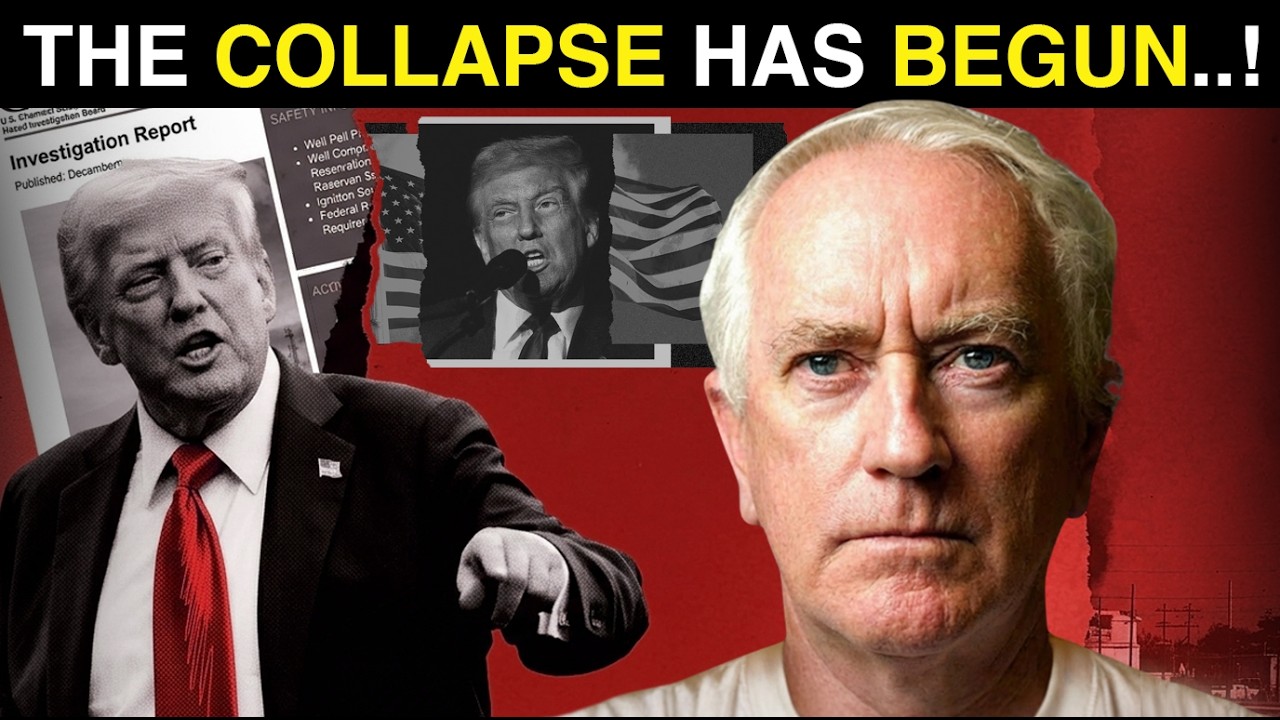
Top Economist: What Trump Doesn’t Want You to Know About the U.S-Iran War

Channel: ProfSteveKeen Published: 2026-03-22 14:00
ProfSteveKeen

Steve Keen argues Trump’s Iran war is driven by narcissism, not strategy, and says it accelerates a broader U.S. regime break: dollar dominance fading, recession risk rising, and political legitimacy eroding.

Watch on YouTube ›

Get the market thesis, key claims, assets, contradictions, and follow-up questions from any financial video — then unlock a version personalized to your portfolio, watchlist, and favorite speakers.

Detailed summary

The video is a long-form political-economy critique centered on Trump’s campaign against Iran and its implications for U.S. power. Steve Keen argues Trump is not acting rationally but is trying to justify his own actions after the fact, repeatedly inventing explanations to avoid admitting mistakes. He frames the Iran war as evidence that Trump’s “peace president” image was false and that his behavior fits narcissistic personality traits: confidence on the surface, fragility underneath, and a need to always be right. Keen then broadens the discussion to U.S. political economy. He says the costs of war and any closure of the Strait of Hormuz would flow through higher oil prices, hurting workers and the middle class while benefiting oil companies and entrenched financial/military interests. …

🔒 The full detailed summary continues — read all of it free with an account. Read the full summary →

Main takeaways

  1. Keen’s core view is that Trump is improvising explanations for Iran and is not acting from coherent strategy.
  2. He sees the Iran war as a catalyst for higher oil prices, social strain, and recession risk.
  3. He argues the U.S. dollar’s long-term dominance is ending, though the transition will not be clean or quick.
  4. He links Trump’s support base to backlash against neoliberalism, deindustrialization, and elite capture.
  5. He expects military and fossil-fuel interests to gain while households absorb the cost.
  6. He thinks the U.S. and UK political systems select poor leaders and block real democratic alternatives.

Market read by horizon

Short term

Tactically, the setup is most sensitive to oil and risk sentiment: any sustained Hormuz disruption would be a near-term bearish growth shock and a bullish input for energy prices. The immediate risk is that war headlines keep volatility elevated while the macro impact transmits quickly into consumer strain.

  • Immediate tactical risk is oil-price upside if the Strait of Hormuz disruption persists; that is the clearest market lever in the transcript.
Show more
  • Keen flags recession risk as rising now, with war-driven energy costs as the near-term shock.
  • He also points to government-led military spending as a short-run offset that could soften the macro hit.
Mid term

Over the next few months, the base case in Keen’s frame is weaker U.S. growth as higher energy costs and war uncertainty bite, with military spending only partly offsetting the drag. Confirmation would come from inflation re-acceleration, softer consumption, and stress in growth-sensitive sectors.

  • Over the next several weeks to months, Keen expects the Iran conflict and energy shock to feed through into weaker household purchasing power and broader recession dynamics.
Show more
  • He sees the AI boom as another fragility that could unwind over the same horizon, adding a second leg to the slowdown.
  • The main confirmation signal in his framework is whether higher oil prices and war disruption start showing up in growth data and corporate stress.
Long term

Structurally, the video argues the U.S. is moving out of a dollar-privileged, finance-heavy regime toward a more fragmented global order. The lasting implication is less about one war and more about the erosion of American monetary and industrial dominance.

  • Structurally, Keen argues the U.S. reserve-currency regime is in secular decline and that the Bretton Woods order is effectively ending.
Show more
  • He sees neoliberal policy and financialization as long-run causes of deindustrialization, inequality, and political fragmentation in the U.S.
  • He believes the deeper regime problem is political-selection design: systems that reward popularity contests and narcissistic personalities rather than competent public decision-making.
Unlock the full horizon read See the full short-term, mid-term, and long-term implications with confirmation and invalidation signals. Unlock horizon read

Key claims (9)

UNCLEAR geopolitics Donald Trump / U.S.-Iran war

Trump’s Iran campaign is the biggest gamble of his presidency.

Opening framing of the talk.

BEARISH political psychology Donald Trump

Trump is not acting rationally and is instead trying to convince himself that his decisions were correct.

He repeatedly says Trump invents reasons after the fact to avoid admitting mistakes.

BEARISH geopolitics Iran / U.S. policy

The war on Iran lacks a credible imminent-threat justification.

He says there was no imminent threat to America and the prior nuclear-facilities claim had already removed the rationale.

Unlock 6 more claims See the full bullish, bearish, and counter-consensus argument map extracted from the transcript. Unlock all claims

Assets discussed (4)

U.S. dollar — USD
BEARISH fx

He says the days of dollar dominance are over and that countries will find ways to trade without it.

Oil — USO
BULLISH commodity

He argues that a closure of the Strait of Hormuz would raise oil prices and benefit oil companies.

Unlock the full asset map (2 more) See all assets mentioned, their directional bias, and the exact reasoning. Unlock asset map

Speakers

SPEAKER Steve Keen

Where this transcript pushes against consensus

  • The transcript makes strong psychological claims about Trump’s narcissism without direct evidence beyond observed behavior and public statements.
  • Keen asserts that recession is “almost guaranteed,” but the claim rests on a scenario stack rather than a measured probability model.
  • The argument that the U.S. dollar’s dominance is already effectively over may be directionally plausible but is stated more definitively than the evidence in the transcript supports.
  • The discussion of U.S. and UK political systems is sweeping and somewhat generalized, with limited acknowledgment of counterexamples or institutional constraints.
  • Some of the causal links between Hormuz disruption, oil prices, and macro recession are plausible but not quantified.

Topics

Trump and Iran warStrait of Hormuz oil shockU.S. recession riskDollar reserve-currency declineNeoliberalism and deindustrializationPolitical system dysfunctionMilitary-industrial and oil-sector winnersAI bubble riskUK electoral system comparisonAthenian democracy / sortition

Create your free research agent

Unlock the full claims, asset map, scores, related transcripts, follow-up questions, and AI chat — shaped around your portfolio, watchlist, favorite speakers, and risks.

  • Full claims and asset map
  • Personalized relevance to your watchlist
  • Follow-up questions you can track
  • Related transcripts from your workspace
  • AI chat about this video
Create your free research agent
TRANSCRIPTAGENT.AI