TranscriptAgent
Try it free
TRANSCRIPTAGENT.AI · transcript analysis

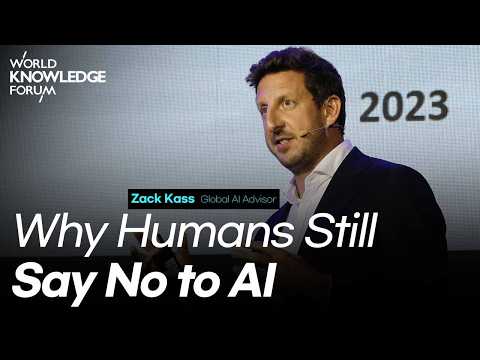
The Hidden Barrier to AI Revolution: Human Psychology

Channel: World Knowledge Forum Published: 2026-05-04 10:01
World Knowledge Forum

A talk about AI adoption argues that the main barrier is not model capability but human psychology: people resist surrendering control, don’t notice rapid technology improvement, and judge machine failure far more harshly than human failure.

Watch on YouTube ›

Get the market thesis, key claims, assets, contradictions, and follow-up questions from any financial video — then unlock a version personalized to your portfolio, watchlist, and favorite speakers.

Detailed summary

The speaker frames AI as moving toward ‘unmetered intelligence’ because inference costs are falling rapidly and frontier capabilities have improved sharply. But the core thesis is not about the technology itself; it is about whether society will accept it. Using the idea of ‘societal thresholds,’ the speaker argues that adoption depends on what people are willing to let machines do, not just what machines can do. The talk uses the elevator as a historical analogy: Otis had a safe technology, but people were afraid to use it until mirrors, music, and an operator made it feel more acceptable. The speaker then applies the same lens to autonomous vehicles, calling them the obvious AI use case because roads kill 1.3 million people a year, yet approval remains low. …

🔒 The full detailed summary continues — read all of it free with an account. Read the full summary →

Main takeaways

  1. AI capability and cost are improving quickly, but adoption is limited by social acceptance rather than raw performance.
  2. The speaker’s central framework is ‘societal thresholds’: what society is willing to let machines do.
  3. The elevator analogy is used to show that even safe technologies need psychological bridging to gain adoption.
  4. Autonomous vehicles are presented as the clearest near-term test of whether society will accept machine control in life-saving contexts.
  5. Humans strongly prefer control, and that preference can block adoption even when automation is safer.
  6. People often fail to notice how quickly AI systems improve, especially if they have little direct exposure to them.
  7. Society is far more forgiving of human mistakes than machine mistakes, which creates an adoption asymmetry.
  8. The speaker expects this mismatch between machine capability and human trust to remain a major constraint across sectors.

Market read by horizon

Short term

Near term, the main risk is that AI enthusiasm runs ahead of public willingness to adopt it in high-stakes use cases. Watch for failures or headline incidents to slow sentiment even when performance keeps improving.

  • The immediate setup is around whether people will accept autonomous vehicles and other AI systems in safety-critical roles despite strong technical progress.
Show more
  • The speaker sees near-term adoption friction coming from trust, visibility, and fear of machine failure rather than from insufficient capability.
  • A practical risk is that isolated crashes or failures get generalized into broad rejection of the whole category.
Mid term

Over the next few months, the likely path is continued technical gains with uneven adoption, especially in areas where users must surrender control. The key confirmation signal is whether repeated exposure and better track records start moving public acceptance.

  • Over the next several weeks or months, the base case is that technical progress in AI continues to outpace public comfort with deployment.
Show more
  • The adoption curve should improve only when more people directly experience the systems and watch safety data accumulate in public view.
  • If visible deployments expand and failure rates remain low, the societal threshold can gradually move; if not, acceptance may stall even with better models.
Long term

Longer term, the structural thesis is that AI diffusion will be gated by human trust thresholds, not just model quality or price. Sectors that can redesign the human experience around the machine may adopt faster than those that demand full surrender of control.

  • Structurally, the talk argues that the binding constraint on AI is social legitimacy, not computational power.
Show more
  • The durable regime implication is that every major AI application must clear a psychological threshold as well as a technical one.
  • In safety-sensitive domains, machine adoption may remain slower than pure efficiency logic would predict because humans punish machine errors disproportionately.
Unlock the full horizon read See the full short-term, mid-term, and long-term implications with confirmation and invalidation signals. Unlock horizon read

Key claims (10)

BULLISH AI capability AI

AI is moving toward human-level and eventually superior intellectual capability.

The speaker says machines are being built to possess human intellectual equivalence and soon superiority.

BULLISH AI economics AI

Inference cost is falling sharply, making AI closer to a utility or commodity.

The speaker emphasizes the rapid decline in the cost to run models as the key economic change.

BULLISH AI diffusion AI

The world will soon have access to 'unmetered intelligence'—cheap, abundant access to high-quality AI.

This is the speaker's central framing of AI's cost/access trajectory.

Unlock 7 more claims See the full bullish, bearish, and counter-consensus argument map extracted from the transcript. Unlock all claims

Assets discussed (6)

AI
BULLISH other

The speaker says AI capabilities are improving rapidly and inference costs are falling toward commodity-like levels, implying broader adoption.

DeepSeek R1
BULLISH other

Mentioned as a catalyst for the rapid decline in inference cost and broader AI accessibility.

Unlock the full asset map (4 more) See all assets mentioned, their directional bias, and the exact reasoning. Unlock asset map

Speakers

SPEAKER Unknown speaker

Where this transcript pushes against consensus

  • The claim that radiology/pathology is ‘a solved problem for every scan except the cardiology chest scan’ is asserted very strongly without supporting evidence in the transcript.
  • The assertion that autonomous-vehicle public approval is 25% globally is presented as a fact but not sourced or contextualized.
  • The talk implies people reject AVs mainly because of psychology, but it does not clearly separate that from regulation, liability, infrastructure, or ethical concerns.
  • The historical elevator analogy is persuasive rhetorically, but it may oversimplify how adoption actually spread across cost, building design, and urbanization.
  • The speaker argues machine failures are treated as systemic while human failures are treated as isolated, but this can vary by domain and is not demonstrated empirically here.

Topics

AI adoptionsocietal thresholdshuman psychologyautonomous vehicleselevator analogymachine trustinference costradiology/pathologyhuman controlmachine failure

Create your free research agent

Unlock the full claims, asset map, scores, related transcripts, follow-up questions, and AI chat — shaped around your portfolio, watchlist, favorite speakers, and risks.

  • Full claims and asset map
  • Personalized relevance to your watchlist
  • Follow-up questions you can track
  • Related transcripts from your workspace
  • AI chat about this video
Create your free research agent
TRANSCRIPTAGENT.AI