
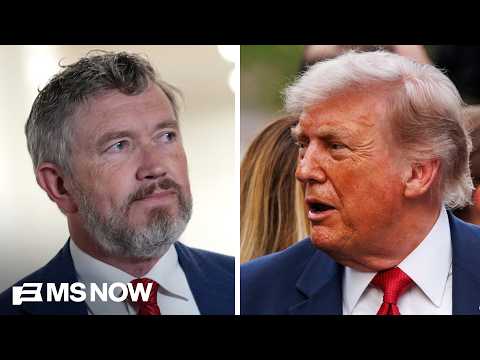
A panel segment on MS NOW examines whether Donald Trump’s backing of primary winners and challengers shows he is acting as a GOP kingmaker. Guest Ken Thomas says the pattern suggests Trump’s influence is real, but it may also force Republicans to spend heavily and manage a more divided Senate caucus.
Watch on YouTube ›Get the market thesis, key claims, assets, contradictions, and follow-up questions from any financial video — then unlock a version personalized to your portfolio, watchlist, and favorite speakers.
The transcript is a political-news discussion centered on Trump’s influence over Republican primaries, not a financial-market segment. The host frames recent outcomes in Indiana, Louisiana, and Kentucky as evidence of Trump’s grip on the GOP and asks whether this solidifies him as a kingmaker or reflects candidate quality. Ken Thomas, identified as a national political reporter for The Wall Street Journal, says it is hard to see the outcomes any other way: Trump has put substantial resources behind candidates he wanted to defeat, and those efforts have generally succeeded. He notes that the challenged candidates faced tens of millions of dollars in fundraising and ads, and that the money eventually overwhelmed them. The discussion then shifts to Thomas Massie’s concession remarks and the possibility that he could run again. …
Immediate takeaway: the market relevance is mostly indirect, through election-risk and policy expectations. The tactical issue is whether Trump’s growing influence increases the odds of GOP policy discipline, but the transcript offers no tradable market catalyst beyond political uncertainty.
Over the coming weeks to months, the key question is whether Trump-backed candidates keep winning without forcing costly defensive spending or Senate backlash. If Republicans stay aligned despite private discomfort, the political narrative around party control strengthens; if the Texas race turns messy, it becomes a story about overreach rather than dominance.
Longer term, the transcript points to a durable Trump-centered GOP regime in which endorsements can outweigh institutional party preferences. The structural implication is a more personality-driven Republican Party, with lasting consequences for Senate strategy and legislative cohesion.
Trump’s recent primary wins are being presented as proof of his strong grip on the Republican Party.
The host explicitly frames the outcomes as proof of Trump’s ironclad grip and asks whether this solidifies his kingmaker status.
Ken Thomas says Trump’s involvement has been successful because the president invested resources against candidates he opposed.
Guest states that Trump put a lot of resources into defeating these candidates and the effort worked.
Massie faced tens of millions of dollars in fundraising and ads, which helped overwhelm his campaign.
Thomas says the financial pressure was too much for Massie despite a formidable run.
Do you think that this solidifies Trump's kingmaker status in the Republican Party? Or is this more about candidate quality?
Ken Thomas says it is hard to see it any other way, because Trump invested heavily against targeted candidates and those efforts succeeded.
Do you think he's going to be looking for another run soon? And what do you make of Ed Gowrein?
Thomas says Massie still has supporters who want another run, while the winning candidate played a cautious, low-profile race and has not been broadly tested.
Is this the accelerant for turning Texas blue for Democrats when it comes to Ken Paxton against James Tallarico in a general runoff?
Thomas says that is the fear, since Republicans worry they may need to spend heavily to protect a seat that should be safe.
Unlock the full claims, asset map, scores, related transcripts, follow-up questions, and AI chat — shaped around your portfolio, watchlist, favorite speakers, and risks.
