TranscriptAgent
Try it free
TRANSCRIPTAGENT.AI · transcript analysis

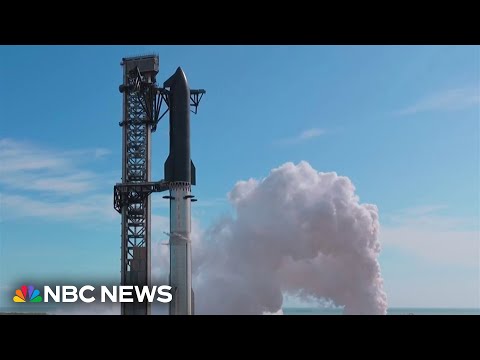
SpaceX plans for a record-breaking IPO

Channel: NBC News Published: 2026-05-20 22:33
NBC News

NBC News frames SpaceX’s expected IPO as a potentially record-setting public offering, driven by huge revenue, fast-growing Starlink subscriptions, and a very large stated TAM, but weighed against sizeable losses and Elon Musk’s desire to retain control.

Watch on YouTube ›

Get the market thesis, key claims, assets, contradictions, and follow-up questions from any financial video — then unlock a version personalized to your portfolio, watchlist, and favorite speakers.

Detailed summary

The segment focuses on reports that SpaceX may go public as soon as June, with a possible valuation near $2 trillion and up to $80 billion raised, which would make it one of the largest IPOs ever. The host emphasizes how unusual the scale is, comparing SpaceX’s potential offering to other large IPOs and saying it could “break the markets.” NBC News tech reporter David Ingram explains that the public filing is effectively the start of the sales pitch to investors. He says the 400-page S-1 gives a first look at SpaceX’s fundamentals and indicates that Elon Musk would aim to retain about 85% of the voting power after the IPO, while also serving as CEO, chairman, and CTO. …

🔒 The full detailed summary continues — read all of it free with an account. Read the full summary →

Main takeaways

  1. SpaceX’s IPO could be among the largest ever, with headline figures around $80 billion raised and a roughly $2 trillion valuation.
  2. The S-1 filing is positioned as the first real look at SpaceX’s financials, control structure, and business mix.
  3. Musk appears to be seeking very high voting control, which matters for governance and minority shareholders.
  4. Starlink is presented as the most concrete current revenue engine, while the broader “space economy” and AI ambitions are still more speculative.
  5. The company is still loss-making, so the valuation will depend heavily on investor belief in long-dated optionality and execution.
  6. A Starship launch the following day serves as a near-term credibility test for the broader story.

Market read by horizon

Short term

Tactically, this is a sentiment-driven setup: the IPO and Starship launch can both amplify attention, but the trade is vulnerable to any stumble in execution, disclosure, or investor pushback on valuation and control.

  • The immediate catalyst is the next-day Starship V3 launch, which could influence sentiment around SpaceX’s execution story.
Show more
  • The IPO is expected in June, so investors will likely focus on the S-1 details, valuation range, and control terms over the next few weeks.
  • Near-term risk is that the market may overreact to headline TAM and valuation numbers before digesting the loss profile and governance structure.
Mid term

Over the next few months, the market will likely price SpaceX as a hybrid of satellite-connectivity cash flow and speculative frontier-tech optionality; that view holds only if Starlink growth and launch progress keep confirming the story.

  • Over the next several weeks to months, the key question is whether investors treat SpaceX as a growth platform with multiple optionality layers or as an expensive, still-unprofitable aerospace business.
Show more
  • Validation will likely come from sustained Starlink growth, progress on Starship, and clearer monetization of adjacent businesses like AI infrastructure.
  • The valuation case may weaken if losses deepen faster than revenue growth or if investors push back on the concentration of voting control.
Long term

Structurally, the segment suggests public markets may increasingly tolerate founder-controlled, loss-making frontier companies if they control critical infrastructure and can frame themselves as future platform monopolies.

  • The transcript presents SpaceX as a potential multi-regime company spanning launch, satellite connectivity, AI infrastructure, and possibly orbital economic activity.
Show more
  • If the IPO succeeds, it could reinforce the idea that frontier-tech companies can command extreme valuations on optionality rather than near-term earnings.
  • Governance is a lasting theme: Musk’s proposed control structure suggests the market may accept founder dominance in exchange for exposure to outsized growth narratives.
Unlock the full horizon read See the full short-term, mid-term, and long-term implications with confirmation and invalidation signals. Unlock horizon read

Key claims (8)

BULLISH SpaceX

SpaceX may go public as soon as next month and could become the biggest IPO of all time.

The host states the IPO could happen soon and be the largest ever.

BULLISH SpaceX

The IPO could raise up to $80 billion at a valuation near $2 trillion.

The host cites the expected fundraising and valuation figures directly.

NEUTRAL SpaceX

The S-1 filing is the start of SpaceX’s sales pitch to investors and provides the first broad look at its fundamentals.

Ingram describes the filing as the brochure and the beginning of the sales pitch.

Unlock 5 more claims See the full bullish, bearish, and counter-consensus argument map extracted from the transcript. Unlock all claims

Assets discussed (4)

SpaceX
BULLISH other

Presented as the centerpiece of a record-breaking IPO, with huge revenue, a large TAM, and growth optionality, though balanced by losses.

Starlink
BULLISH other

Described as the main revenue driver so far, with 10 million subscribers and rapid growth.

Unlock the full asset map (2 more) See all assets mentioned, their directional bias, and the exact reasoning. Unlock asset map

Speakers

HOST Gadi Schwartz GUEST David Ingram

Interview (2 Q&A)

IPO fundamentals vs hype

What do we make of these numbers, and what is real versus hype before the IPO?

Ingram says the filing is the start of the sales pitch and the first public look at fundamentals, including control structure and financials, but it is still a promotional document.

business mix and TAM

How much of SpaceX’s future is AI versus the space economy versus connectivity?

Ingram says investors should consider three pieces: AI, SpaceX, and Starlink, with Starlink already contributing a lot of current revenue.

Where this transcript pushes against consensus

  • The segment repeats the $28 trillion TAM and massive valuation figures without independently validating the assumptions behind them.
  • The framing leans heavily on headline upside while giving limited scrutiny to how the company gets from current losses to durable public-market profitability.
  • The idea that SpaceX could ‘break the markets’ is rhetorical and not analytically supported.
  • The AI revenue and spending commentary is suggestive but under-explained; the causal link between AI capex and future SpaceX value is not established.

Topics

SpaceX IPOElon Musk controlStarlink growthS-1 filingvaluation and TAMlosses and profitabilityAI data centersStarship launch

Create your free research agent

Unlock the full claims, asset map, scores, related transcripts, follow-up questions, and AI chat — shaped around your portfolio, watchlist, favorite speakers, and risks.

  • Full claims and asset map
  • Personalized relevance to your watchlist
  • Follow-up questions you can track
  • Related transcripts from your workspace
  • AI chat about this video
Create your free research agent
TRANSCRIPTAGENT.AI