TranscriptAgent
Try it free
TRANSCRIPTAGENT.AI · transcript analysis

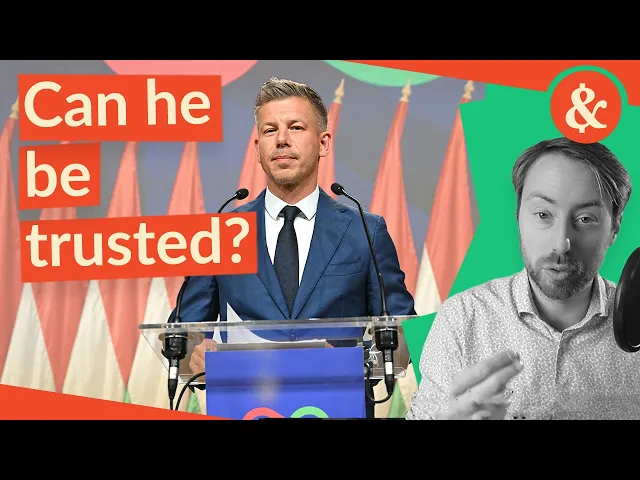
Orban is out! What now?

Channel: Money & Macro Published: 2026-04-13 13:58
Money & Macro

The video argues that Orbán’s defeat is a major turning point for Hungary, but not an instant clean break. The speaker says Péter Magyar now has a mandate to unwind Orbán’s entrenched system, while weak public finances, oligarch networks, and institutional capture make the transition slow and uncertain.

Watch on YouTube ›

Get the market thesis, key claims, assets, contradictions, and follow-up questions from any financial video — then unlock a version personalized to your portfolio, watchlist, and favorite speakers.

Detailed summary

This episode frames Viktor Orbán’s loss as the result of two main failures: Hungary’s relative economic underperformance and the accumulation of visible corruption. The speaker says wages lagged peers like Poland, inflation was severe after COVID-era spending, energy shocks, and forint weakness, and that Orbán’s wealthy allies benefited disproportionately from state contracts. The central political argument is that Orbán built a deeply entrenched system: altered voting rules, media control, loyalists embedded in the courts, fiscal institutions, prosecution, and media authority, plus privatized trust structures and oligarch-controlled companies that remain even after the election loss. …

🔒 The full detailed summary continues — read all of it free with an account. Read the full summary →

Main takeaways

  1. Orbán’s defeat is framed as a genuine political turning point.
  2. The speaker’s core thesis links voter backlash to weak growth, inflation, and corruption.
  3. Magyar may have enough mandate to begin dismantling Orbán-era institutions, but reform will likely be slow.
  4. Hungary’s fiscal and demographic weaknesses make the policy reset difficult.
  5. The forint’s rally reflects optimism about EU funding and better governance.
  6. The speaker remains skeptical that a conservative successor automatically becomes a liberal reformer.

Market read by horizon

Short term

Tactically, the election result is mildly bullish for Hungarian assets on hopes of EU funding and a stronger rule-of-law signal, but that move is vulnerable if reforms stall or Orbán-era networks resist change.

  • The immediate market reaction is supportive for the forint on hopes that EU funding may be released.
Show more
  • Near-term political focus is whether Magyar can translate his landslide into actual institutional changes.
  • The biggest tactical risk is that Orbán’s remaining loyalist networks slow or block reforms even after the election loss.
Mid term

Over the next few months, the key question is whether Magyar can convert political victory into institutional change fast enough to improve credibility, lower financing stress, and keep the EU funding unlock narrative alive.

  • Over the next several weeks to months, the base case is a slow institutional cleanup rather than an instant reset.
Show more
  • Validation would come from concrete steps against Orbán-era loyalists, progress on media/judicial independence, and movement toward EU funding release.
  • If Magyar fails to deliver visible institutional change, the market may reprice the result as only a partial regime shift.
Long term

Structurally, the episode argues Hungary remains a test case for whether illiberal institutions can survive an electoral setback. The durable thesis is less about one election and more about whether a captured state can truly be unwound after years of patronage and legal entrenchment.

  • Structurally, the video argues Hungary has been operating under a durable illiberal regime built through law, patronage, and captured institutions.
Show more
  • The long-run question is whether a new majority can actually reverse a system designed to survive electoral turnover.
  • The broader regime implication is that democratic backsliding can persist even after an election loss if embedded networks remain intact.
Unlock the full horizon read See the full short-term, mid-term, and long-term implications with confirmation and invalidation signals. Unlock horizon read

Key claims (8)

BEARISH political economy Hungary

Orbán lost mainly because Hungary’s economy performed worse than comparable Eastern European countries.

The speaker directly ties the electoral loss to relative economic underperformance.

BEARISH inflation Hungary

Hungary suffered Europe’s worst inflation crisis under Orbán after COVID spending, energy shocks, and forint depreciation.

This is presented as a causal chain for voter dissatisfaction and macro weakness.

BEARISH corruption Viktor Orbán political network

Orbán’s allies and oligarchs benefited heavily from state contracts, making corruption politically costly once the economy stagnated.

The speaker uses Mészáros and state-contract concentration as evidence.

Unlock 5 more claims See the full bullish, bearish, and counter-consensus argument map extracted from the transcript. Unlock all claims

Assets discussed (5)

Hungarian forint — HUF
BULLISH fx

The speaker says the forint rallied on the election result and the possible unlocking of EU funding.

EU funding to Hungary
BULLISH other

Restoring rule of law could unlock about 22 billion euros in EU funding, supporting Hungary’s external financing outlook.

Unlock the full asset map (3 more) See all assets mentioned, their directional bias, and the exact reasoning. Unlock asset map

Speakers

SPEAKER Unknown speaker

Where this transcript pushes against consensus

  • The claim that Magyar’s 53% vote automatically translates into a workable two-thirds supermajority is presented as a theory, but the transcript does not explain the legal mechanics in detail.
  • The argument that Orbán’s system can be dismantled relies heavily on institutional capture assumptions, but there is limited evidence offered on how quickly those institutions can actually be reformed.
  • The speaker treats Magyar as a likely reformer but also says Orbán, Erdoğan, and Putin all began as reformers—this creates an unresolved tension about how predictive Magyar’s current rhetoric really is.
  • The economic interpretation is directional but broad; no hard data series beyond relative wages, inflation, and deficits are provided to separate cyclical from structural underperformance.

Topics

Hungary electionViktor OrbánPéter MagyarTisza partyEU fundingforintcorruptionjudicial/media captureeconomic stagnationdemocratic backsliding

Create your free research agent

Unlock the full claims, asset map, scores, related transcripts, follow-up questions, and AI chat — shaped around your portfolio, watchlist, favorite speakers, and risks.

  • Full claims and asset map
  • Personalized relevance to your watchlist
  • Follow-up questions you can track
  • Related transcripts from your workspace
  • AI chat about this video
Create your free research agent
TRANSCRIPTAGENT.AI