
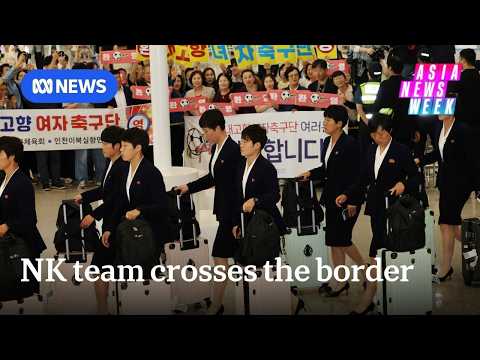
BBC Seoul correspondent Jake Kwon reports on North Korea’s first sports crossing into South Korea in nearly eight years, where the women’s team won a semi-final in the AFC Women’s Champions League and advanced to the final.
Watch on YouTube ›Get the market thesis, key claims, assets, contradictions, and follow-up questions from any financial video — then unlock a version personalized to your portfolio, watchlist, and favorite speakers.
The segment focuses on the political and symbolic significance of a rare North Korean women’s football visit to South Korea. Jake Kwon explains that this is the first North Korean sports team to enter South Korea in nearly eight years and frames the match as more than a sporting event because inter-Korean relations are currently frozen and at a low point. He describes a heavily managed but welcoming atmosphere in the stadium, with South Korean authorities reportedly spending about $200,000 to support attendance and avoid national flags, allowing only team flags. Kwon says thousands of fans showed up, many waving North Korean team flags and cheering the North Korean side, in an environment shaped by peace activists and people curious about North Korea. The report then pivots to whether the event could be a diplomatic opening or just a one-off. …
Near term, this is mainly a headline-driven geopolitical symbol: the event may generate attention, but there is no clear evidence of an imminent inter-Korean policy shift.
Over the next few weeks, the base case is that this remains a contained sports-diplomacy episode unless there are repeat crossings, official follow-up, or softened rhetoric from either side.
Longer term, the episode reinforces a durable pattern: North Korea can use selective sports participation for optics and legitimacy while the underlying inter-Korean split remains largely intact.
This was the first North Korean sports team to enter South Korea in nearly eight years.
The correspondent says the last North Korean sports team visit was nearly 8 years ago.
Inter-Korean relations are currently frozen and at one of their worst points in recent years.
Kwon describes the political environment as frozen solid and worse than usual.
South Korea spent about $200,000 to help support attendance and create a friendly atmosphere.
The speaker says the government funded tickets and related support.
How significant was the North Korean team’s arrival in South Korea?
Kwon says it was a very rare occasion, with the last North Korean sports team visit nearly eight years earlier, and that the visit carried major political stakes because relations are frozen.
What was the atmosphere like at the game and was there support for the North Koreans?
He says thousands of South Koreans came, the government helped fund attendance, flags were restricted to team flags, and the crowd largely cheered for North Korea in a peace-oriented atmosphere.
Could this be the start of more North Korean involvement in sports in South Korea, or just a one-off?
He says sports have historically been a diplomatic bridge, but this specific event showed limited warmth and may instead reflect North Korea seeking normal treatment, prize money, and propaganda value.
Unlock the full claims, asset map, scores, related transcripts, follow-up questions, and AI chat — shaped around your portfolio, watchlist, favorite speakers, and risks.
