TranscriptAgent
Try it free
TRANSCRIPTAGENT.AI · transcript analysis

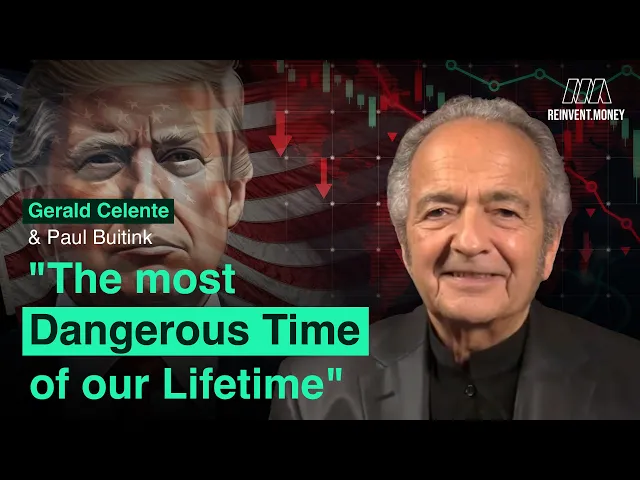
"The Greatest Depression Coming" | Gerald Celente on Trump, the War, Epstein, Gold and Markets

Channel: Reinvent Money Published: 2026-04-04 07:17
Reinvent Money

Gerald Celente argues the Iran war risk is the dominant macro threat, warning that U.S./Israel escalation could trigger nuclear risk, a global oil spike, and a severe market crash. He frames Trump and other U.S. leaders as part of a corrupt, war-driven political system, but finishes on a defensive note: gold remains a favored safe haven and citizens should prepare physically, emotionally, and spiritually.

Watch on YouTube ›

Get the market thesis, key claims, assets, contradictions, and follow-up questions from any financial video — then unlock a version personalized to your portfolio, watchlist, and favorite speakers.

Detailed summary

This interview on Reinvent Money features host Paul Bing speaking with recurring guest Gerald Celente, publisher of the Trends Journal. The conversation centers on U.S./Israel-Iran escalation, the possibility of a wider war, and the market and social consequences if the conflict expands. Celente repeatedly says this is the most dangerous period of his lifetime and says his greatest fear is nuclear war. He claims that if the United States and/or Israel invade Iran, they will lose, and he warns that a ground invasion would be disastrous. He argues that America has not won a major war since World War II and believes any attack on Iran would likely drive Brent crude above $100 and possibly above $130, while also crashing global equity markets. …

🔒 The full detailed summary continues — read all of it free with an account. Read the full summary →

Main takeaways

  1. Celente’s central call is that U.S./Israel escalation against Iran is a potentially catastrophic market and geopolitical event.
  2. He thinks the most dangerous tail risk is nuclear conflict, either direct or via escalation dynamics.
  3. He expects oil to surge and equity markets to fall sharply if war broadens.
  4. He argues the current political-media environment is corrupt, centralized, and ineffective at restraint.
  5. He believes the market was vulnerable even before the conflict because of AI, private equity stress, and overvaluation.
  6. Gold remains his preferred safe-haven hedge, even if it is temporarily pressured by forced selling.

Market read by horizon

Short term

Near term, the market is most vulnerable to an escalation headline around Iran that could gap crude higher and hit risk assets while liquidity is thin over a holiday weekend. The immediate trade-off is headline shock risk versus the possibility that no direct strike materializes.

  • The immediate focus is the Iran escalation risk over the Easter-weekend market closure, which he treats as a possible catalyst for a shock move.
Show more
  • He thinks any ground invasion would be a tactical disaster and could quickly force an extreme response in oil and risk assets.
  • He warns that the near-term tail risk is a false-flag or sudden escalation event that can change the market regime overnight.
Mid term

Over the next several weeks, the base case is a choppier, weaker market if the conflict persists, with energy inflation and defense of cash/liquidity becoming more important than growth narratives. Confirmation would come from sustained oil strength and broader risk-off behavior; de-escalation would soften the case materially.

  • Over the next several weeks to months, his base case is a worsening macro drawdown if the war does not end quickly.
Show more
  • He expects the combination of geopolitics, overvaluation, AI disruption, and private-equity stress to evolve into a broader market correction or crash.
  • He would view a continued rise in energy prices and weakness in global equities as confirmation of the thesis.
Long term

Structurally, Celente is arguing that the world is in a late-cycle war-and-debt regime where geopolitical shocks repeatedly destabilize markets and institutions. In that framework, gold and other hard assets remain the lasting hedge against a system he sees as increasingly militarized and concentrated.

  • Celente’s structural view is that the U.S. is in a late-stage imperial decline marked by war, media concentration, and elite corruption.
Show more
  • He sees a durable regime of corporate-state fusion and weakened democratic accountability rather than a temporary policy failure.
  • His long-run inflation/asset view remains that gold is a lasting hedge against monetary and geopolitical instability.
Unlock the full horizon read See the full short-term, mid-term, and long-term implications with confirmation and invalidation signals. Unlock horizon read

Key claims (8)

BEARISH

This is the most dangerous time of our lifetime and the greatest fear is nuclear war.

Repeated as a core framing of the interview.

BEARISH Iran war risk Iran

If the United States and/or Israel attacks Iran, they will lose and the war will expand disastrously.

A direct forecast tied to the Iran conflict.

BEARISH Iran war risk Iran

A ground invasion of Iran would be wiped out quickly and is militarily unwinnable for the U.S.

He says troops would be destroyed if sent in.

Unlock 5 more claims See the full bullish, bearish, and counter-consensus argument map extracted from the transcript. Unlock all claims

Assets discussed (7)

Iran
BEARISH other

A major escalation point; he says U.S./Israel attack on Iran would fail and trigger broader war risk.

Brent crude
BULLISH commodity

He expects Brent to surge above $100 and possibly above $130 if Iran is attacked.

Unlock the full asset map (5 more) See all assets mentioned, their directional bias, and the exact reasoning. Unlock asset map

Speakers

GUEST Gerald Celente HOST Paul Bing

Interview (5 Q&A)

Epstein files

To what extent is this all just a big distraction from the Epstein files?

Celente says no, he thinks it is connected and that the Epstein material implicates Trump and a broader elite crime syndicate.

Iran conflict outlook

How do you expect this conflict to evolve?

He says ground troops would be destroyed, and his main concern is nuclear escalation or a false-flag-style event.

conflict forecast

What do you think is going to happen next?

He thinks the U.S. cannot win, ground troops would be suicidal, and escalation risk dominates.

Unlock the full interview (2 more Q&A) Every question, answer summary, and YouTube timestamp. Unlock full Q&A

Where this transcript pushes against consensus

  • Celente treats many assertions as self-evident or conspiratorial without presenting evidence in the interview, especially around Epstein, media control, and elite coordination.
  • He repeatedly asserts that U.S. and Israeli action against Iran would certainly fail, but does not engage much with scenarios short of outright defeat.
  • The claim that a war would produce the “greatest depression” is presented as a strong forecast but with limited quantitative backing in the conversation.
  • His discussion of Trump’s motives and the behavior of U.S. institutions is highly polemical and often substitutes insult for analysis.
  • He suggests ground troops would be wiped out quickly, but does not address escalation ladders, deterrence, or non-invasion coercive options in detail.

Topics

Iran war risknuclear escalationoil and energy pricesmarket crashgold safe havenTrump and U.S. politicsmedia concentrationEpstein filesAI and private equity stressglobal stagflation

Create your free research agent

Unlock the full claims, asset map, scores, related transcripts, follow-up questions, and AI chat — shaped around your portfolio, watchlist, favorite speakers, and risks.

  • Full claims and asset map
  • Personalized relevance to your watchlist
  • Follow-up questions you can track
  • Related transcripts from your workspace
  • AI chat about this video
Create your free research agent
TRANSCRIPTAGENT.AI