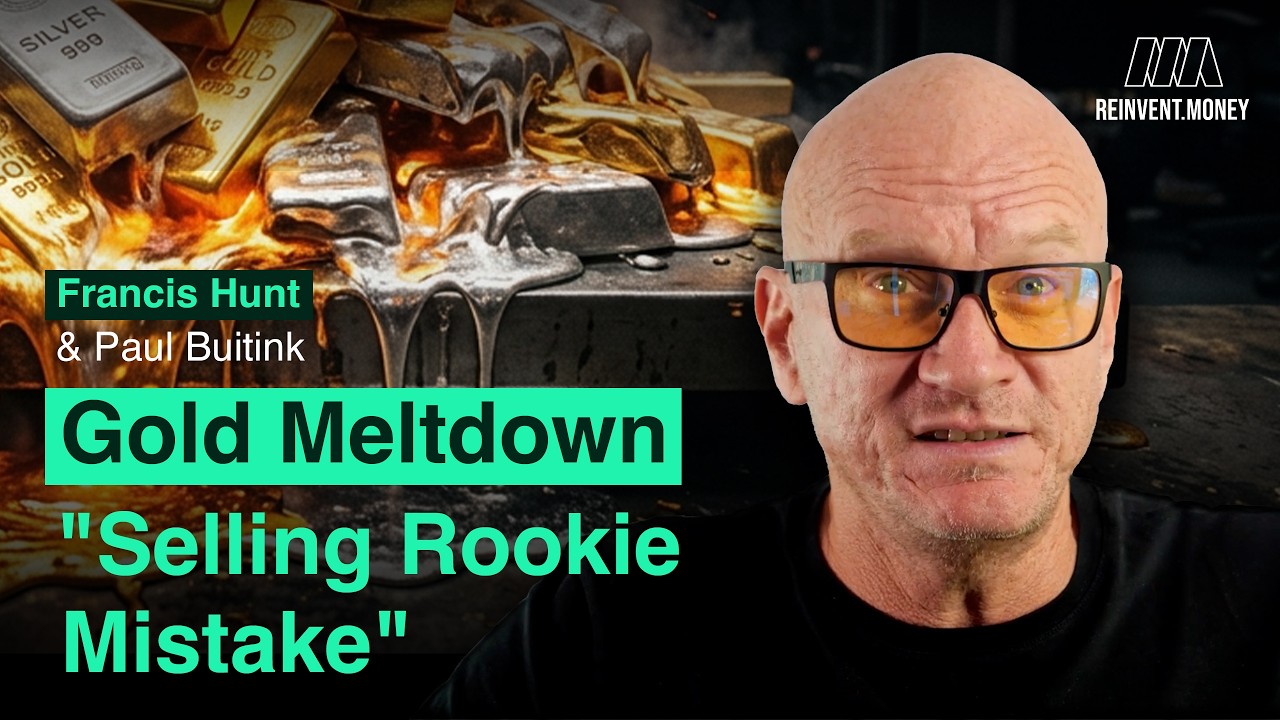
Francis Hunt argues the current market is in a late-stage fiat/debt unwind: near-term liquidity stress can still hit gold and silver, but the deeper breakdown in credit and rates is ultimately bullish for hard assets.
Watch on YouTube ›Get the market thesis, key claims, assets, contradictions, and follow-up questions from any financial video — then unlock a version personalized to your portfolio, watchlist, and favorite speakers.
This interview is built around Hunt’s thesis that the headline geopolitical shock is secondary to a much larger structural problem: the fiat/debt system is losing stability. He says the war-related environment is being used to create inflationary bottlenecks, push rates higher, and expose weak credit structures, especially private credit, which he describes as opaque and similar to prior subprime-style failures. In his view, that kind of stress can temporarily pressure gold and silver because investors and leveraged holders may sell liquid assets to raise cash, but that same process is what eventually makes precious metals stronger once debt destruction, higher rates, and forced selling become dominant. He repeatedly ties today’s conditions to historical analogies: the 1970s, Bretton Woods’ collapse, the 2008 crisis, and the Asian financial crisis. …
Near term, the main risk is a liquidity squeeze: if credit stress worsens, metals can be sold even inside a bullish longer-term setup, while the dollar can spike. The immediate watch is whether private-credit stress and margin-driven selling spread into broader risk assets.
Over the next few months, the base case is a deflationary shock followed by a larger repricing of debt, housing, and leveraged growth assets. If rates remain high and contagion keeps spreading, he expects precious metals to regain leadership after an interim shakeout.
Structurally, he sees a secular breakdown of fiat credibility and debt expansion, with the likely endpoint being more centralized control, tokenized ownership, and weaker private property rights. In that regime, hard assets and direct possession remain the enduring hedge.
The current volatility in gold and silver should not be overinterpreted because the larger debt-market breakdown is ultimately bullish for precious metals.
He explicitly says the debt market is dying and that this is 'turbo juice for gold and silver.'
The private credit market is the weakest and most dangerous part of the credit stack, comparable to subprime before 2008.
He argues private credit is unexchange-traded, opaque, and prone to forced liquidity issues.
The market is moving from the weakest credit segments into broader defaults in cars, property, and consumer lending.
He says failures are starting to appear beyond private credit in prime lending and ordinary loans.
Why are gold and silver moving sideways or going down despite significant geopolitical uncertainty and war in Iran?
Francis Hunt explains the downturn is short-term noise within a broader engineered inflationary narrative. The real foundation problem is fiat and debt. The engineered supply chain bottlenecks and geopolitical tensions are designed to raise prices, eventually force rates up, and debase bonds. In the short term, rate rises are seen as negative for non-yielding precious metals, but macro-wise it's highly bullish — a two-steps-back-to-jump-forward dynamic. Additionally, forced selling from troubled private credit markets is causing holders to sell good assets like gold to cover losses in bad ones.
Do you think we're going to get rate cuts now, given the Trump administration pushing for lower rates?
Francis says the US is essentially in a recession with negative non-farm payrolls, rising unemployment, and low wage growth versus true inflation. He argues the CPI is propaganda (claiming 2.4-2.5% is false). The key point is that debt gets debased by rising interest rates, not cuts. He points to US and Australian 10-year yields popping up, with Australia's 10-year targeting 5.75-6%, meaning a severe housing correction is coming there.
Will we see massive QE coming anytime soon since high rates and high depositions don't sound sustainable?
The guest says you need the crisis first — the deflationary part — before QE. He compares it to CV19 or the Bear Stearns moment setting up Lehman's. That slap-in-the-face deflationary crisis hasn't happened yet. During that crisis, any liquidity will be sold because people need cash for rent after losing jobs.
Unlock the full claims, asset map, scores, related transcripts, follow-up questions, and AI chat — shaped around your portfolio, watchlist, favorite speakers, and risks.