TranscriptAgent
Try it free
TRANSCRIPTAGENT.AI · transcript analysis

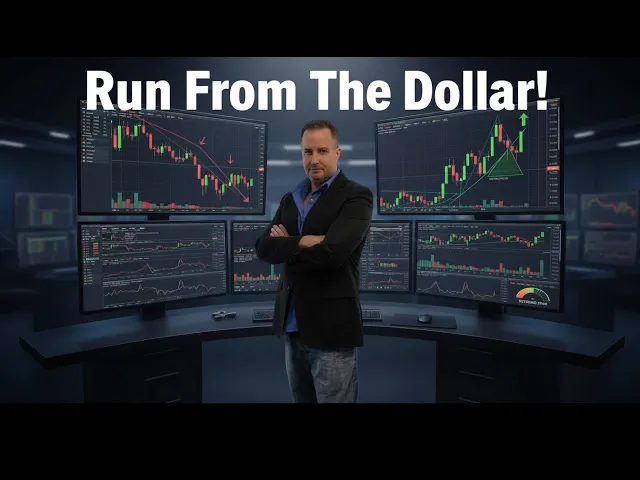
De-Dollarization is HERE: DXY Bear Flag, History Signals Major Downside, Here Is The Trade

Channel: Gareth Soloway Published: 2026-04-16 12:00
Gareth Soloway

Gareth Soloway argues the U.S. dollar is in a bearish technical setup, with de-dollarization already underway and likely to continue lower. He says the DXY has formed a bear flag, failed to rally meaningfully during war risk, and that a weaker dollar should support euro, pound, Canadian dollar, Australian dollar, gold, and silver.

Watch on YouTube ›

Get the market thesis, key claims, assets, contradictions, and follow-up questions from any financial video — then unlock a version personalized to your portfolio, watchlist, and favorite speakers.

Detailed summary

Gareth Soloway opens by saying the U.S. dollar and interest rates are key to watch while stocks are at all-time highs and rates remain stubbornly elevated. He focuses on the DXY and argues that the dollar’s sharp decline after Trump took office in early 2025, combined with tariff shocks to other nations, pushed foreign countries to reconsider holding the dollar as the dominant reserve currency. In his view, this is evidence of gradual de-dollarization. He emphasizes that the dollar’s reaction to the U.S.-Iran war was weak relative to what past safe-haven behavior would have suggested. He says the rally in the dollar was limited and that this failure to surge is a major signal that the dollar is headed lower. …

🔒 The full detailed summary continues — read all of it free with an account. Read the full summary →

Main takeaways

  1. Soloway’s core view is bearish on the U.S. dollar and bullish on the de-dollarization theme.
  2. He treats the DXY as a bear flag after a major selloff.
  3. He sees the dollar’s muted war-time rally as confirmation that safe-haven demand is weaker than in prior cycles.
  4. He expects weakness to show up in major non-dollar FX pairs like EUR/USD, GBP/USD, USD/CAD, and AUD/USD.
  5. He thinks a weaker dollar is supportive for gold and silver, but inflationary for U.S. import prices.
  6. He does not recommend abandoning dollars entirely, especially if equities fall sharply at the same time.

Market read by horizon

Short term

Near term, the trade is to watch for a downside break in DXY and continuation strength in major non-dollar FX pairs; any abrupt dollar bounce would be the main tactical risk. The current setup looks fragile for dollar bulls because the war-related safe-haven bid did not materialize strongly.

  • Watch whether DXY breaks below the current consolidation instead of bouncing.
Show more
  • Near-term risk is that a short squeeze in the dollar could invalidate the bear-flag setup.
  • Immediate confirmation comes from continued strength in EUR/USD, GBP/USD, AUD/USD, and CAD against the dollar.
Mid term

Over the next few weeks to months, the base case is a grind lower in the dollar toward the low-90s, with confirmation coming from sustained breakout behavior in EUR/USD, GBP/USD, AUD/USD, and CAD. The thesis weakens if policy shifts or a broader risk-off event restores classic safe-haven demand for the dollar.

  • Over the next several weeks or months, his base case is continued DXY downside toward the 90 to 88.5 support region.
Show more
  • The broader FX trend would be validated if the breakout behavior in euro, pound, Canadian dollar, and Australian dollar persists.
  • A change in policy or a renewed structural reason for foreign reserve demand could slow or reverse the move, but he thinks that would be difficult once countries have reassessed the dollar.
Long term

The long-run view is a gradual erosion of dollar reserve dominance, not an overnight collapse. If that regime change continues, it should favor hard assets and non-dollar currencies while making U.S. imports structurally more inflationary.

  • He believes reserve-currency transitions take years or decades, not months, so the current move is a long-cycle regime change rather than a one-off trade.
Show more
  • The structural implication is that the dollar may be losing some of its reserve-currency premium as foreign governments diversify away from U.S. exposure.
  • A weaker dollar regime would generally favor hard assets and non-dollar stores of value over cash.
Unlock the full horizon read See the full short-term, mid-term, and long-term implications with confirmation and invalidation signals. Unlock horizon read

Key claims (8)

BEARISH de-dollarization DXY / U.S. dollar

The U.S. dollar’s decline after Trump took office in early 2025 was intensified by tariffs and made other countries question the dollar’s role as reserve currency.

He ties the early-2025 dollar drop to tariff shocks and says foreign nations began reassessing dollar dependence.

BEARISH safe-haven demand DXY / U.S. dollar

The dollar’s limited rally during the U.S.-Iran war is a bearish signal because a stronger safe-haven bid would have been expected historically.

He says the dollar rallied only modestly and underperformed past war-period safe-haven behavior.

BEARISH downtrend continuation DXY

The DXY is forming a bearish flag pattern and is likely to break lower.

He explicitly calls the consolidation after the decline a bear flag.

Unlock 5 more claims See the full bullish, bearish, and counter-consensus argument map extracted from the transcript. Unlock all claims

Assets discussed (8)

U.S. Dollar Index — DXY
BEARISH index

He says DXY is forming a bear flag, has failed to rally on war risk, and is likely headed toward lower support around 90 to 88.5.

Euro / U.S. dollar — EUR/USD
BULLISH fx

He says the euro has broken out versus the dollar and is building a bull flag.

Unlock the full asset map (6 more) See all assets mentioned, their directional bias, and the exact reasoning. Unlock asset map

Where this transcript pushes against consensus

  • The de-dollarization thesis is asserted strongly, but direct evidence is limited mostly to price action and inferred foreign sentiment rather than concrete reserve-flow data.
  • He links the post-2025 dollar decline mainly to tariffs and Trump-era policy, but the causal chain is not demonstrated in detail.
  • The expectation that the dollar should have rallied much more during the U.S.-Iran war is plausible, but it is an analogy rather than a quantified historical comparison.
  • The 1.70 target for GBP/USD is presented casually without a detailed roadmap or timeframe.
  • The claim that the dollar’s decline signals broad U.S. ‘degradation’ is more interpretive than analytically supported in the video.

Topics

U.S. dollarde-dollarizationDXY technical analysisforeign exchange pairsgold and silverinflationtariffsreserve currency

Create your free research agent

Unlock the full claims, asset map, scores, related transcripts, follow-up questions, and AI chat — shaped around your portfolio, watchlist, favorite speakers, and risks.

  • Full claims and asset map
  • Personalized relevance to your watchlist
  • Follow-up questions you can track
  • Related transcripts from your workspace
  • AI chat about this video
Create your free research agent
TRANSCRIPTAGENT.AI