
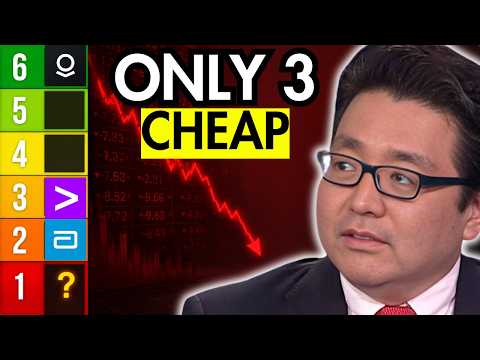
The video ranks 10 beaten-down stocks from worst to best based on risk/reward, not just how far they have fallen. The speaker argues that some of the biggest drawdowns are traps because growth has slowed or valuations were excessive, while a few names now look interesting because their businesses remain intact and the stocks have rerated sharply lower.
Watch on YouTube ›Get the market thesis, key claims, assets, contradictions, and follow-up questions from any financial video — then unlock a version personalized to your portfolio, watchlist, and favorite speakers.
The speaker opens by arguing that the market looks healthier at the index level than it does underneath. The S&P 500 is up and leadership has been narrow, with energy and tech doing most of the work while sectors like healthcare, financials, and communication services have lagged. That setup leads to the core thesis of the episode: a stock being down 20%, 30%, 40%, or even more does not automatically make it cheap, because the decline may reflect decelerating fundamentals or still-excessive valuation. He frames the ranking explicitly as a risk-versus-reward exercise, not a list of the biggest losers. At the bottom of the list is Palantir, which he likes as a business but rejects as an investment at current prices. …
Tactically, the video favors select beaten-down quality stocks over crowded momentum names, with the cleanest near-term setups seen in Abbott and Intuit. The immediate risk is that market punishment for slowing growth continues, especially where multiple compression is still unfinished.
Over the next few months, the base case is that stocks with intact franchises and rerated valuations can recover if growth stabilizes and guidance holds. The thesis weakens if slowdown fears broaden from isolated names into a more persistent re-rating of software, consumer, and consulting businesses.
Structurally, the video argues that the market is entering a more selective regime where quality alone is not enough unless it is bought at a reasonable price. Durable franchises still matter, but valuation resets, AI disruption risk, and slower growth mean investors need a higher margin of safety than they did during the prior growth cycle.
The market’s strength at the index level is masking weak and uneven sector leadership underneath.
He says the S&P 500 is up, but leadership is narrowed to energy and tech while several other sectors lag.
A falling share price does not automatically mean a stock is cheap.
This is the central screen for the whole ranking.
Palantir has exceptional growth and a pristine balance sheet, but the stock still needs perfect execution because the valuation is extremely high.
He highlights strong revenue growth, profitability, zero net debt, and very rich forward multiples.
What caused the outsized negative reaction to Intuit's stock?
The speaker explains two reasons: 1) Turboax saw a deceleration in revenue year-over-year, and investors are very sensitive to any signs of a slowdown; and 2) the 3,000 job cuts were seen by the market as a potential sign of weakness, though CEO Susan Goodrazi framed them as creating efficiency. The speaker also notes Intuit raised its guidance yet the stock still fell 20%.
Unlock the full claims, asset map, scores, related transcripts, follow-up questions, and AI chat — shaped around your portfolio, watchlist, favorite speakers, and risks.
