TranscriptAgent
Try it free
TRANSCRIPTAGENT.AI · transcript analysis

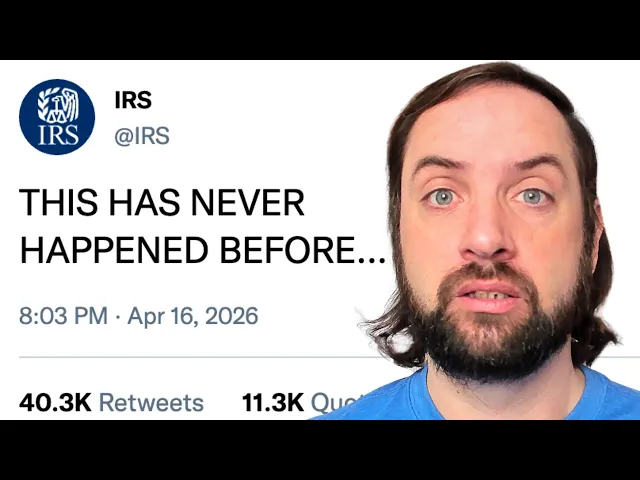
New IRS Tax Return Data Shows People are COMPLETELY Out Of Money

Channel: Eurodollar University Published: 2026-04-16 19:00
Eurodollar University

The video argues that recent IRS tax refunds are rising, but households are mostly saving the money or paying down debt instead of spending it. The speaker frames this as evidence of a weak labor market, stressed consumers, and a broader downturn that tax cuts cannot meaningfully reverse.

Watch on YouTube ›

Get the market thesis, key claims, assets, contradictions, and follow-up questions from any financial video — then unlock a version personalized to your portfolio, watchlist, and favorite speakers.

Detailed summary

The speaker says the IRS is showing average refunds up about 10%, but early evidence indicates Americans are not using the extra cash to boost consumption. Instead, they are saving it, paying down debt, or spending only on necessities like gasoline. He treats that as rational behavior under stress and as confirmation that households are already under pressure from weak job growth, falling incomes, and higher living costs. The core thesis is that tax refunds and tax cuts are not effective macro stimulus when the economy is already weakening. He argues that consumer behavior is driven more by labor-market conditions than by windfall payments, so when jobs and incomes are deteriorating, people naturally reduce revolving credit use and direct refunds toward balance-sheet repair. …

🔒 The full detailed summary continues — read all of it free with an account. Read the full summary →

Main takeaways

  1. Refunds are up, but the speaker says households are using them defensively rather than expansively.
  2. Weak labor-market conditions, not headline stimulus, are presented as the key driver of consumer behavior.
  3. Revolving credit growth and sentiment data are used as evidence that consumers were already pulling back before the energy shock.
  4. The speaker argues tax rebates have historically produced low spending multipliers in downturns.
  5. 2001, 2008, and the current period are presented as broadly similar in how recipients use windfall payments.
  6. The video’s macro conclusion is bearish on stimulus efficacy and constructive only on households’ short-term balance-sheet repair.

Market read by horizon

Short term

Tactically, the setup is for limited near-term spending uplift from refund season, with the risk concentrated in household balance-sheet repair rather than consumption acceleration. The immediate watch items are spending leaks into essentials like gas and whether consumer credit continues to flatten.

  • Near term, the refund season should continue to help balance sheets more than retail demand.
Show more
  • Immediate upside in consumption looks limited because the speaker says consumers are prioritizing debt repayment and savings.
  • Higher gasoline costs are the main area where some of the refund money may still leak into spending.
Mid term

Over the next few months, the base case is that refunds and tax cuts cushion households but do not change the broader trajectory unless jobs and incomes stabilize. If payrolls, revolving credit, and sentiment improve together, the thesis weakens; otherwise the consumer likely stays defensive.

  • Over the next several weeks to months, the base case is continued consumer caution and limited stimulus pass-through.
Show more
  • The view depends on labor-market deterioration continuing; if job growth and income trends improve, the propensity to spend could rise.
  • The speaker expects the economy to keep grinding lower even if refunds and tax cuts remain supportive at the household level.
Long term

Structurally, the video argues that windfall transfers have low multiplier effects in downturns because stressed households save or deleverage. The lasting implication is a regime where labor-market health matters far more than fiscal handouts for determining spending behavior.

  • Structurally, the video argues that downturns are driven by labor-market weakness more than by the size of fiscal transfers.
Show more
  • The long-run thesis is that Keynesian stimulus often overestimates the spending response of stressed households.
  • The speaker’s regime view is that when income and job security weaken, windfalls are used to repair balance sheets rather than to power a virtuous spending cycle.
Unlock the full horizon read See the full short-term, mid-term, and long-term implications with confirmation and invalidation signals. Unlock horizon read

Key claims (10)

BULLISH tax policy IRS tax refunds

IRS data shows average taxpayer refunds are up about 10% this year.

The speaker quotes IRS data and repeated a roughly 10% increase in average refunds.

BEARISH consumer demand consumer spending

Americans are mostly saving refunds or using them to pay down debt rather than spending them.

This is the central thesis repeated throughout the transcript.

BEARISH labor market consumer spending

The weak spending response is evidence of stress from jobs and incomes, not a failure of household rationality.

He explicitly says people behave prudently when under stress and that this signals strain.

Unlock 7 more claims See the full bullish, bearish, and counter-consensus argument map extracted from the transcript. Unlock all claims

Assets discussed (8)

IRS tax refunds
MIXED other

Higher refunds are positive for households, but the speaker argues they are not translating into broad spending stimulus.

Federal Reserve consumer credit data
BEARISH other

Used as evidence that revolving credit growth was flattening and consumers were becoming more cautious.

Unlock the full asset map (6 more) See all assets mentioned, their directional bias, and the exact reasoning. Unlock asset map

Speakers

SPEAKER Unknown speaker

Where this transcript pushes against consensus

  • The argument relies heavily on a single macro interpretation: that weak spending after refunds mainly proves recessionary stress, but it does not quantify how much spending would have happened absent the refunds.
  • The speaker treats payroll revisions and credit data as decisive evidence of a downturn, but the transcript does not provide the underlying figures or alternative explanations.
  • The comparison to 2001, 2008, and 2020-2021 is directionally useful but somewhat apples-to-oranges because those periods had very different labor-market, policy, and supply-side conditions.
  • The claim that tax refunds are not macro-stimulative is asserted strongly, but the evidence cited is more narrative and historical than causal.
  • The repeated dismissal of mainstream economics is rhetorical and not itself evidence.

Topics

IRS tax refundsconsumer spendingdebt repaymentlabor market weaknessconsumer creditKeynesian stimuluseconomic downturngasoline prices2001 and 2008 rebate comparisonsEurodollar University promotion

Create your free research agent

Unlock the full claims, asset map, scores, related transcripts, follow-up questions, and AI chat — shaped around your portfolio, watchlist, favorite speakers, and risks.

  • Full claims and asset map
  • Personalized relevance to your watchlist
  • Follow-up questions you can track
  • Related transcripts from your workspace
  • AI chat about this video
Create your free research agent
TRANSCRIPTAGENT.AI