TranscriptAgent
Try it free
TRANSCRIPTAGENT.AI · transcript analysis

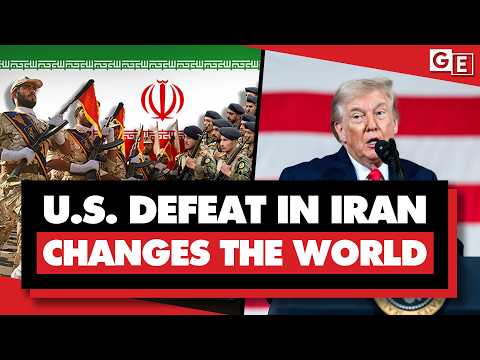
US defeat in Iran War will change the world - Now even American hawks admit it!

Channel: Geopolitical Economy Report Published: 2026-05-22 08:00
Geopolitical Economy Report

Ben Norton argues that the US is losing its war against Iran and that even prominent neoconservative war hawks now privately or publicly acknowledge it. He frames Robert Kagan’s Atlantic essay as a rare admission from an architect of prior US wars that the Iran campaign is backfiring strategically, weakening US credibility and strengthening Iran, China, Russia, and the broader Global South.

Watch on YouTube ›

Get the market thesis, key claims, assets, contradictions, and follow-up questions from any financial video — then unlock a version personalized to your portfolio, watchlist, and favorite speakers.

Detailed summary

Ben Norton’s core thesis is that the US and Israel’s war against Iran is failing, and that this failure is so visible that even major neoconservative voices in Washington are acknowledging it. He argues that Robert Kagan’s Atlantic article, “Checkmate in Iran,” is especially significant because Kagan is not an anti-war critic but a long-time war hawk and Iraq War advocate. Norton presents Kagan’s article as confirmation of the argument he says Geopolitical Economy Report has been making for months: the war is not only unwinnable on current terms, but its consequences will accelerate US decline and the rise of a more multipolar order. A major part of the video is devoted to establishing Kagan’s ideological background. …

🔒 The full detailed summary continues — read all of it free with an account. Read the full summary →

Main takeaways

  1. Norton’s thesis is that the US is losing the war on Iran and cannot reverse the strategic damage easily.
  2. He argues that Robert Kagan’s Atlantic essay is important because it is an admission from a leading neocon war hawk, not an anti-war activist.
  3. He frames neoconservatism as an imperial network tied to Iraq, Libya, Syria, Ukraine, NATO, and elite media.
  4. He says Iran’s leverage comes from the Strait of Hormuz, missile capacity, and the ability to hit Gulf energy infrastructure.
  5. He believes the war is accelerating US decline and strengthening Iran, China, Russia, and the Global South.
  6. He uses polling to argue the war is unpopular in the US and politically hurting Trump.
  7. He presents the current conflict as a turning point with consequences larger than prior US losses in Vietnam or Afghanistan.

Market read by horizon

Short term

Near term, the actionable risk is escalation around Hormuz, Gulf energy assets, and any attempt by Trump to mask weakness with rhetoric. The setup is vulnerable to sudden headline shocks rather than a clean trend trade.

  • Watch for any Trump attempt to declare victory while quietly seeking a ceasefire or off-ramp.
Show more
  • The immediate tactical risk is escalation around the Strait of Hormuz and Gulf energy infrastructure.
  • Public opposition inside the US appears high, which could intensify political pressure on the White House.
Mid term

Over the next few weeks or months, the base case in the video is a US climbdown or stalemate masked as policy success, while Iran’s deterrence remains intact. Confirmation would be continued Iranian leverage and failed US coercion; invalidation would require visible US-imposed concessions.

  • Over the next several weeks and months, the base case in this video is a US strategic retreat rather than a clean win.
Show more
  • The key confirmation signal is whether Iran retains deterrence and the US fails to impose decisive leverage through blockade or bombing.
  • If Gulf states or energy markets remain exposed, the conflict could broaden into a longer regional economic shock.
Long term

Structurally, the transcript argues that failed regime-change wars keep eroding US credibility and accelerate multipolarity. If that pattern holds, Iran becomes another durable example of limits on American power and of China/Russia/Global South gaining relative influence.

  • The structural thesis is that repeated US overreach is accelerating multipolarity rather than preserving unipolar dominance.
Show more
  • If Norton is right, Iran’s endurance would become a reference point for the limits of US coercive power.
  • The broader implication is that China, Russia, and other Global South actors gain credibility when US power appears unable to finish wars.
Unlock the full horizon read See the full short-term, mid-term, and long-term implications with confirmation and invalidation signals. Unlock horizon read

Key claims (6)

BEARISH US empire decline United States/Iran

The United States is losing the war it started against Iran.

This is the central thesis repeated throughout the transcript.

BEARISH US credibility The Atlantic / Robert Kagan

Robert Kagan’s Atlantic article is significant because it is a neoconservative admission that the US cannot control the consequences of losing to Iran.

Norton emphasizes Kagan’s ideological history to show that this is an admission from within the hawkish establishment.

BULLISH energy security Strait of Hormuz

Iran’s leverage comes from its ability to control or disrupt the Strait of Hormuz, the world’s key oil transit choke point.

The video repeatedly links Iranian power to the strait and to global energy flows.

Unlock 3 more claims See the full bullish, bearish, and counter-consensus argument map extracted from the transcript. Unlock all claims

Assets discussed (10)

Iran
BULLISH other

Presented as the side gaining leverage and strategic strength through resilience and regional deterrence.

United States
BEARISH other

Framed as losing the conflict, suffering credibility damage, and facing broader imperial decline.

Unlock the full asset map (8 more) See all assets mentioned, their directional bias, and the exact reasoning. Unlock asset map

Speakers

SPEAKER Ben Norton

Where this transcript pushes against consensus

  • The transcript treats Kagan’s quoted conclusions as settled proof rather than as one establishment analyst’s interpretation.
  • Several factual claims are presented very confidently without independent sourcing in the video, especially around operational damage to US bases and the exact extent of Iranian control of the Strait of Hormuz.
  • The video states the war began on February 28 and makes broad claims about a US-Israel launch without clarifying the specific military actions or legal framing.
  • The argument relies heavily on political and ideological characterizations of neocons, which are rhetorically forceful but analytically broad.
  • Polling figures are used to support the thesis, but the transcript does not provide full survey wording or methodology.

Topics

Iran warneoconservatismRobert KaganProject for the New American CenturyStrait of HormuzUS empire declinemultipolar worldTrump politicspolling on warGulf energy security

Create your free research agent

Unlock the full claims, asset map, scores, related transcripts, follow-up questions, and AI chat — shaped around your portfolio, watchlist, favorite speakers, and risks.

  • Full claims and asset map
  • Personalized relevance to your watchlist
  • Follow-up questions you can track
  • Related transcripts from your workspace
  • AI chat about this video
Create your free research agent
TRANSCRIPTAGENT.AI