
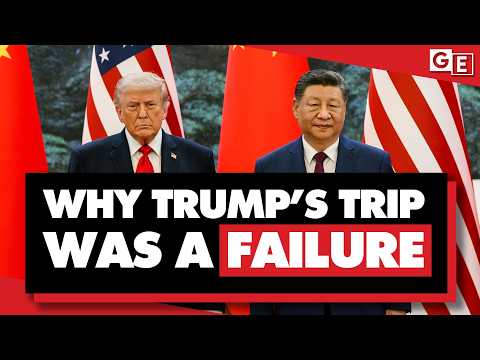
Ben Norton argues that Trump’s May China visit was not a diplomatic win but a retreat to the status quo after years of U.S. tariff and tech escalation. He says the White House overstates minor or ambiguous “deals” on Iran, rare earths, Boeing, agriculture, and chips, while China largely held its line and refused to make meaningful concessions.
Watch on YouTube ›Get the market thesis, key claims, assets, contradictions, and follow-up questions from any financial video — then unlock a version personalized to your portfolio, watchlist, and favorite speakers.
Ben Norton’s core thesis is blunt: Trump’s China trip was a failure because it did not extract meaningful concessions from Beijing, and most of the White House’s victory claims are either vague, misleading, or simply a reversal of damage Trump himself caused through the trade war and tech war. He frames the visit as a desperate attempt to manufacture political success after Trump escalated pressure on China in 2025, including extreme tariff threats and export controls. A major part of the argument is that the U.S.-China conflict is not new and is bipartisan. Norton says Trump started the trade war in 2018, Biden continued it, and Trump then massively escalated it again in his second term. Against that backdrop, he argues Beijing had no reason to suddenly “bail out” the U.S. or reward a country that had spent years trying to constrain China’s development. …
Tactically, the headline ‘deal’ looks more like optics than a durable market catalyst, so watch for disappointment if the announced concessions do not convert into actual policy or shipment changes.
Over the next few weeks to months, the likely path is partial de-escalation in isolated sectors without a real reset in U.S.-China competition; if chip, rare-earth, or farm trade volumes do not normalize, the ‘win’ narrative should weaken.
The structural message is that coercive U.S. trade and tech pressure is pushing China toward self-reliance and accelerating fragmentation of global supply chains; that regime shift matters more than any single summit.
Trump’s trip to China was a failure rather than a success.
The speaker argues Beijing made no meaningful concessions and the White House’s wins are mostly optics or reversals of prior U.S. pressure.
China had no incentive to help the U.S. after years of trade war, tech war, tariffs, and the Iran conflict.
The speaker says Beijing would not reward a country that had been trying to contain and damage it economically.
The Iran/Strait of Hormuz language in the White House fact sheet is misleading because China’s position differs sharply from the U.S. position.
He says China wants commerce to flow but does not support U.S. attacks on Iran or U.S. framing of the issue.
Unlock the full claims, asset map, scores, related transcripts, follow-up questions, and AI chat — shaped around your portfolio, watchlist, favorite speakers, and risks.
