
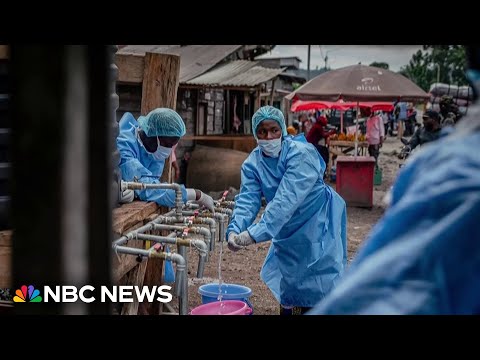
Craig Spencer, an emergency doctor and Ebola survivor, argues the East Africa outbreak is growing faster than officials can track and that the response is underpowered, undercoordinated, and already behind the curve. He says the case count likely understates reality, criticizes past U.S. and global health pullbacks, and calls for immediate on-the-ground action rather than symbolic announcements.
Watch on YouTube ›Get the market thesis, key claims, assets, contradictions, and follow-up questions from any financial video — then unlock a version personalized to your portfolio, watchlist, and favorite speakers.
The segment centers on a rapidly spreading Ebola outbreak in East Africa and uses Dr. Craig Spencer’s firsthand experience to argue that the situation is being underestimated and mishandled. The host opens with WHO figures—more than 900 suspected cases and 220 suspected deaths—and notes that the outbreak reached those numbers in about ten days, much faster than the 2014–2016 West Africa epidemic. Spencer, introduced as an emergency doctor, public health professor at Brown, and Ebola survivor, says he is “incredibly concerned” because the reported total is probably only a fraction of the true count. Spencer’s core thesis is that public-health visibility and response capacity are both lagging badly. He says there are not enough teams, epidemiologists, or testing resources to know the true scale yet, and that there are still too many unconnected chains of transmission. …
Immediate setup is a deteriorating health-crisis response, not a tradable market thesis. The near-term risk is continued spread and headline escalation if case counts keep outpacing containment capacity.
Over the next few weeks, the key question is whether real field resources arrive quickly enough to slow transmission; if not, the narrative likely shifts toward worsening containment failure and larger humanitarian mobilization.
Structurally, the interview argues for permanent epidemic preparedness and stronger global-health infrastructure. The lasting implication is that outbreak control depends on sustained surveillance and response capacity, not late-stage political announcements.
The reported Ebola case count likely understates the true number on the ground.
Spencer says the thousand-or-so reported cases are probably only a fraction because testing and epidemiological coverage are insufficient.
There are not enough response teams, epidemiologists, or tests to accurately map the outbreak.
He explicitly cites shortages in personnel and testing as the reason for uncertainty.
The outbreak may not become clear for another week or two because chains of transmission are still being untangled.
He says a clearer picture probably will not emerge immediately.
How concerned are you by the number of cases we're seeing, and do you agree with the IRC's assessment that this could become the deadliest outbreak on record?
Dr. Spencer is incredibly concerned. He notes that in just over ten days, this became one of the biggest outbreaks ever, and the ~1,000 reported cases are likely just a fraction of the true number. There aren't enough teams, epidemiologists, or testing to get a clear picture yet.
What is it like to have Ebola? What was your experience with the disease?
Dr. Spencer says it was the worst 19 days of his life with no way to sugarcoat it. He had the best-case scenario of a worst-case scenario—treated in a high-quality U.S. ICU—while hundreds or thousands of patients in eastern Congo will be treated in far inferior facilities, arguing for an urgent stepped-up response.
Why is it that despite dealing with several past Ebola outbreaks, we're not prepared for this one?
Spencer says we keep forgetting and unlearning the lessons we've learned. A decade ago we learned the value of smart investments in preparedness, but the U.S. and other countries pulled support out of countries like eastern Congo, impacting detection and swiftness of response. There are incredible human costs on the ground that news numbers don't capture.
Unlock the full claims, asset map, scores, related transcripts, follow-up questions, and AI chat — shaped around your portfolio, watchlist, favorite speakers, and risks.
