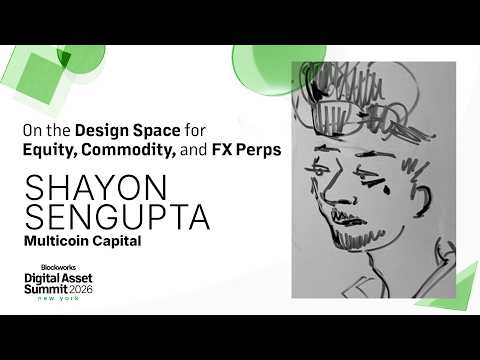
Shayan Sen Gupta of Multicoin Capital argues that tokenized real-world assets are moving from legacy rails to crypto rails faster than expected, and that the biggest opportunity is not holding the assets themselves but owning the infrastructure that routes, issues, and composes them. He breaks the market into synthetics, wrapped assets, collateralized borrowing, and native on-chain issuance, then maps treasuries, private credit, equities, commodities, FX, and real estate to those models.
Watch on YouTube ›Get the market thesis, key claims, assets, contradictions, and follow-up questions from any financial video — then unlock a version personalized to your portfolio, watchlist, and favorite speakers.
Shayan Sen Gupta, a general partner and co-head of venture at Multicoin Capital, presents a thesis that the next major growth wave in crypto comes from exogenous assets—traditional assets moving onto crypto rails. His core claim is that the gap between enormous TradFi volumes and much smaller crypto volumes will converge because blockchain rails are cheaper, more global, permissionless, and always on. He says the shift is already underway, citing growing on-chain RWA market cap, equity perpetual volumes, and the rise of institutional custody, compliance, and friendlier U.S. regulation. He grounds the argument in a market-structure framing: most crypto historically handled endogenous assets, while TradFi assets like equities, commodities, rates, and FX transact on legacy systems that have not been meaningfully updated in decades. …
Tactically, the clearest setup is continued strength in on-chain synthetics and RWA infrastructure names if equity perps and tokenized treasuries keep growing. The immediate risk is that wrapped products stay friction-heavy and liquidity concentrates in only a few venues.
Over the next few months, the market likely keeps favoring the best-in-class venues, issuers, and composability protocols as RWA activity broadens beyond treasuries. The view is confirmed if private credit, equities, and FX synthetics show sustained volume growth and institutional participation.
Structurally, the talk argues that crypto becomes the operating layer for price discovery, settlement, and issuance across multiple asset classes. If that happens, the durable value accrues to exchanges, on-ramps, and composability primitives rather than to the wrapped assets themselves.
TradFi asset markets and crypto markets will converge much faster than most people expect.
The speaker repeatedly says the left and right sides of the market-size chart will converge and that the migration will be faster than expected.
Blockchain rails are more efficient for trading assets globally, permissionlessly, and 24/7.
This is the central operating claim behind the migration thesis.
RWA market cap has already surged past $30 billion, led by tokenized treasuries and money-market funds.
He uses the current size and composition of the market as evidence of traction.
Unlock the full claims, asset map, scores, related transcripts, follow-up questions, and AI chat — shaped around your portfolio, watchlist, favorite speakers, and risks.