
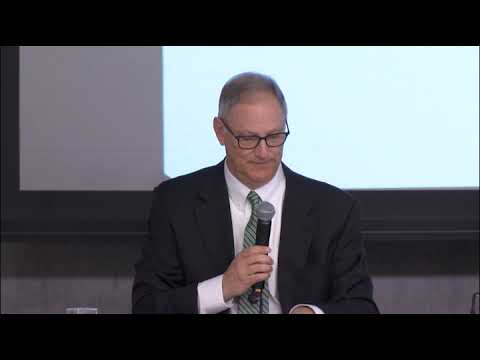
This Federal Reserve panel is a discussion about how banking regulators can facilitate innovation without weakening safety and soundness. The speakers largely agree that community banks need better third-party risk management, more practical supervisory guidance, and easier paths to adopt technology, form new banks, and share infrastructure—while one speaker warns that “facilitating innovation” should not become a backdoor for crypto or weaker rules.
Watch on YouTube ›Get the market thesis, key claims, assets, contradictions, and follow-up questions from any financial video — then unlock a version personalized to your portfolio, watchlist, and favorite speakers.
This panel from the Federal Reserve’s EGRPRA public meeting is centered on how regulation can support innovation in community banking. Todd Vermilier, the moderator, frames the session as a discussion of “facilitating innovation,” then invites remarks from Michael Emancipator of ICBA, Kelvin Chen of the Consumer Bankers Association, Philip Basil of Better Markets, and David Schroeder of the Community Bankers Association of Illinois. The discussion repeatedly returns to one core tension: how to let banks modernize quickly while preserving safety, soundness, consumer protection, and supervisory accountability. Michael Emancipator argues that community banks are naturally innovative but are constrained by vendor concentration, examiner caution, and burdensome due diligence. …
Near term, the actionable setup is incremental supervisory easing around third-party risk, due diligence, and information sharing rather than big legislative change. The immediate risk is that innovation gets pushed out of the regulated banking system if exam friction stays high.
Over the next few months, the likely path is gradual improvement through guidance, FAQs, and shared standards if agencies decide to prioritize community bank operations. Confirmation would be more practical examiner behavior and reusable frameworks; failure would leave de novo formation and vendor adoption constrained.
Structurally, the panel argues that community banks can remain viable only if regulation evolves into a platform for safe experimentation rather than a barrier to entry. If that does not happen, innovation and financial intermediation will keep migrating toward less supervised channels and large incumbent platforms.
Community banks are innovative but face structural barriers from vendor concentration and supervisory caution.
Michael says community banks rely heavily on third-party providers and are disadvantaged by concentration and examiner behavior.
Shared due diligence frameworks could reduce duplicated compliance work and help banks adopt vendors more safely.
ICBA proposes standards and certification-based acceptance to lower burden while preserving oversight.
Modernizing confidential supervisory information rules would make bank-fintech collaboration faster and more effective.
Michael argues fintech partners need supervisory context to fix problems without breaking confidentiality rules.
Would any of you like to react to what a panelist said or put additional ideas on the table?
How do we get back to a world where we're seeing more de novo community bank activity?
The speaker connects de novo activity to technology costs — noting that technology should get cheaper over time, similar to flat-screen TVs. They argue that one reason for few de novos is the significant capital required, partly to offset the cost of personnel and technology until the bank becomes viable. If technology were cheaper and easier to onboard, less capital would need to be burned through to meet regulatory requirements.
Was there outside expertise from companies brought in to have conversations with banks using the technology, to get everyone in the same room during the process?
The respondent says they were trying to do a lot more of that — having offices of innovation where outside firms and non-banks would come to the board to talk about what they were doing, bringing in other regulators and consumer regulators to understand how the world is shifting. However, it's their understanding that this has become less frequent across the regulatory space in more recent administrations, which has detriments — for example, dealing with live legislation on stable coins without a shared understanding of how stable coin operators make their money.
Unlock the full claims, asset map, scores, related transcripts, follow-up questions, and AI chat — shaped around your portfolio, watchlist, favorite speakers, and risks.
