
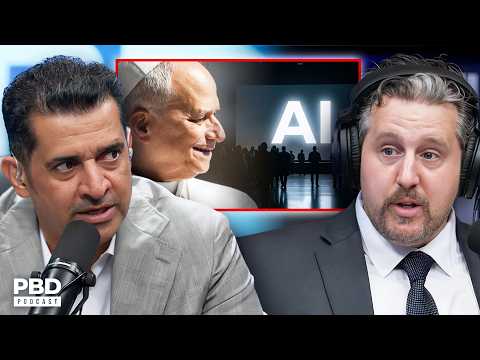
The video is a Valuetainment roundtable reacting to Pope Francis’ warning that AI should be “disarmed,” especially around autonomous weapons, misinformation, and the risk that a few big firms or governments shape the technology. The panel largely agrees with the pope’s concerns while arguing that blanket anti-AI regulation is impractical and that the bigger economic effect may be productivity gains and new jobs, even as political misuse, censorship, and accountability issues remain unresolved.
Watch on YouTube ›Get the market thesis, key claims, assets, contradictions, and follow-up questions from any financial video — then unlock a version personalized to your portfolio, watchlist, and favorite speakers.
This transcript is a commentary segment built around the Pope’s warning that AI “needs to be disarmed.” The speakers frame his remarks as a civilizational warning rather than a narrow tech opinion, and they quickly move into a broad discussion of AI safety, regulation, labor disruption, and political control. The core thesis from the panel is not that AI should be stopped, but that it needs guard rails because autonomous weapons, deepfakes, and concentrated control over AI systems could create serious social and political harm. The first major thread is moral and philosophical. The Pope’s 13-point list is paraphrased as saying AI should serve humanity, preserve human dignity, and not replace human judgment, empathy, or conscience. The speakers repeatedly agree with the idea that AI cannot be a source of morality and should not be trusted with decisions about life and death. …
Tactically, AI sentiment looks constructive but noisy: productivity headlines support the trade, while regulation/deepfake/autonomous-weapons fears can trigger sharp rotations. The immediate risk is not collapse, but narrative-driven volatility around AI names and policy headlines.
Over the next few months, the base case is continued AI adoption with uneven labor effects and escalating policy debate. The key validation signal is whether AI is still producing productivity gains and new work, versus whether misuse or politics force a stricter regulatory regime.
Longer term, AI looks like a regime shift in how power, labor, and truth are organized. The structural risk is that whoever controls the models and deployment standards can shape information, work, and social norms in durable ways.
The Pope’s warning is that AI should be ‘disarmed’ so it cannot become an instrument of domination.
The speaker quotes the pope directly and frames the warning as central to the discussion.
AI should serve humanity rather than replace human judgment and dignity.
Repeated as one of the Pope’s numbered points and endorsed by the panel.
A few companies controlling AI and data is dangerous.
The transcript explicitly warns about concentration of intelligence and data among a small number of firms.
The Pope came out and issues a warning about AI and autonomous weapons. Is this all the 13 points in a rap or is this just something he's saying there?
Rob clarifies it's just something the Pope said, not a 13-point rap, and that he does have the 13 points to share.
Humberto, what are your thoughts on the Pope's 13 points about AI?
Humberto says the Pope makes some valid points, especially about AI morality and not relying on AI for moral decisions, and not letting AI control weapons because human life is too valuable for an algorithm to decide life or death. He agrees AI must serve humanity, but notes that oversight is difficult because we're in an arms race with other countries.
Jeff, what are your thoughts on this?
Jeff argues there's not just two sides but a ton of nuance. On economics, AI makes people more productive which drives growth, as seen with programmers. On the political side, autonomous weapons are dangerous and hard to regulate — you can't practically stop all AI from being armed. He argues these issues will be solved bottom-up, not top-down, and that regulation boards would be captured by different factions over time.
Unlock the full claims, asset map, scores, related transcripts, follow-up questions, and AI chat — shaped around your portfolio, watchlist, favorite speakers, and risks.
