
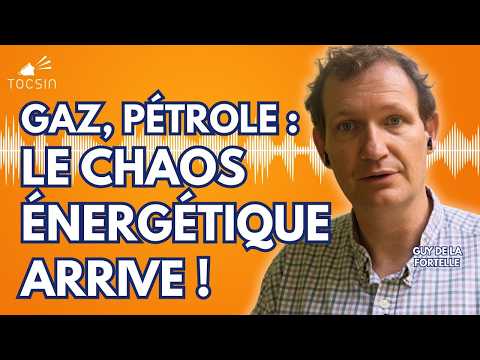
Guy de la Fortelle argues that the Middle East conflict is moving from a fake ceasefire/peace narrative into a prolonged economic war, with oil stocks being drawn down too fast and Europe heading toward a real energy shortage. He says markets are underestimating the duration of the disruption, and that the consequences could spill from energy into inflation, finance, and even monetary instability.
Watch on YouTube ›Get the market thesis, key claims, assets, contradictions, and follow-up questions from any financial video — then unlock a version personalized to your portfolio, watchlist, and favorite speakers.
This segment is built around Guy de la Fortelle’s core thesis that the Iran/US/Israel standoff is not resolving quickly and that the market is dangerously assuming a short conflict. He points to a sharp swing in Polymarket odds for a permanent US-Iran peace agreement by June 30 — from 76% early in the week to 42% by the morning of the recording — as evidence that the peace narrative is already fading. In his view, there is no workable “zone d’accord” for Iran, Israel, the UAE, and the US at the same time, so the negotiations are structurally trapped. He then links that geopolitical impasse to a broader energy squeeze. He says the US has resumed air strikes against military targets in Iran, Iran has responded, drones are being intercepted on both sides, and the confrontation is effectively shifting into economic warfare. …
Near term, the setup is tactically bearish for energy stability: any renewed escalation around Iran or Hormuz can quickly reprice oil, gas, and fuel availability. The risk is that markets are still underestimating how long the disruption lasts.
Over the next few months, the base case is persistent energy stress rather than a clean resolution; confirmation would come from continued inventory drawdowns, tight gas storage, and sustained shipping risk. A genuine diplomatic settlement and normalization of flows would be the main invalidation.
Structurally, the transcript argues that recurring energy shocks are feeding a broader regime of higher scarcity, weaker financial resilience, and monetary instability. In that regime, hard assets like gold and more self-sufficient living arrangements are presented as lasting defenses.
Prediction markets for a permanent US-Iran peace agreement fell sharply, showing the peace narrative weakening.
He cites Polymarket odds moving from 76% to 42% within days.
There is no workable settlement zone among Iran, Israel, the UAE, and the US.
He argues the parties have no honorable exit path and therefore negotiations are structurally blocked.
The conflict is shifting into economic warfare, with the battlefield now being the economy.
He quotes the Iranian president saying the main battlefield is economic war.
La paix est-elle sur le point d'être signée dans le Golfe et à Ormuz ?
Non, la paix n'est pas près d'être signée. L'orateur explique que les paris sur un accord de paix permanent entre les États-Unis et l'Iran ont explosé à 76% début de semaine sur Polymarket, mais sont redescendus à 42%. Il n'y a pas de zone d'accord possible entre les belligérants — Iran, Émirats, Israël ou États-Unis — et aucune porte de sortie honorable pour les quatre pays en même temps.
Quels sont vos conseils pour se préparer à la crise et que faut-il stocker ?
L'orateur explique que l'or est plus intéressant que l'argent comme stockage de valeur à long terme car quand le système monétaire s'effondre, on revient à un étalon or. Il recommande aussi de réfléchir à où l'on habite — les petites villes et campagnes sont plus sûres que les centres-villes, avec la possibilité d'avoir un potager, du stockage, et une entraide communautaire. Il mentionne aussi l'importance d'avoir des réserves d'eau et un moyen de chauffage alternatif comme le bois.
Est-ce qu'il y a encore des raisons d'espérer ?
L'orateur répond qu'il n'y a pas de raison d'espoir mais des raisons d'espérance, et que le bonheur est dans sa recherche.
Unlock the full claims, asset map, scores, related transcripts, follow-up questions, and AI chat — shaped around your portfolio, watchlist, favorite speakers, and risks.
