TranscriptAgent
Try it free
TRANSCRIPTAGENT.AI · transcript analysis

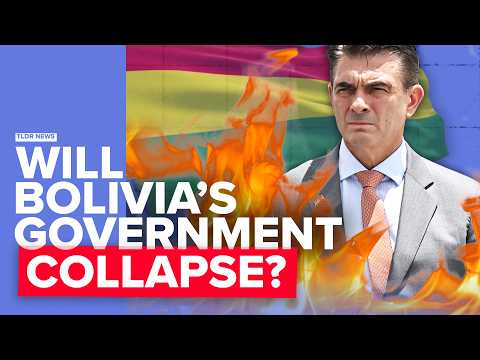
Bolivia’s Protests Explained

Channel: TLDR News Global Published: 2026-05-28 04:30
TLDR News Global

This video explains Bolivia’s protests as the product of a long economic and political unwind: MAS-era commodity-fueled growth gave way to stagnation, fiscal stress, and party fragmentation, then President Rodrigo Paz’s subsidy cuts and a contested land reform law sparked a wider anti-government uprising. The speaker argues that current unrest is likely to intensify, especially if oil prices stay high and fuel shortages persist.

Watch on YouTube ›

Get the market thesis, key claims, assets, contradictions, and follow-up questions from any financial video — then unlock a version personalized to your portfolio, watchlist, and favorite speakers.

Detailed summary

The core thesis is that Bolivia’s current protests are not a single-issue event but the culmination of years of macro and political deterioration. The video traces the arc from the MAS era under Evo Morales, when nationalizations and a commodity boom funded welfare expansion and sharply reduced poverty, to the later collapse in gas production, falling commodity prices, larger deficits, and declining approval ratings. In that telling, today’s unrest reflects the exhaustion of the old model and the political blowback from the new government’s attempt to repair finances with unpopular reforms. A key part of the explanation is historical context. The speaker says MAS governed from 2006 to 2019, expanded protections for Indigenous communities, nationalized major sectors including telecoms, electricity, mining, and especially gas, and benefited from high oil and gas revenues. …

🔒 The full detailed summary continues — read all of it free with an account. Read the full summary →

Main takeaways

  1. Bolivia’s protests are framed as the result of a long unwind from the commodity boom, not just one new law.
  2. MAS-era nationalization and welfare spending were supported by gas revenues that later stagnated.
  3. The 2019 Morales crisis is presented as legally messy and politically contested, with later analysis complicating the fraud narrative.
  4. Post-2020 MAS infighting weakened the state and helped create the conditions for a right-wing reform government.
  5. Rodrigo Paz’s subsidy cuts and land reform law triggered immediate backlash from workers, Indigenous groups, and rural communities.
  6. The speaker expects tensions to escalate rather than calm down in the near term.

Market read by horizon

Short term

Near term, the setup looks tense: protests, road blockades, and emergency powers point to more volatility rather than a quick settlement. The main tactical risk is that fuel shortages and elevated energy prices keep feeding the unrest.

  • Protests have already spread beyond the original land-law trigger into a broader anti-government movement.
Show more
  • Road blockades around La Paz and the congressional move allowing emergency powers raise escalation risk.
  • Fuel prices and shortages remain immediate flashpoints after subsidy removal.
Mid term

Over the next few months, the base case is a grindy standoff unless the government can ease shortages and rebuild legitimacy without fully abandoning fiscal repair. If the subsidy cuts or land rules are modified enough to reduce rural backlash, the unrest could cool; if not, the crisis likely broadens.

  • Over the next several weeks, stability likely depends on whether the government can restore fuel supply and defuse rural grievances.
Show more
  • If Paz can reduce shortages without fully reversing reform, unrest may narrow; if not, protests could harden into sustained resistance.
  • The key test is whether the state can isolate Morales’s alleged role from broader social anger.
Long term

Structurally, the transcript argues Bolivia remains trapped by resource dependence and the politics of distributing pain after the commodity boom ends. The lasting regime issue is whether any government can unwind extractive-state benefits without triggering a legitimacy crisis among the constituencies that once relied on them.

  • The transcript implies Bolivia remains vulnerable to commodity-cycle dependence, especially in gas.
Show more
  • The old MAS model delivered social gains but created structural reliance on extractive revenues.
  • Longer term, Bolivia’s political regime looks less stable when fiscal repair collides with Indigenous/rural land politics.
Unlock the full horizon read See the full short-term, mid-term, and long-term implications with confirmation and invalidation signals. Unlock horizon read

Key claims (10)

BEARISH political unrest Bolivia

Bolivia’s protests began as a response to a land mortgage rule but quickly became a broader anti-government movement.

The speaker explicitly says the protests broadened beyond the initial trigger.

MIXED commodity cycle Bolivia

Bolivia’s earlier growth model under MAS relied heavily on gas revenues, nationalization, and welfare expansion.

The transcript links nationalization and gas windfalls to social spending and growth.

BULLISH macroeconomic improvement Bolivia

Bolivia’s poverty, extreme poverty, and debt-to-GDP all improved materially during the commodity boom.

The speaker gives concrete numbers for poverty and debt reduction.

Unlock 7 more claims See the full bullish, bearish, and counter-consensus argument map extracted from the transcript. Unlock all claims

Assets discussed (8)

Bolivia
MIXED other

Country risk is improving and deteriorating at different points in the cycle: earlier commodity boom, now political unrest and economic stress.

Rodrigo Paz
BEARISH other

His reform agenda and subsidy cuts are presented as catalyzing unrest and political backlash.

Unlock the full asset map (6 more) See all assets mentioned, their directional bias, and the exact reasoning. Unlock asset map

Speakers

SPEAKER Unknown speaker

Where this transcript pushes against consensus

  • The transcript presents Morales’s 2019 fall as both likely unconstitutional and possibly a coup-like removal; that dual framing is nuanced but unresolved.
  • The government’s belief that Morales is coordinating the protests is asserted, but the transcript does not provide evidence for that claim.
  • The land reform law is described as being perceived as a land-seizure risk, but the exact legal provisions are only summarized, not demonstrated.
  • The video links current unrest partly to the war in Iran and energy disruption, but the causal chain is broad and not quantified.

Topics

Bolivia protestsRodrigo PazEvo MoralesMAS partyfuel subsidiesland reformcommodity cyclegas revenuesstate of emergencyIndigenous politics

Create your free research agent

Unlock the full claims, asset map, scores, related transcripts, follow-up questions, and AI chat — shaped around your portfolio, watchlist, favorite speakers, and risks.

  • Full claims and asset map
  • Personalized relevance to your watchlist
  • Follow-up questions you can track
  • Related transcripts from your workspace
  • AI chat about this video
Create your free research agent
TRANSCRIPTAGENT.AI