
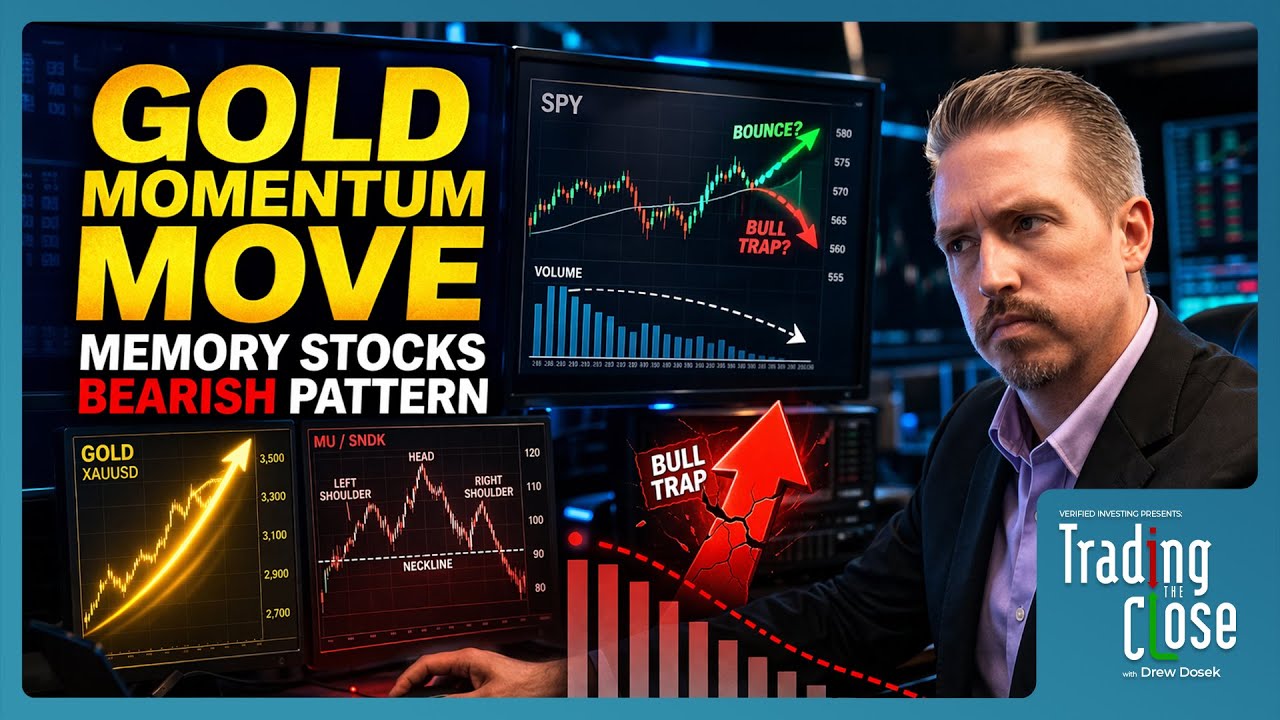
The speaker argues the market bounce looks unconvincing because volume is weak, while oil’s pullback has eased pressure. He stays constructive on select names like Intel, Wingstop, and some space/aerospace stocks, but warns several indices and memory/AI names are still sitting at resistance or forming bearish patterns.
Watch on YouTube ›Get the market thesis, key claims, assets, contradictions, and follow-up questions from any financial video — then unlock a version personalized to your portfolio, watchlist, and favorite speakers.
This episode is a technical market wrap from Drew Dosk on Trading the Close. He opens by saying the S&P 500 and other indices pushed higher after the prior day’s rebound, but the key concern is lack of conviction because volume is weak. In his view, that weak participation keeps uncertainty high and makes the move vulnerable to being a bull trap rather than a confirmed bottom. He walks through major indices first. The S&P 500 closed higher, but he emphasizes that current volume is far below the prior day’s spike and far below the kind of accumulation he associates with durable bottoms. He points to nearby resistance around 6651. The NASDAQ 100 and IWM both rallied into resistance and closed back below it, which he treats as evidence that the rally is not yet confirmed. …
Near term, the bounce looks vulnerable: the market is still trading under a cloud of weak volume, and several indices are pressing into resistance instead of expanding decisively. Oil and the 10-year yield are the quickest confirmation variables; if oil rebounds or yields stop falling, the equity rally can fade fast.
Over the next few weeks, the tape needs sustained participation to turn this into a real bottom; otherwise the move likely resolves into more sideways churn or a renewed leg lower. A cleaner break in oil, yields, and broad index resistance would validate the rebound, while failure there keeps the market in a corrective regime.
Structurally, the speaker is arguing that market leadership and price/volume behavior are the real regime signal, not headline narratives. The lasting thesis is that oil, semis, and a handful of high-beta leaders will continue to telegraph risk appetite and institutional demand long before the rest of the market catches up.
The market’s rally lacks conviction because volume is weak despite higher closes.
He repeatedly emphasizes that the main problem with the bounce is poor volume and no institutional confirmation.
Oil’s pullback has eased tensions in market pricing and is the clearest signal for broader risk appetite.
He explicitly says oil direction tells you where the rest of the market is going and links falling oil to reduced stress.
The S&P 500 needs a move above the nearby resistance zone to validate the rebound.
He identifies the next resistance near 6651 and frames it as the level that would matter on a continuation.
Unlock the full claims, asset map, scores, related transcripts, follow-up questions, and AI chat — shaped around your portfolio, watchlist, favorite speakers, and risks.

