TranscriptAgent
Try it free
TRANSCRIPTAGENT.AI · transcript analysis

The economically passive are about to get crushed by AI. Don't use it and you are toast.

Channel: Clive Thompson Published: 2026-05-15 10:00
Clive Thompson

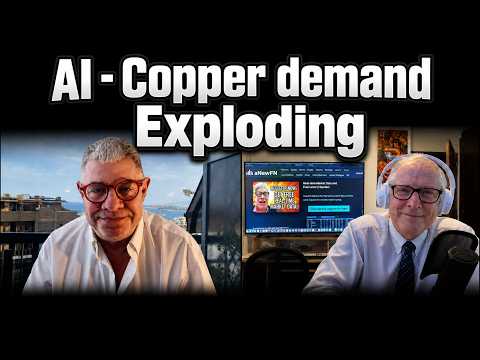
Clem Chambers argues that AI is a once-in-a-generation productivity shock that will punish passive workers and reward people who adapt fast. His core view is that AI will drive a massive energy, reindustrialization, and commodities buildout, with copper, uranium, rare earths, and even air-conditioning capacity benefiting, while office workers, slow adopters, and cash holders risk being crushed by inflation and job displacement.

Watch on YouTube ›

Get the market thesis, key claims, assets, contradictions, and follow-up questions from any financial video — then unlock a version personalized to your portfolio, watchlist, and favorite speakers.

Detailed summary

This is a highly opinionated, conversational interview centered on Clem Chambers’ thesis that AI is not just a software upgrade but a broad economic regime change. His central claim is blunt: “if you're not using this stuff, you're toast,” and more specifically, the economically passive will be crushed while the economically active will capture the upside. He frames AI as an “artificial brain” analogous to the steam engine’s “artificial muscle,” arguing that it will raise productivity, force reorganizations inside companies, and create a new class of winners among individuals who learn the tools early. A major thread of the discussion is labor displacement inside white-collar companies. Chambers says large firms are already planning staff cuts and that AI will let one highly productive worker do the job of many. …

🔒 The full detailed summary continues — read all of it free with an account. Read the full summary →

Main takeaways

  1. AI is framed as an economic forcing function, not a niche tool.
  2. Chambers believes white-collar inefficiency will be rapidly exposed and cut.
  3. Energy, copper, uranium, rare earths, and cooling infrastructure are key beneficiaries.
  4. Inflation is expected to rise because the buildout will be front-loaded with money creation.
  5. The main risk is being economically passive rather than technologically skeptical.
  6. Early AI adoption is treated as a direct edge in jobs, business, and investing.

Market read by horizon

Short term

Tactically bullish on AI-adjacent infrastructure and tools; the immediate risk is being underexposed or not using the technology at all. In the near term, the market setup favors names tied to power, cooling, copper, uranium, and AI software adoption.

  • Near term, the key tactical theme is immediate AI adoption: the speaker treats current usage of tools like ChatGPT, Grok, Claude Code, Cursor, Base 44, and Manis as urgent rather than optional.
Show more
  • He expects the next visible catalyst to be company-level efficiency drives, staff reductions, and workflow automation, especially in office-heavy firms.
  • For investors, the near-term setup he emphasizes is bullish on hard-commodity names tied to AI infrastructure, especially copper and uranium.
Mid term

Over the next few months, the base case is broader enterprise AI rollout, selective job cuts, and rising attention to energy and input constraints. Confirmation would come from more corporate efficiency announcements and visible capex into power and compute; invalidation would be slower adoption or tighter policy that stalls the buildout.

  • Over the next several weeks to months, he expects AI adoption to spread unevenly but steadily through businesses, forcing restructuring and reducing redundant headcount.
Show more
  • His base case is a K-shaped economy where AI-capable workers and owners of productive assets do well while passive labor and cash balances lag.
  • He expects energy demand, cooling demand, and industrial inputs to become more visible market narratives as AI deployment scales.
Long term

Structurally, the interview argues for a new productivity regime where AI becomes a durable competitive moat for countries, firms, and individuals. Long term, the winners are likely to be those controlling energy, compute, and critical materials rather than those defending old labor models.

  • Structurally, he sees AI as a new general-purpose technology comparable to the steam engine, with durable effects on productivity, labor markets, and geopolitics.
Show more
  • He thinks the long-run regime is one where intelligence becomes a strategic advantage for individuals, companies, and nations, similar to industrial power in past eras.
  • He argues that countries that master AI and energy buildout will dominate economically, while those that restrict or lag will fall behind.
Unlock the full horizon read See the full short-term, mid-term, and long-term implications with confirmation and invalidation signals. Unlock horizon read

Key claims (8)

BEARISH

If a private investor does not use AI tools, they will be crushed economically.

Repeated explicitly as a direct warning throughout the interview.

BEARISH AI

AI will force companies to reduce headcount because one AI-proficient worker can do the work of many.

He cites a top-100 company planning a 10% staff reduction and fewer graduate hires.

MIXED

AI adoption will create a K-shaped economy with a sharp split between active winners and passive losers.

He explicitly uses the phrase K-shaped economy and contrasts price makers vs price takers.

Unlock 5 more claims See the full bullish, bearish, and counter-consensus argument map extracted from the transcript. Unlock all claims

Assets discussed (10)

AI
BULLISH other

Presented as a transformative productivity and economic force that should be adopted immediately.

copper companies
BULLISH miner

Expected to benefit from AI-related buildout and higher demand for hard commodities.

Unlock the full asset map (8 more) See all assets mentioned, their directional bias, and the exact reasoning. Unlock asset map

Interview (17 Q&A)

AI adoption

What does he think will happen to companies that don't adopt AI and higher productivity tools?

He says companies and workers that fail to adopt AI will lose out and may go bust. He warns that if programmers keep spending only modest amounts on tools and don't keep up, their companies will be behind the curve.

markets outlook

What opportunities does he think AI and inflation will create in the economy?

He expects higher inflation, a major AI-driven buildout, and an economic boom. He says hard commodities like copper and uranium, as well as businesses tied to cooling and infrastructure, should benefit from the transition.

AI jobs

How does he see AI affecting jobs and white-collar work?

He argues that many office workers are not doing much productive work and can be replaced or reduced by AI. He says companies will eliminate a large share of staff, especially those doing busy work or interrupt-driven, low-value tasks, while productive workers will be paid more.

Unlock the full interview (14 more Q&A) Every question, answer summary, and YouTube timestamp. Unlock full Q&A

Where this transcript pushes against consensus

  • The claim that AI will quickly replace large fractions of office work is asserted forcefully but not supported with hard evidence in the transcript.
  • The idea that energy demand will need to rise 10x is presented as a rhetorical estimate rather than a sourced forecast.
  • He assumes AI will continue to improve rapidly and economically, but does not engage much with technical, regulatory, or cost constraints that could slow adoption.
  • The commodity bullishness is directionally plausible, but the transcript does not provide valuation, supply-demand data, or timing detail.
  • Several statements use absolute language like “toast” and “guaranteed to lose,” which is persuasive but not analytically nuanced.

Topics

AI adoptionlabor displacementwhite-collar automationenergy demandcopperuraniumrare earthsinflationindustrial buildoutproductivity

Create your free research agent

Unlock the full claims, asset map, scores, related transcripts, follow-up questions, and AI chat — shaped around your portfolio, watchlist, favorite speakers, and risks.

  • Full claims and asset map
  • Personalized relevance to your watchlist
  • Follow-up questions you can track
  • Related transcripts from your workspace
  • AI chat about this video
Create your free research agent
TRANSCRIPTAGENT.AI