TranscriptAgent
Try it free
TRANSCRIPTAGENT.AI · transcript analysis

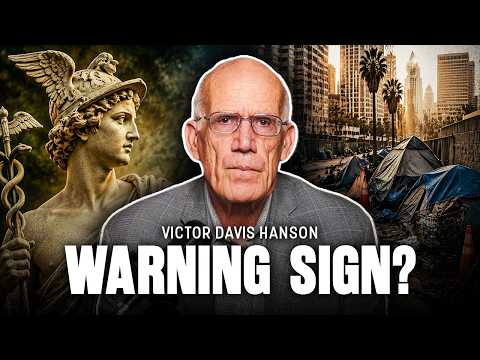
California Politics, Hermes, and the China Challenge | Victor Davis Hanson

Channel: Victor Davis Hanson Published: 2026-05-30 06:00
Victor Davis Hanson

Victor Davis Hanson uses the episode to connect California politics, immigration, DEI, and election administration to a broader critique of elite hypocrisy and institutional decay, then pivots to a history segment on Hermes and closes with a geopolitical take on Canada, China, Trump, and Biden-era optics. The video is part commentary, part lecture, with the market-relevant material centered on macro/political risk rather than tradable asset calls.

Watch on YouTube ›

Get the market thesis, key claims, assets, contradictions, and follow-up questions from any financial video — then unlock a version personalized to your portfolio, watchlist, and favorite speakers.

Detailed summary

This episode is not a market show in the narrow sense; it is a long-form political and historical commentary with a few recurring macro implications. Victor Davis Hanson’s core thesis in the opening political segment is that California’s governing class has created a system in which elite actors and subsidized constituencies are shielded from the consequences of their own policies, while working and middle classes absorb the damage. He uses the Los Angeles mayoral race, homelessness, public safety, ballot administration, and DEI as examples of a broader failure of accountability. …

🔒 The full detailed summary continues — read all of it free with an account. Read the full summary →

Main takeaways

  1. Hanson’s central political claim is that California’s governance model is failing because elite insulation and DEI-style identity protections suppress accountability.
  2. He believes the LA/California electorate is more dissatisfied than official narratives suggest, but social pressure and mail-in voting may obscure it.
  3. He argues Trump is increasingly using his opponents’ own institutional tactics back at them, especially around lawfare and restitution.
  4. His Canada/China discussion is broadly bullish on U.S. relative power and skeptical that China is as formidable as its image suggests.
  5. The Hermes segment is a pure history interlude and not part of the market thesis, though it shows the show’s structure.
  6. The Biden discussion is used to reinforce a broader claim that political leadership and media narratives can hide obvious incapacity.

Market read by horizon

Short term

Near term, the actionable read is political rather than price-based: Hanson thinks elite-driven policy failures in California and wavering Canadian alignment with the U.S. are live issues, while Trump-related legal and restitution fights remain a source of immediate volatility.

  • In the immediate setup, the video frames California as politically unstable, with homelessness, ballot rules, and local scandal as live flashpoints.
Show more
  • Hanson sees the Los Angeles mayoral race as potentially misleading because silent anti-incumbent voters may not tell pollsters how they really plan to vote.
  • He treats Trump’s restitution and legal maneuvers as a near-term continuation of the broader lawfare fight.
Mid term

Over the next few months, his base case is that U.S. relative strength stays intact, China’s weaknesses become harder to ignore, and California remains under pressure unless voters or policymakers force concrete reform. Confirmation would come from allied rearmament, better U.S.-Canada alignment, and continued evidence that China’s demographic/energy constraints matter.

  • Over the next several weeks to months, Hanson’s base case is that California remains a case study in policy failure unless voters force a course correction.
Show more
  • He expects continued public backlash around crime, homelessness, taxes, and ballot integrity, but thinks it may take a visible crisis to convert sentiment into action.
  • His geopolitical base case is that the U.S. stays comparatively advantaged versus China because of energy, demographics, and innovation, while China’s constraints become more visible over time.
Long term

The structural thesis is that open, innovative, energy-rich systems still outcompete over-regulated or authoritarian ones over time. Hanson sees the long-run regime as favoring the U.S. because demographic resilience, capital formation, and institutional flexibility should outlast the apparent strength of rivals.

  • Structurally, Hanson’s argument is that the U.S. still benefits from a more open, higher-productivity system than authoritarian or over-regulated rivals.
Show more
  • He sees China as a long-run competitor with demographic and institutional weaknesses that undermine its apparent scale advantages.
  • He treats California as a long-run warning about what happens when ideology displaces merit, accountability, and energy realism.
Unlock the full horizon read See the full short-term, mid-term, and long-term implications with confirmation and invalidation signals. Unlock horizon read

Key claims (8)

BEARISH elite governance and accountability California politics

California’s political elite are insulated from the consequences of the policies they impose on everyone else.

He explicitly argues wealthy neighborhoods and elites are protected while working-class residents absorb homelessness, crime, and public-service failures.

BEARISH institutional incentives DEI

DEI has become a mechanism that protects people from criticism and uneven enforcement, not just a hiring preference system.

He argues that identity-based status changes how wrongdoing is treated and how media report it.

BEARISH state policy failure California

Los Angeles and California are suffering from a broad governance failure across taxes, energy, schools, homelessness, and public assistance.

He lists multiple indicators of dysfunction and says the state has been ruined by policy choices.

Unlock 5 more claims See the full bullish, bearish, and counter-consensus argument map extracted from the transcript. Unlock all claims

Assets discussed (8)

Karen Bass
BEARISH other

Used as an example of California governance failure and hypocrisy around homelessness/public safety.

Nithya Raman
BEARISH other

Discussed as emblematic of elite hypocrisy over homeless encampments and public safety.

Unlock the full asset map (6 more) See all assets mentioned, their directional bias, and the exact reasoning. Unlock asset map

Speakers

SPEAKER Victor Davis Hanson HOST Bradley Develin HOST Sammy Winks

Interview (4 Q&A)

LA mayor race

Do you think subsidized immigrants and wealthy elites form the largest voting constituency, which is why Spencer Pratt could maybe lose the race?

The guest says Pratt is behind Karen Bass and running neck-and-neck with Ramon. His only chance is if conservatives vote for him and if liberal voters who privately hate the conditions in LA (human feces, crime, needles) vote for him covertly via mail-in ballots but never admit it publicly. A significant but unknown number of people who have been victimized by crime and decay might vote for him secretly.

Trump slush fund

Is there a slush fund created by Trump for January 6th defendants, and are left-wing states trying to tax it?

The guest says yes, people wrongly arrested or who served unduly long sentences from January 6th would be eligible, and people like Carter Page could also be eligible. He notes that left-wing governors in California, Illinois, and New York are saying they'd like to tax those funds at 100%.

taxation

What are your thoughts on California and other blue states taxing these Trump-related restitution funds at 100%?

The guest argues the fund is justified because Trump and January 6th defendants were treated unfairly, contrasting that with the lack of consequences for people involved in the 2020 unrest. He says the tax proposal feels like theft and frames the fund as restitution for politically motivated wrongdoing.

Unlock the full interview (1 more Q&A) Every question, answer summary, and YouTube timestamp. Unlock full Q&A

Where this transcript pushes against consensus

  • The transcript makes very broad claims linking crime, scandal, and immigration to DEI without presenting hard evidence for the causal chain.
  • Several factual assertions are asserted confidently but not sourced in the conversation, such as specific fraud totals, ballot counts, and polling implications.
  • The speaker’s discussion of California and immigration relies heavily on anecdote and ideological framing rather than comparative data.
  • The China analysis emphasizes weaknesses but underplays areas where China still has scale, industrial capacity, and policy coordination.
  • The Trump-lawfare section is highly rhetorical and blurs legal distinctions between different cases and protest episodes.

Topics

California politicsDEI and accountabilityLos Angeles mayoral racehomelessness and public safetyTrump lawfare and restitutionHermes and Greek mythologyCanada-US relationsChina demographic and strategic weaknessTrump foreign policyBiden health and media narratives

Create your free research agent

Unlock the full claims, asset map, scores, related transcripts, follow-up questions, and AI chat — shaped around your portfolio, watchlist, favorite speakers, and risks.

  • Full claims and asset map
  • Personalized relevance to your watchlist
  • Follow-up questions you can track
  • Related transcripts from your workspace
  • AI chat about this video
Create your free research agent
TRANSCRIPTAGENT.AI