TranscriptAgent
Try it free
TRANSCRIPTAGENT.AI · transcript analysis

Acid Suppression Pharmacology (PPIs, H2 Blockers, Antacids)

Channel: Dirty Medicine Published: 2026-04-25 06:00
Dirty Medicine

This is a pharmacology teaching video on acid-suppressing drugs: PPIs, H2 blockers, and antacids. The speaker emphasizes mechanisms, exam-style adverse effects, and drug interactions, with most of the weight on long-term PPI risks and cimetidine-specific H2-blocker side effects.

Watch on YouTube ›

Get the market thesis, key claims, assets, contradictions, and follow-up questions from any financial video — then unlock a version personalized to your portfolio, watchlist, and favorite speakers.

Detailed summary

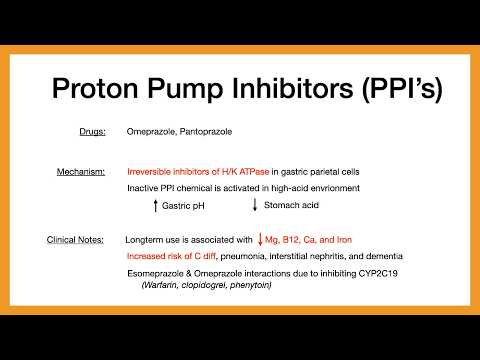
The speaker gives a focused review of acid-suppressive pharmacology, starting with proton pump inhibitors (PPIs). The core mechanism is that PPIs — the drugs ending in “-prazole” such as omeprazole and pantoprazole — irreversibly inhibit the H+/K+ ATPase in gastric parietal cells, raising gastric pH and improving GERD and peptic ulcer symptoms. The speaker adds a small pharmacology aside: PPIs are chemically inactive until they reach the acidic stomach environment, which is why they work selectively there. Most of the discussion then shifts to exam-relevant adverse effects and associations. The main high-yield point is that long-term PPI use is associated with micronutrient malabsorption, especially low magnesium, vitamin B12, calcium, and iron. …

🔒 The full detailed summary continues — read all of it free with an account. Read the full summary →

Main takeaways

  1. PPIs irreversibly block the gastric H+/K+ ATPase and are highly stomach-specific because they activate in acid.
  2. Long-term PPI use is linked to magnesium, B12, calcium, and iron malabsorption, with osteoporosis/fracture risk as a major exam association.
  3. Additional PPI associations mentioned include pneumonia, interstitial nephritis, dementia in the elderly, and C. diff.
  4. Cimetidine is the standout H2 blocker because of prolactin-related antiandrogenic effects and CNS/CYP2C19 issues.
  5. Antacids act quickly by neutralizing acid, but each has characteristic side effects and drug-interaction concerns.
  6. The whole video is framed as test-prep: recognize the initial GI presentation and then connect it to a delayed adverse effect or interaction.

Market read by horizon

Short term

No market setup is present; the transcript is a pharmacology lecture, so there is no actionable short-term trading read.

  • Immediate setup is purely educational: memorize the drug classes, mechanisms, and the highest-yield adverse effects.
Show more
  • For exam-style questions, the highest-probability traps are PPI malabsorption, cimetidine gynecomastia, and antacid-specific side effects.
  • If a question includes chronic GERD plus anemia, neuropathy, fractures, or low magnesium, the intended answer is likely a PPI complication.
Mid term

No medium-term market path can be inferred from this content; it does not discuss assets, positioning, or catalysts.

  • Over the next several weeks/months of study or review, the base case is to retain class-specific patterns rather than isolated facts: PPI malabsorption, H2 blocker antiandrogen effects, and antacid toxicities.
Show more
  • Questions are likely to test recognition across a chain: the symptom that leads to treatment, then the delayed adverse effect, then the correct drug class.
  • Confirmation comes from being able to distinguish omeprazole/esomeprazole CYP2C19 inhibition from cimetidine’s broader side-effect profile.
Long term

No structural market thesis is present. The video is educational medical content, not a macro or investment framework.

  • Structurally, the lesson is that acid suppression is a three-pathway system with different mechanisms, durations, and adverse-effect fingerprints.
Show more
  • The durable memory model is: PPIs are strongest and most specific, H2 blockers are mechanism-linked but weaker and cimetidine-heavy, and antacids are fast but interaction-prone.
  • The long-run implication for learners is to anchor drugs to mechanism plus signature toxicity, not to a generic 'acid reduction' bucket.
Unlock the full horizon read See the full short-term, mid-term, and long-term implications with confirmation and invalidation signals. Unlock horizon read

Key claims (11)

NEUTRAL pharmacology PPIs

PPIs end in '-prazole' and irreversibly inhibit the H+/K+ ATPase in gastric parietal cells, raising stomach pH and improving GERD or peptic ulcer disease.

This is the speaker's core mechanism-and-use summary for PPIs.

BEARISH adverse effects PPIs

Long-term PPI use is associated with micronutrient malabsorption, especially low magnesium, vitamin B12, calcium, and iron.

This is the main adverse-effect cluster emphasized as testable.

BEARISH bone health PPIs

Chronic PPI-related calcium and magnesium malabsorption increases the risk of osteoporosis and fractures.

The speaker explicitly links reduced absorption to bone risk.

Unlock 8 more claims See the full bullish, bearish, and counter-consensus argument map extracted from the transcript. Unlock all claims

Speakers

SPEAKER Unknown

Where this transcript pushes against consensus

  • The video asserts several associations as exam facts that are clinically debated or lower-specificity in real practice, especially dementia and pneumonia with PPIs.
  • Some statements are simplified for teaching, such as the blanket 'hypokalemia across all antacids' framing and the calcium-oxalate explanation.
  • The mechanism discussion is accurate at a high level but compresses several pharmacology steps into mnemonic-friendly claims.
  • The talk does not provide primary evidence or comparative risk magnitudes for most adverse effects, so the causal strength is left unquantified.

Topics

PPIsH2 blockersantacidsGERDpeptic ulcer diseasemicronutrient malabsorptionCYP2C19 interactionscimetidine side effectsmilk-alkali syndromedrug toxicities

Create your free research agent

Unlock the full claims, asset map, scores, related transcripts, follow-up questions, and AI chat — shaped around your portfolio, watchlist, favorite speakers, and risks.

  • Full claims and asset map
  • Personalized relevance to your watchlist
  • Follow-up questions you can track
  • Related transcripts from your workspace
  • AI chat about this video
Create your free research agent
TRANSCRIPTAGENT.AI