
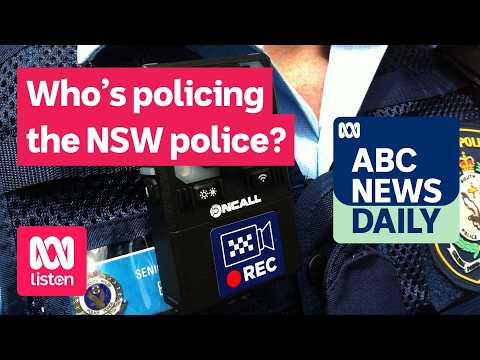
This is an ABC News Daily podcast segment about alleged misconduct inside the NSW Police Force and the weaknesses of the system meant to police police. Reporter Dylan Welch argues that NSW police misconduct is both widespread and under-enforced, with internal investigations often handled by police themselves and only a tiny fraction leading to charges.
Watch on YouTube ›Get the market thesis, key claims, assets, contradictions, and follow-up questions from any financial video — then unlock a version personalized to your portfolio, watchlist, and favorite speakers.
The episode centers on Dylan Welch’s Four Corners investigation into alleged police abuse and misconduct in New South Wales, with Sam Hawley guiding a discussion about accountability, body-worn cameras, and the watchdog system. Welch opens with a stark framing: NSW Police is now the national leader in legal payouts and one of the most complained-about agencies in the country, setting the tone for a critique of police oversight rather than a market thesis in the usual sense. Welch’s core claim is that the current accountability framework is too weak because police are still largely investigating police. He says Four Corners examined hundreds of public-record cases, but that many more complaints never become public because they do not get past internal police review. …
Near term, this is a reputational and political overhang for NSW Police rather than a tradable market setup; the immediate risk is escalation if the report triggers more complaints or ministerial scrutiny.
Over the next few months, the likely path is continued scrutiny of NSW police conduct, with reform pressure centered on mandatory body-cam use and stronger external oversight. The story only shifts if authorities publish clearer discipline outcomes or materially change the internal-investigation model.
The structural implication is that self-policing in law enforcement has persistent limits, and periodic external commissions may be needed to reset accountability. The transcript frames this as a durable governance problem, not a one-off scandal.
NSW Police paid out $40 million in legal payouts and court costs last financial year, making it the national leader in legal payouts.
Presented as the central statistical frame for the segment’s accountability critique.
Hundreds of public-record misconduct cases were reviewed, but many more complaints never become public because they are handled internally.
Welch explains that the visible record understates the scale of the issue.
Police investigating police creates objectivity problems, especially when senior officers review junior officers in the same station.
This is the episode’s central institutional criticism of the complaint process.
Last financial year, the New South Wales Police Force paid out 40 million dollars in legal payouts and court costs. What does that reflect about the force's current state?
The NSW Police are now the national leader in legal payouts. That same year there were 478 civil suits filed relating to NSW police misconduct, equivalent to two cases every working day. The force has also become the most complained about police agency over the last decade, with complaints rising about 70% over the last 5 years. Only about 2% of misconduct findings led to charges against an officer.
What happened in the Brad Kelson case that shows police misconduct?
Brad Kelson was unlawfully arrested in 2021 in Sydney after witnesses said they saw him push his partner. Police escalated the situation, with officer Mark Davis slamming Brad's face into a metal bench, throwing him into a police truck, and later kneeing him five times while he was pinned down. Brad ended up with 10 to 12 broken ribs and a punctured lung, spending four days in intensive care. The charges against him were thrown out, and a magistrate found evidence of collusion where officers copied each other's statements including an identical spelling mistake.
Can you briefly tell me about the Jodie Noach case?
Jodie Noach was a woman naked in the middle of a psychotic episode who was terribly assaulted by two young police officers in Emu Plains. The officers emptied both cans of pepper spray on her face repeatedly, sprayed her genitals, dragged her by her hair along the bitumen cutting up her back, kicked her in the head, and stomped on her. She later died of cancer 18 months after the incident. The two officers, Nathan Black and Timothy Trouch, pleaded guilty to common assault and were sentenced to jail.
Unlock the full claims, asset map, scores, related transcripts, follow-up questions, and AI chat — shaped around your portfolio, watchlist, favorite speakers, and risks.
