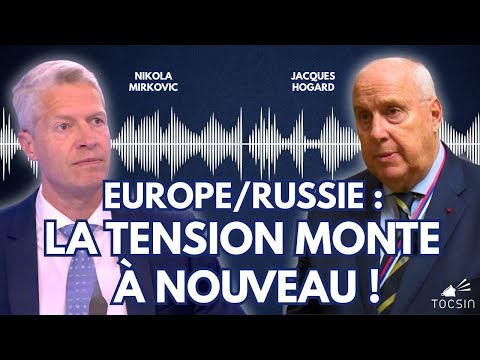
This is a long French morning-show transcript mixing lifestyle, health, domestic politics, and geopolitics. The most market-relevant segment is the NATO/Russia discussion: the speakers frame a recent drone incident in Romania as a possible escalation point, argue that the West is using propaganda to push confrontation, and describe the conflict as already effectively involving NATO through weapons, intelligence, and logistics support. The rest of the show is mostly non-market chatter, including a restaurant/gastronomy segment, an Alpha-Gal / Lyme / tick discussion, and a political rant about post-PSG disorder and censorship.
Watch on YouTube ›Get the market thesis, key claims, assets, contradictions, and follow-up questions from any financial video — then unlock a version personalized to your portfolio, watchlist, and favorite speakers.
The transcript is structured as a French morning show with several guests and recurring editorial monologues. The opening block features Alain Fontaine, who argues that French gastronomy is being threatened by fast-food expansion, rising restaurant costs, and the collapse of neighborhood cafés/bistros. He frames this as a sovereignty issue: traditional restaurants support agriculture, social life, and local community ties, while fast food represents a more uniform, lower-quality model. He also asks for state support through communication and even UNESCO recognition for French bistro culture. A second segment with Hélène Banoun centers on alpha-gal syndrome, tick-borne disease, Lyme disease, and the alleged connection between ticks and red-meat allergies. She presents the idea that tick proliferation is real, cites U.S. …
Near term, the Romania drone story is a headline-risk event that can trigger more NATO-Russia rhetoric and quick risk-on/risk-off swings in Europe. The main tactical danger is misattribution or overreaction before technical verification.
Over the next several weeks to months, the transcript’s base case is continued escalation in language and incident frequency, keeping European geopolitical risk elevated. The view would weaken if forensic findings or diplomacy clearly deflate the incident cycle.
Long term, the transcript argues that NATO is a durable U.S.-led power structure built around bases, finance, and alliance dependence, so strategic tension with Russia is not episodic but structural. If that framework holds, Europe stays exposed to recurring security shocks and limited strategic autonomy.
Fast food now represents a majority of French restaurant activity and threatens French gastronomic sovereignty.
Alain Fontaine argues that fast food has become dominant and is displacing traditional French dining culture.
Traditional restaurants face an unfair cost structure versus fast food, especially on labor charges.
He says restaurants bear 35-40% labor costs versus 20-25% in fast food.
The Romania drone incident could be a false-flag or a misattributed event used for propaganda escalation.
Hogar and Mirkovic repeatedly say technical proof is lacking and blame is being rushed.
Is the growth of fast food putting French gastronomy in danger?
He says yes: fast food now represents 52% of French restaurants, so it has become a major force. He argues this creates a dangerous uniformization of food choices and threatens food sovereignty and traditional French meals.
What could help traditional restaurateurs compete with fast food?
He says there is an unequal playing field: traditional restaurants carry much higher labor costs and must hire skilled staff, while fast-food chains rely on lower pay and precarious jobs. He believes public authorities should support traditional food through communication, like they do for road safety or anti-smoking campaigns.
Should the state do more than communicate and actually regulate fast food?
He clarifies that regulation already exists around fast food, but the main issue is how food is promoted. In his view, fast food marketing pushes power-purchase arguments while hiding unhealthy consequences such as obesity.
Unlock the full claims, asset map, scores, related transcripts, follow-up questions, and AI chat — shaped around your portfolio, watchlist, favorite speakers, and risks.