
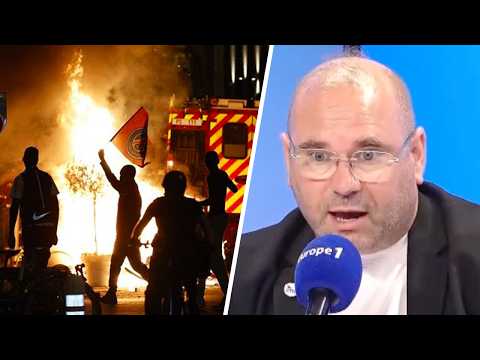
This is a special-edition radio debate about the violence that followed PSG’s Champions League win, with guests and callers arguing that the official language (“globalement sous contrôle”) understates what they describe as organized, widespread urban violence. The main throughline is that police did their job tactically, but the state failed politically: there were too many arrests, too many injured officers, too many cities affected, and too little follow-through from the justice system and the broader political class.
Watch on YouTube ›Get the market thesis, key claims, assets, contradictions, and follow-up questions from any financial video — then unlock a version personalized to your portfolio, watchlist, and favorite speakers.
The transcript is not a market video in the usual sense; it is a live current-affairs discussion on Europe 1 centered on post-PSG victory riots and the political framing of public order. The core thesis repeated by the speakers is that the violence was far more serious than the phrase “globalement sous contrôle” suggests, and that the state’s response is being managed through technocratic language rather than an honest political reckoning. Several speakers contrast Laurent Nunez’s restrained wording with Bruno Retailleau’s earlier “barbares” language, arguing that the newer formulation soft-pedals the scale of the disorder. The discussion leans heavily on counts and examples: 780 interpellations, 457 custody placements, 57 police/gendarme injuries, more than 70 cities touched, and pillaging in about a dozen or so cities. …
Immediate setup: the security and political narrative is overwhelmingly bearish on the state’s handling of public order, with fresh scrutiny likely if more footage, arrests, or injuries surface. Tactical debate now is less about the match and more about whether officials are underplaying the scale of disorder.
Over the next few weeks, the argument is likely to shift toward accountability, judicial follow-through, and whether tougher anti-riot measures are announced. The view would weaken only if courts and ministries can demonstrate visible deterrence and fewer repeat incidents at subsequent events.
Structurally, the transcript frames France as entering a more persistent public-order regime where mass celebrations, protests, and policing are repeatedly stress-tested. Its long-run implication is a deeper political conflict over whether the state can still guarantee order without exceptional measures.
The interior minister’s phrasing understates the severity of the violence compared with last year’s language.
Multiple speakers explicitly contrast “globalement sous contrôle” and “débordements” with last year’s “barbares.”
The unrest spread to 71 cities and was worse in aggregate than the previous year.
The speakers use city count and arrest/injury figures to argue the situation deteriorated and broadened.
Police can disperse and arrest people, but the justice system does not punish enough afterward.
This is presented as the key bottleneck between arrests and deterrence, with low conviction rates cited as evidence.
Est-ce que je me trompe quand je dis qu'on est passé du réel au pas de vague en comparant les déclarations du ministre de l'intérieur actuel à celles de Bruno Retailleau l'année dernière ?
Mathieu H approuve que le bilan de cette année est pire que l'année passée mais les mots du ministre sont moins forts que ceux de Retailleau. Il souligne que 71 villes ont été touchées cette année contre 56 agglomérations l'an passé, et parle de 'scène sauvage' et de 'scène syndisation de la France' — la diffusion des violences sur tout le territoire.
Axel Ronde, avez-vous été convaincu par votre patron, le premier flic de France (Laurent Nuñez), qui a qualifié la situation de globalement sous contrôle ?
Axel Ronde dit que la réalité du terrain était beaucoup plus chaotique et dure. Il mentionne des collègues blessés par des bombes artisanales, un collègue de la BAC 92N grièvement blessé aux jambes, et qualifie les agresseurs de 'horde de barbares'. Il rapporte qu'un jeune homme a été agressé au couteau par quatre individus, entre la vie et la mort.
Axel Ronde, est-ce que vous partagez l'avis de Laurent Nuñez et pensez-vous que la situation était globalement sous contrôle ?
Axel Ronde répond que tout dépend où on place le curseur, et que le problème est qu'on s'habitue de plus en plus à la violence. Il ironise en disant que oui, la situation était sous contrôle 'parce que la police nationale dire il y avait pas de kalachnikov hier'. Il trouve que le ministre a fait de la politique en présentant cela comme un match gagné par les forces de l'ordre, alors que ce match ne devrait pas avoir lieu.
Unlock the full claims, asset map, scores, related transcripts, follow-up questions, and AI chat — shaped around your portfolio, watchlist, favorite speakers, and risks.
