
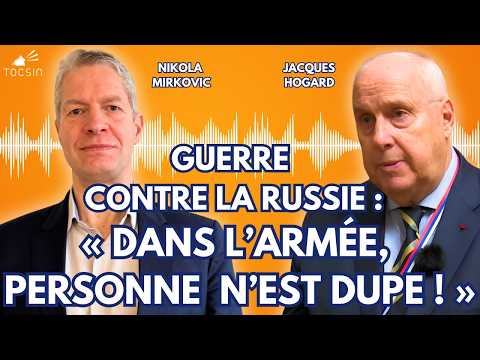
The video is a geopolitical panel about a Romanian drone incident near NATO territory and how it is being framed by Russia, Romania, the EU, and NATO. The guests argue that the episode is being immediately weaponized in a propaganda war, that attribution is still uncertain, and that Western officials are using it to intensify anti-Russian messaging and justify deeper NATO/EU involvement.
Watch on YouTube ›Get the market thesis, key claims, assets, contradictions, and follow-up questions from any financial video — then unlock a version personalized to your portfolio, watchlist, and favorite speakers.
This is a French-language geopolitical panel centered on a drone that crashed into a residential building in Romania, a NATO and EU member, and the political meaning of that incident. The host frames it as potentially the first time since the start of the Ukraine war that a drone hit a housing building on NATO territory, but also notes that attribution is disputed: Romania and NATO blame Russia, while Moscow denies responsibility and says the origin should be verified by a technical and independent investigation. The Romanian president is also said to have suggested the drone may have been deflected by Ukrainian air defenses before crossing into Romania. The guests, Jacques Hogard and Nicolas Mirkovic, both argue that the immediate rush to assign blame reflects a larger information war. …
Near term, the setup is headline-driven and fragile: if the Romanian drone attribution remains unresolved, the incident can still be used for diplomatic pressure, but a verified technical finding would likely cool the immediate escalation narrative. The immediate risk is political overreaction before facts are established.
Over the next few weeks, the most likely path in the panel’s view is continued rhetorical hardening around NATO-Russia tension, with Ukraine-related border incidents feeding more alliance politics. That view would weaken if Western capitals or NATO institutions visibly slow down attribution and avoid turning the event into a formal escalation.
Structurally, the transcript argues Europe is drifting into a durable proxy-war regime in which NATO and the EU preserve relevance through confrontation with Russia. The long-run implication, if this frame is right, is a more militarized European order with persistent information warfare and elevated tail risk of miscalculation.
The Romanian drone incident is still unresolved and should not yet be treated as settled Russian responsibility.
The host says attribution is disputed and notes conflicting claims from Romania/OTAN versus Moscow, plus a possible Ukrainian air-defense deflection.
The incident is part of a broader war of communication and propaganda, not just a military event.
Hogard argues each side tries to assign blame and manipulate narratives, including possible false-flag logic.
Western officials are using the incident to push escalation and justify larger war budgets.
Mirkovic says leaders will seize any pretext to justify budgets and confrontation with Russia.
Est-ce que vous faites la même analyse ce matin qu'au 31 octobre 2025 concernant les incursions de drones russes ?
Jean-Noël Barrot répond que cette transgression ultime est encore de l'ordre de l'échec de Vladimir Poutine pour masquer son échec. Il souligne que l'Ukraine reprend du terrain, gagne la guerre des drones, que la Russie perd 35000 hommes sur le front, et que le doute s'est installé à Moscou.
Y a-t-il un point de départ qui explique le nouveau dynamisme et la nouvelle volonté de l'Occident d'aller au front en Ukraine ?
Jacques Oogar répond que l'OTAN et l'UE jouent leur survie dans cette affaire, donc elles mettent le paquet. Il explique que si la victoire russe est consacrée en Ukraine, ce qu'il croit inéluctable à terme, l'OTAN utilise l'Ukraine comme proxy. Il soulève la question de savoir si l'OTAN a les moyens d'un affrontement direct avec la Russie et ses alliances (Corée du Nord, Chine, Iran), et évoque le risque nucléaire avec des dirigeants dont la sagesse peut être remise en cause.
Concrètement avec quelles armes l'Europe compte-t-elle exister militairement ?
Nicolas Mirkovic répond que le projet européen est un échec politique, social et économique. Selon lui, l'Europe cherche un bouc émissaire pour fédérer autour d'un ennemi commun et éviter de parler de ses problèmes réels. Il ajoute que l'Europe n'a pas les moyens militaires : ses armées ne parlent pas la même langue, n'ont pas de stratégie commune, dépendent des États-Unis et utilisent du matériel américain.
Unlock the full claims, asset map, scores, related transcripts, follow-up questions, and AI chat — shaped around your portfolio, watchlist, favorite speakers, and risks.
