TranscriptAgent
Try it free
TRANSCRIPTAGENT.AI · transcript analysis

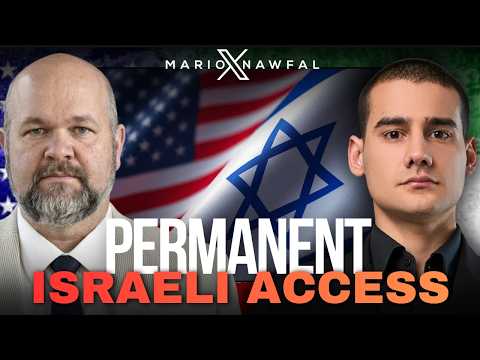
BREAKING: U.S. TO MERGE MILITARY WITH ISRAEL - w/ Political Analyst Robert Barnes

Channel: Mario Nawfal Published: 2026-05-31 16:10
Mario Nawfal

Robert Barnes argues the U.S.-Israel relationship is being locked into law in a way that could permanently entangle American military, intelligence, and technology systems with Israel’s interests. The conversation is framed around the Iran ceasefire/deal process, Trump’s political incentives, and a proposed defense bill provision Barnes says would institutionalize military integration and weaken U.S. control over sensitive tech and supply chains.

Watch on YouTube ›

Get the market thesis, key claims, assets, contradictions, and follow-up questions from any financial video — then unlock a version personalized to your portfolio, watchlist, and favorite speakers.

Detailed summary

The core thesis is blunt: Barnes says a pending defense-related provision would move the U.S.-Israel relationship far beyond ordinary aid into a legally entrenched military and technology integration that could compromise U.S. national security for decades. He describes the proposal as giving Israel access to classified material, weapons systems, and supply chains in a way that removes the need for case-by-case approvals and could let Israeli personnel sit inside development and planning processes. He frames this as an institutional lock-in rather than a temporary policy choice, and repeatedly warns that once such integration exists it will be very difficult to unwind. A large part of the discussion is also about Iran and the possibility of renewed conflict after a short war or ceasefire. …

🔒 The full detailed summary continues — read all of it free with an account. Read the full summary →

Main takeaways

  1. Barnes sees the proposed U.S.-Israel military integration as a structural national-security risk, not routine alliance management.
  2. He believes Trump can politically claim victory in Iran, but that renewed war would be a bad and unpopular choice.
  3. The Iran deal process is presented as fragile because Trump keeps changing terms late and undermining trust.
  4. Barnes argues Israel has a long history of exploiting U.S. access to secrets and technology.
  5. He thinks public backlash is rising fast enough to change the politics around Israel in Congress and presidential primaries.

Market read by horizon

Short term

Near term, the tactical risk is Trump or Congress overreaching and reigniting a deal crisis around Iran or the Israel integration bill. The setup is headline-sensitive, and any public backlash or legislative exposure could quickly alter positioning.

  • Immediate focus is the Iran ceasefire/deal and whether Trump follows through on de-escalation or reopens conflict.
Show more
  • Barnes says the key near-term risk is Trump adding new terms at the last minute and blowing up the deal again.
  • He thinks Iran will only respond to visible action, not rhetoric, after repeated mixed signals from Washington.
Mid term

Over the next few months, the base case in Barnes’s framing is more political whiplash: either the Iran de-escalation holds with repeated friction, or the administration’s bargaining style keeps generating fresh instability. The bill’s fate will show whether the Israel issue is becoming politically toxic enough to constrain Congress.

  • Over the next several weeks or months, Barnes expects the story to hinge on whether Congress actually locks in deeper military/tech integration with Israel or whether public backlash stops it.
Show more
  • He thinks Trump’s posture toward Iran will remain unstable: either he claims success and exits, or he overreaches and restarts tensions.
  • The broader political narrative may shift as more voters and legislators treat Israel as a high-salience issue rather than a niche foreign-policy topic.
Long term

Structurally, Barnes argues this is a regime story about whether U.S. national-security institutions remain sovereign or become increasingly intertwined with a foreign ally’s priorities. If public sentiment keeps shifting, the long-run implication is a more contested, less automatically pro-Israel Washington consensus.

  • Barnes’s structural thesis is that the U.S. has been drifting toward a captured national-security relationship in which Israeli interests are embedded inside American institutions.
Show more
  • He argues the long-run risk is loss of secrecy, loss of supply-chain control, and reduced U.S. autonomy over advanced military technology.
  • His historical framing says the pattern is durable: repeated espionage/scandal episodes suggest the problem is systemic rather than episodic.
Unlock the full horizon read See the full short-term, mid-term, and long-term implications with confirmation and invalidation signals. Unlock horizon read

Key claims (7)

MIXED U.S.-Iran conflict Iran

Trump believes he can resume military action against Iran, but Barnes thinks that would be politically irrational and broadly opposed.

Barnes contrasts Trump/Hegseth’s view with the CIA, Pentagon, and public sentiment.

MIXED U.S.-Iran conflict Iran

Trump can politically declare victory on Iran to his own base even if independent voters would view the war as lost.

Barnes separates MAGA acceptance from broader public acceptance.

MIXED Negotiation dynamics Iran

The post about lifting the blockade was part of a deal process, but Trump buried and then complicated it with too many extra conditions.

Barnes says the deal existed and Trump tried to redictate terms at the last minute.

Unlock 4 more claims See the full bullish, bearish, and counter-consensus argument map extracted from the transcript. Unlock all claims

Assets discussed (10)

Iran
BEARISH other

Discussed as the central geopolitical risk; possible renewed conflict would be negative for stability and risk assets.

U.S. military
NEUTRAL other

Core subject of the proposed legal integration and technology-sharing debate.

Unlock the full asset map (8 more) See all assets mentioned, their directional bias, and the exact reasoning. Unlock asset map

Speakers

HOST Mario Nawfal GUEST Robert Barnes

Interview (23 Q&A)

war resumption

Is resuming the war politically possible, or is that off the table?

He says it is not possible in most people’s minds, but Trump and Hegseth think it is still plausible as leverage. In Trump’s mind, they could do one more round, declare victory, and leave, though he thinks that would still be high-risk.

blockade post

Why do you think the blockade post signaled that a deal was close?

He says he already knew behind the scenes that a deal was available and understood the post as Trump telling his audience the blockade was being lifted. He adds that the Iranians wanted that public confirmation before finalizing the deal.

deal terms

Why did Trump add those extra terms and escalate the language in the post?

He thinks Trump keeps trying to redictate terms at the last minute, assuming Iran will capitulate. He frames it as classic dealmaker behavior that can poison the process and says Trump also self-sabotages by changing language based on how he wants to be perceived.

Unlock the full interview (20 more Q&A) Every question, answer summary, and YouTube timestamp. Unlock full Q&A

Where this transcript pushes against consensus

  • Barnes offers a strong accusation that Trump’s recent behavior reflects declining mental state, but he does not present medical evidence beyond interpretation of behavior and public posts.
  • He treats the proposed bill as effectively transforming Israel into a quasi-insider in U.S. military systems; the exact legal scope is not independently verified in the transcript.
  • His historical claims about Israeli espionage and technology theft are broad and occasionally presented as settled fact without sourcing during the conversation.
  • He suggests a major political realignment around Israel is already underway, but this is more inference than demonstrated evidence in the transcript.
  • Some claims about media, think tank, and donor networks are sweeping and may overstate uniform coordination.
  • The interview contains several emotionally charged assertions and analogies that are rhetorically strong but only partially substantiated on-air.

Topics

U.S.-Israel military integrationIran deal / ceasefireTrump decision-makingbehavioral dementia speculationJonathan Pollard / espionageIsraeli access to U.S. techThomas Massie / NDAAIsrael lobby influenceRonald Reagan vs Israel2028 presidential politics

Create your free research agent

Unlock the full claims, asset map, scores, related transcripts, follow-up questions, and AI chat — shaped around your portfolio, watchlist, favorite speakers, and risks.

  • Full claims and asset map
  • Personalized relevance to your watchlist
  • Follow-up questions you can track
  • Related transcripts from your workspace
  • AI chat about this video
Create your free research agent
TRANSCRIPTAGENT.AI