TranscriptAgent
Try it free
TRANSCRIPTAGENT.AI · transcript analysis

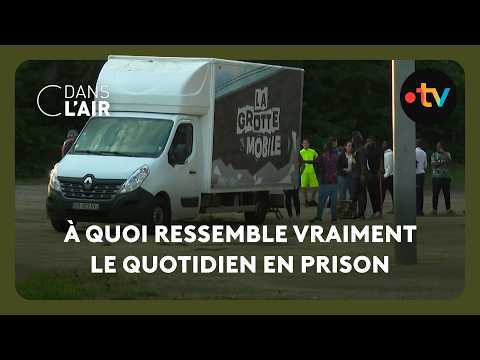
La Grotte Mobile

Channel: C dans l'air - France Télévisions Published: 2026-06-02 15:00
C dans l'air - France Télévisions

A French TV roundtable uses a mobile prison-cell exhibit to illustrate youth delinquency, prison reality, and the pull of social media and drug trafficking on very young minors. The discussion then widens into authority, family structure, integration, and whether France has the means—or the will—to respond.

Watch on YouTube ›

Get the market thesis, key claims, assets, contradictions, and follow-up questions from any financial video — then unlock a version personalized to your portfolio, watchlist, and favorite speakers.

Detailed summary

This segment is built around a report on A. Camara, a former inmate who tours France with a truck containing a replica prison cell to show teenagers what incarceration actually looks like. The report’s core message is simple and concrete: young people are often fed romanticized prison imagery on social media, while the real conditions are cramped, hot, and restrictive. Camara tries to counter that narrative by showing the cell, describing prison as 9 m2, and warning minors that criminal responsibility begins early enough to matter in practice. The video frames this as prevention work, not punishment: an attempt to interrupt trajectories toward violence and trafficking before they harden. The discussion then shifts to why very young people are vulnerable. …

🔒 The full detailed summary continues — read all of it free with an account. Read the full summary →

Main takeaways

  1. The report’s tactical intervention is symbolic but practical: show prison conditions directly to teenagers rather than rely on abstract warnings.
  2. The panel sees very early youth exposure to violent content and drug economies as a major risk factor.
  3. The discussion frames delinquency as a failure of authority in family, school, and society, not just a policing problem.
  4. One speaker argues that France has sufficient money but misallocates it away from prevention and social support.
  5. The panel treats French attitudes toward violence as historically and culturally distinctive, with riots and revolutionary imagery still shaping norms.

Market read by horizon

Short term

Tactically, the setup is about prevention and early intervention rather than any tradable catalyst; the immediate risk is that the same youth-violence cycle keeps reproducing faster than institutions can respond.

  • The immediate issue in the segment is prevention: the prison-truck tour is meant to interrupt misconceptions before they turn into behavior.
Show more
  • The most urgent tactical risk described is very young teens being pulled into trafficking roles and violent online content.
  • Police are presented as unable to absorb all the load; the near-term constraint is institutional overload rather than a lack of arrests.
Mid term

Over the next few months, the base case in the discussion is continued pressure on schools, families, associations, and police unless prevention is strengthened and young teens are pulled out of violent peer networks earlier.

  • Over the next several weeks or months, the key question is whether early interventions actually reduce recruitment into delinquency and trafficking.
Show more
  • The panel implies that any meaningful improvement would require stronger authority structures in families and schools, plus more preventive labor in neighborhoods.
  • If social media exposure and peer normalization of violence keep rising, the current trend of earlier delinquency likely persists.
Long term

Structurally, the segment argues France faces a durable authority and socialization problem: if institutions that transmit norms keep weakening, delinquency and violent normalization remain persistent features rather than episodic shocks.

  • Structurally, the segment argues that delinquency is tied to a broader regime of weakened authority and fragmented socialization.
Show more
  • The long-run thesis is that France’s relationship to violence is historically loaded, with revolutionary memory and riot culture still shaping how some groups interpret conflict.
  • A durable solution would likely require rebuilding institutions that transmit norms—family, school, community associations—rather than relying mainly on law enforcement.
Unlock the full horizon read See the full short-term, mid-term, and long-term implications with confirmation and invalidation signals. Unlock horizon read

Key claims (9)

NEUTRAL youth delinquency prevention prison-cell replica truck

A former detainee tours France with a prison-cell replica to show young people what incarceration really looks like.

Central premise of the report: prevention through realistic exposure to prison conditions.

BEARISH violence normalization social media

Social media creates a distorted image of prison that can make it seem attractive to teenagers.

The report explicitly contrasts real prison conditions with social-network portrayals.

NEUTRAL criminal responsibility French juvenile justice

A minor can be sent to prison from age 13, and many families do not know that.

The segment uses this as a preventive warning.

Unlock 6 more claims See the full bullish, bearish, and counter-consensus argument map extracted from the transcript. Unlock all claims

Speakers

HOST Christophe Roux GUEST A.Goutard GUEST H.El Karoui GUEST Pascal Perrineau SPEAKER A. Camara

Interview (2 Q&A)

réaction au reportage

Quelle est votre réaction face à ce reportage sur un ancien détenu qui présente la réalité de la prison aux jeunes?

P.Perrineau juge le reportage très intéressant, soulignant que la prison vient vers les jeunes pour leur montrer la réalité carcérale, face à des jeunes qui ont quitté le principe de réalité pour un monde virtuel. Il voit la tâche de cet ancien détenu comme de premier plan, cherchant à restructurer une jeunesse qui manque de cadre, de repères et d'autorité.

immigration et intégration

Hakim El Karoui, souhaitez-vous ajouter quelque chose?

H.El Karoui ajoute une réflexion sur les enfants de 3e ou 4e génération d'immigration. Il explique que l'intégration passe par une désintégration du lien entre enfants et parents, où les fils ne reconnaissent plus l'autorité des pères qu'ils perçoivent comme humiliés ou colonisés. Il critique le manque d'anticipation et de moyens humains dans les quartiers concernés, affirmant que la France fait les mauvais choix politiques.

Where this transcript pushes against consensus

  • The claim that France has 'plein d'argent' but chooses the wrong redistribution is asserted, not demonstrated with budget data.
  • The linkage between immigrant-background families and weakened authority is presented in a broad sociological way that risks overgeneralization.
  • The idea that exposure to violent content directly drives delinquency is plausible but not evidenced here with causal proof.
  • The suggestion that policing cannot do more may understate what targeted enforcement or local coordination could still achieve.

Topics

youth delinquencyprison conditionssocial media violencedrug traffickingauthorityfamily structureintegrationassociative fundingFrench riot culturepolicing limits

Create your free research agent

Unlock the full claims, asset map, scores, related transcripts, follow-up questions, and AI chat — shaped around your portfolio, watchlist, favorite speakers, and risks.

  • Full claims and asset map
  • Personalized relevance to your watchlist
  • Follow-up questions you can track
  • Related transcripts from your workspace
  • AI chat about this video
Create your free research agent
TRANSCRIPTAGENT.AI