
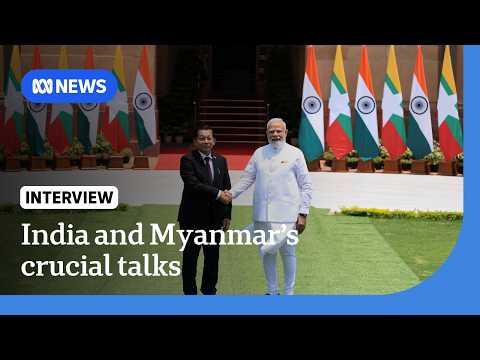
The video argues that Myanmar leader Min Aung Hlaing’s first overseas trip to India is mainly about legitimacy, balance, and border management rather than a real policy reset. India is engaging the junta to protect its own security and infrastructure interests while trying not to lose ground to China.
Watch on YouTube ›Get the market thesis, key claims, assets, contradictions, and follow-up questions from any financial video — then unlock a version personalized to your portfolio, watchlist, and favorite speakers.
This segment is a geopolitical interview centered on why Myanmar’s leader Min Aung Hlaing chose India for his first state visit since taking office. Thomas Keen of the International Crisis Group says the trip matters because it gives the Myanmar administration a visible stamp of recognition, but he frames it as a pragmatic sequencing choice rather than a sign of a major diplomatic pivot. In his telling, Min Aung Hlaing would have preferred China first, but likely used the India visit as an earlier opportunity and expects to visit China later in the month. Keen’s core thesis is that the Myanmar military government is seeking legitimacy and normalization after the controversial 2025–2026 elections, which he says most people inside Myanmar do not regard as credible. …
Tactically, the visit is a legitimacy-positive event for Myanmar’s junta and a mild signal that India will keep dealing with it despite criticism. The immediate risk is reputational: any stronger optics around normalizing the regime could draw pushback without changing the underlying security calculus.
Over the next few months, the likely path is continued India-Myanmar engagement focused on borders, trade, and containment of instability, with China still the main strategic reference point. The view changes if India meaningfully elevates democracy pressure or if border violence forces a sharper policy response.
Structurally, the region is settling into a system where Myanmar’s military needs outside recognition while India and China compete for influence around an internally fragmented borderland. That leaves the junta with room to maneuver externally even as its domestic legitimacy remains weak.
Myanmar’s first overseas trip under Min Aung Hlaing was to India, and China was likely his preferred first stop.
Keen says the choice of India first was probably driven by timing, with a later China visit expected.
The trip is meant to secure legitimacy and normalization for the Myanmar administration after controversial elections.
He explicitly says the regime wants international recognition and that the elections were widely rejected domestically.
India has already been engaging Myanmar’s military since the 2021 coup, so the visit is not a major policy shift for New Delhi.
Keen frames the meeting as continuity rather than a sharp break.
What was Minong Lang hoping to achieve in New Delhi?
He wanted legitimacy and normalization of ties. The trip also served as a stamp of recognition for his administration, and Myanmar hoped to boost economic ties with India.
Does India risk appearing to legitimize Myanmar's military regime by meeting with Minong Lang?
He said critics would certainly see it that way, and that the elections were not credible. But from India's perspective, it has engaged the military since the coup and wants to counter China's influence in Myanmar while maintaining its own regional interests.
Has border insecurity along the Myanmar-India frontier been a problem for India?
Yes. He said border management and stability have been major problems, especially since the coup, with increased non-state armed group activity and large stretches of the border outside Naypyidaw's control. India also has to engage these groups because it wants stability and connectivity projects in the region.
Unlock the full claims, asset map, scores, related transcripts, follow-up questions, and AI chat — shaped around your portfolio, watchlist, favorite speakers, and risks.
