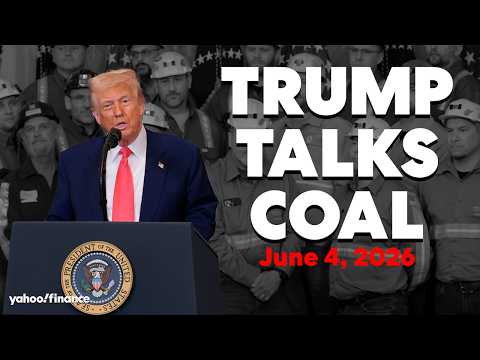
Trump used the Oval Office announcement to frame coal as a national-security and affordability issue, unveiling a roughly $700 million package aimed at keeping coal plants open, restarting some plants, protecting mines, and expanding exports. The event mixed policy details with broad attacks on wind, Democrats, and the Biden-era regulatory approach, while also folding in several unrelated Trump talking points.
Watch on YouTube ›Get the market thesis, key claims, assets, contradictions, and follow-up questions from any financial video — then unlock a version personalized to your portfolio, watchlist, and favorite speakers.
This transcript is an Oval Office announcement centered on coal policy, but it is also highly characteristic of a Trump press availability: the coal announcement is repeatedly interrupted by political messaging, media attacks, and side topics ranging from election rules to Iran, Ukraine, Cuba, automakers, and a possible Trump currency. The core thesis is that coal is not a sunset industry but a strategic pillar of U.S. energy, grid reliability, industrial competitiveness, and low electricity prices. Trump and his officials present the package as a major intervention: roughly $700 million of government funding, matched by about $1.7 billion of private investment, to keep plants open, extend plant lives, restart some facilities, and support coal exports and mine activity. Trump’s framing is aggressively pro-coal and anti-renewables. …
Near term, this is supportive for coal-linked names and utilities with exposed baseload assets, but the trade is headline-driven and vulnerable to execution or legal setbacks. The actionable focus is whether the announced funding, DPA actions, and permit flow translate into visible plant extensions or restarts.
Over the next few months, the base case is a selective policy-backed stabilization of coal rather than a broad secular revival. Confirmation would come from actual project execution, export progress, and persistent grid-reliability concerns; the view fades if policy steps stall or markets ignore coal because gas/nuclear meet demand.
Structurally, the transcript argues for a return to explicit firm-power and energy-security politics, with coal retained as a strategic reserve in the U.S. energy mix. Even if coal remains a shrinking fuel over time, the regime implication is that heavy industry, grid resilience, and national security may keep coal politically relevant far longer than climate orthodoxy assumes.
The administration is announcing a roughly $700 million coal support package that will protect 14 coal plants, 42 coal mines, add two new coal plants, and build a new export terminal.
This is the central factual claim of the announcement and sets the scale of the policy action.
The administration says it is invoking the Defense Production Act to save 13 coal plants across several states and extend their operating lives for decades.
A specific policy mechanism is described to keep plants running and justify long-lived coal capacity.
Trump argues coal is essential to lower electricity prices and says the package will save Americans $50 billion in electricity costs.
This is a major economic justification for the policy and ties coal to consumer affordability.
What do all these states that have coal plants being saved have in common?
Another speaker (Chris) answers that Trump won them, and Trump confirms he won every one of them by a lot.
What percentage of the coal miner vote did you get?
Another speaker responds 'Pretty pretty high' and Trump agrees, saying it's 'probably higher than any group in the country.'
Could you say a few words to the group?
Secretary Bergam thanks President Trump and summarizes the administration's coal achievements including energy emergency declaration, 76 coal mining permits approved, opening 13.1 million acres for leasing, designating metallurgical coal as a critical mineral, and the work of the National Energy Dominance Council.
Unlock the full claims, asset map, scores, related transcripts, follow-up questions, and AI chat — shaped around your portfolio, watchlist, favorite speakers, and risks.