
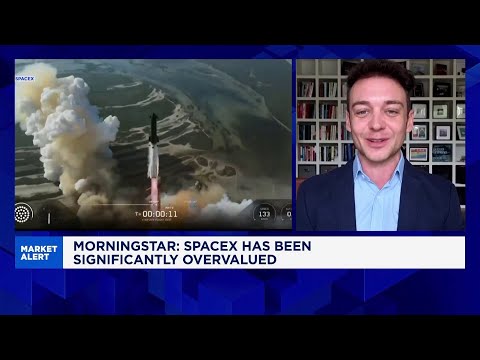
The segment argues that SpaceX’s proposed $1.8 trillion valuation is aggressive and likely unachievable under a conservative sum-of-the-parts framework, even if Starlink and launch can still grow very quickly. The guest says the IPO is being structured to maximize demand and a first-day pop through tight supply, heavy publicity, retail allocation, and possible index inclusion, while governance concerns around Elon Musk are being tolerated because investors want exposure to the story.
Watch on YouTube ›Get the market thesis, key claims, assets, contradictions, and follow-up questions from any financial video — then unlock a version personalized to your portfolio, watchlist, and favorite speakers.
This CNBC International Live segment centers on whether SpaceX’s reported $1.8 trillion valuation is justified and how the IPO is being positioned to succeed. The guest’s core view is cautious: for a company this large, with multiple business lines moving in different directions, valuation outcomes can vary widely, but his team is taking a more conservative stance and “can’t get anywhere near” the level the company is targeting. He still believes the company can grow massively, but not enough to support that headline valuation under his framework. A big part of the discussion is the proposed IPO structure. The guest says the listing has been engineered to maximize investor enthusiasm and likely support a pop: only about 4% of the free float is being offered, the IPO is being fast-tracked for Nasdaq treatment, and there is significant publicity around the deal. …
Near term, the trade is about IPO mechanics more than business fundamentals: tight float and index-related buying could support a pop, but the setup is vulnerable if demand is less one-sided than expected.
Over the next few months, the stock’s path will depend on whether Starlink and launch can substantiate the cash-flow story while AI and orbital-computing claims remain aspirational. A weak aftermarket would expose how much of the valuation was driven by scarcity and publicity rather than fundamentals.
Structurally, SpaceX is being valued as a layered option on launch, connectivity, and AI infrastructure rather than as a traditional aerospace company. The long-run question is whether those optionalities ever cash-flow at a scale that justifies the implied regime shift in how frontier tech is priced.
SpaceX’s valuation range is wide, but the guest’s team is far more conservative and cannot get close to the headline target.
He explicitly says they are taking a more conservative stance and cannot approach the company’s number.
Nasdaq is effectively trying to satisfy investors by enabling access to the IPO, while S&P’s refusal to change rules could leave index funds without exposure.
The guest frames Nasdaq as appeasing investors and contrasts it with S&P’s stricter stance.
The company’s AI addressable-market claim is huge but depends on untested orbital computing and is therefore highly uncertain.
He says the AI market number is huge but relies on completely untested assumptions.
What do you make of the different decisions by index providers Nasdaq and S&P regarding adjusting rules for the SpaceX IPO? Who has got it right?
Michael says it's subjective who got it right or wrong, but Nasdaq is appeasing investors and giving people what they want by providing access to this massive IPO.
Is the company's stated addressable market of $26.5 trillion for its AI offering a genuine growth narrative or just boosterism for the IPO?
Michael says the IPO doesn't need more pepping up given the hype, and while the $20 trillion AI number is impressive, it depends on completely untested orbital computing. He says it's possible but its realism is questionable.
Can Starlink continue to generate the sort of cash needed for SpaceX's very capital intensive ambitions?
Michael says yes, 80% of their valuation comes from Starlink and the launch business, which have tangible growth and cash flows. Additionally, with only 4% free float being offered in the IPO, SpaceX has plenty of dry powder to raise more capital later if needed.
Unlock the full claims, asset map, scores, related transcripts, follow-up questions, and AI chat — shaped around your portfolio, watchlist, favorite speakers, and risks.
