TranscriptAgent
Try it free
TRANSCRIPTAGENT.AI · transcript analysis

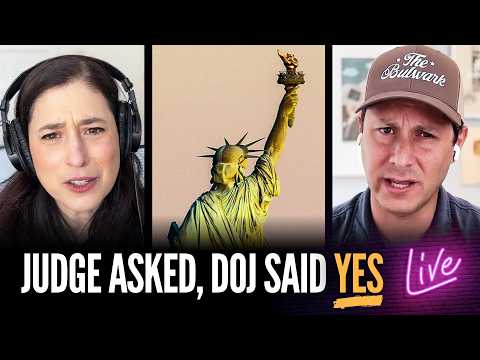
DOJ Just Argued They Could Bulldoze the Statue of Liberty | Receipts Live

Channel: The Bulwark Published: 2026-06-05 12:02
The Bulwark

Sam Stein and Katherine Repel use this episode of Receipts Live to tie together three themes: Republican Senate weakness on a Trump “weaponization fund,” a solid-but-not-hot jobs report, and a broader warning that the Trump administration is normalizing corruption and data manipulation. The segment ends with a surreal legal exchange in which the DOJ appears to concede the government could theoretically bulldoze the Statue of Liberty, which they treat as a symbolic expression of the administration’s anti-immigrant posture.

Watch on YouTube ›

Get the market thesis, key claims, assets, contradictions, and follow-up questions from any financial video — then unlock a version personalized to your portfolio, watchlist, and favorite speakers.

Detailed summary

This episode opens with Sam Stein introducing Katherine Repel and teeing up a set of political-economy topics: the Senate vote on ICE funding and the Trump “weaponization fund,” the May jobs report, the broader issue of “data deletion,” and finally a courtroom exchange about whether the government could bulldoze the Statue of Liberty. The conversation is structured as a rapid sequence of news-driven segments rather than a single sustained thesis, but the through-line is that the Trump administration is using power in ways that are corrosive to institutions, markets, and public trust. The first major segment is about Senate Republicans who said they would resist a Trump-related fund unless restrictions were added, but then failed to do so. …

🔒 The full detailed summary continues — read all of it free with an account. Read the full summary →

Main takeaways

  1. Republican resistance to Trump often collapses at the last moment, even after public red-line statements.
  2. The May jobs report was solid, but not strong enough to dispel inflation concerns or preserve hopes for quick Fed cuts.
  3. Repel frames corruption not just as bribery, but as a system where favors, punishments, and selective enforcement distort economic behavior.
  4. The administration’s data practices are a core concern: if the government stops counting people or problems, it becomes easier to politically erase them.
  5. The Statue of Liberty exchange is treated as an extreme but symbolically coherent expression of the administration’s immigration stance.

Market read by horizon

Short term

Near term, the stronger payroll print and still-sticky inflation backdrop keep the Fed leaning cautious, which is a headwind for risk assets and a support for higher-for-longer rate expectations.

  • The immediate market focus is the jobs report: a better-than-expected print reduces the case for near-term Fed easing and keeps rate-hike risk on the radar.
Show more
  • Equities may stay under pressure if traders continue to price in higher-for-longer rates after the stronger payroll and still-hot inflation backdrop.
  • The tariff-refund process remains a live business risk because companies may avoid filing suit against the administration due to fear of retaliation or audits.
Mid term

Over the next several weeks, the market will care less about one jobs beat and more about whether inflation stays firm enough to block cuts; if so, equities may need to reprice slower policy easing. The business backdrop also remains distorted by policy uncertainty, especially around tariffs and retaliation risk.

  • Over the next few weeks and months, the key question is whether labor-market strength holds while inflation stays sticky; if so, the Fed narrative shifts toward delayed cuts and possibly tighter policy.
Show more
  • If hiring broadens beyond healthcare but remains concentrated in temporary or cyclical sectors, the report may prove less durable than the headline suggests.
  • Repel’s base case is that corruption and selective enforcement will keep imposing hidden costs on firms, especially through compliance, legal strategy, and the need to manage political relationships.
Long term

The deeper regime risk is institutional: if rule of law, audits, and official data become politicized, capital allocation and competition become less efficient over time. That is a structural negative for growth quality and for confidence in U.S. market institutions.

  • The structural thesis is that rule-of-law erosion changes how the economy functions: firms spend more time on political positioning and less on productive investment.
Show more
  • If selective enforcement and favors become normalized, competitive outcomes may increasingly reflect proximity to power rather than efficiency or innovation.
  • The long-run risk is not just one bad policy but a regime in which official records, audits, and statistics become less trustworthy, weakening democratic accountability and market pricing.
Unlock the full horizon read See the full short-term, mid-term, and long-term implications with confirmation and invalidation signals. Unlock horizon read

Key claims (8)

BEARISH

Republican senators who vowed to restrict the fund ended up voting for the bill without getting those restrictions.

Stein and Repel frame the vote as a failure of stated resistance.

BEARISH

Tom Tillis publicly drew a red line on the weaponization fund but still folded.

The clip and commentary present Tillis as the clearest example of posturing without follow-through.

BEARISH

Corruption and selective enforcement are corrosive to the economy because they undermine trust in rule of law.

Repel explicitly connects corruption to long-run economic damage through incentive distortion and tax morale.

Unlock 5 more claims See the full bullish, bearish, and counter-consensus argument map extracted from the transcript. Unlock all claims

Assets discussed (10)

ICE funding bill
NEUTRAL other

A legislative funding package discussed for its political and corruption implications, not a tradeable asset.

Trump weaponization fund
BEARISH other

Described as a slush fund and a corruption vehicle that could distort incentives and policy.

Unlock the full asset map (8 more) See all assets mentioned, their directional bias, and the exact reasoning. Unlock asset map

Speakers

HOST Sam Stein GUEST Katherine Repel

Interview (9 Q&A)

vote-a-rama

Did you follow the vote-a-rama live, and what was your reaction to how it turned out?

She says she was not following it live, only catching up the next morning. She was not especially surprised by the outcome, though she acknowledged it was still worth discussing.

weaponization fund

Why do you think Republicans failed to codify restrictions on the weaponization fund?

She argues Republicans are simply too spineless or scared to take a real stand, even when they have already criticized Trump. She says Tom Tillis is a recurring example of someone who talks tough but eventually folds.

corruption

How does corruption like this affect the economy?

She says corruption is corrosive because it undermines trust in the rule of law and hurts fiscal outcomes. She points to tax morale, arguing that special treatment for Trump and others can make tax cheating more likely and distort business behavior more broadly.

Unlock the full interview (6 more Q&A) Every question, answer summary, and YouTube timestamp. Unlock full Q&A

Where this transcript pushes against consensus

  • Repel assumes the IRS immunity arrangement will operate as a broad de facto no-audit shield; that is plausible rhetorically but legally unclear from the transcript alone.
  • The discussion of a future rate hike is more speculative than the jobs report itself warrants; the Fed’s next move could still depend on subsequent inflation data.
  • The claim that Trump may be able to keep the weaponization fund alive despite officials saying it is dead is presented as likely, but the legal and procedural mechanics are not fully established.
  • The ocean-monitoring and data-deletion examples are compelling, but the transcript occasionally blends direct evidence with broader rhetorical extrapolation.
  • The DOJ concession on bulldozing the Statue of Liberty is treated as effectively real policy intent, though it may also reflect a narrow legal-answer context rather than an actual plan.

Topics

Trump corruption and weaponization fundSenate Republican weaknessMay jobs reportFed rates and inflationdata deletionimmigration and Social Security recordstariff refunds and litigationrule of law and economic distortionStatue of Liberty / immigration symbolismgovernment transparency

Create your free research agent

Unlock the full claims, asset map, scores, related transcripts, follow-up questions, and AI chat — shaped around your portfolio, watchlist, favorite speakers, and risks.

  • Full claims and asset map
  • Personalized relevance to your watchlist
  • Follow-up questions you can track
  • Related transcripts from your workspace
  • AI chat about this video
Create your free research agent
TRANSCRIPTAGENT.AI