TranscriptAgent
Try it free
TRANSCRIPTAGENT.AI · transcript analysis

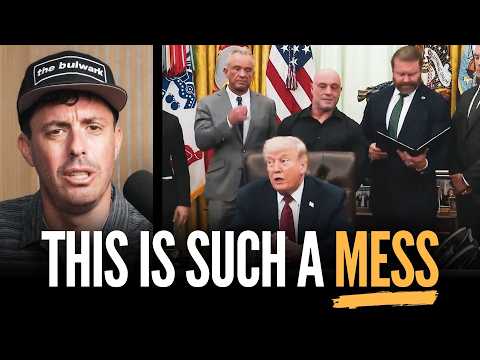
BREAKING: Strait of Hormuz is ALREADY Closed Again

Channel: The Bulwark Published: 2026-04-18 12:00
The Bulwark

Tim Miller says the Strait of Hormuz appears to have been closed again within hours of Trump portraying it as reopened, and he frames the episode as evidence that Trump’s diplomacy is improvisational, unreliable, and already undercut by Iranian hardliners and renewed attacks on ships.

Watch on YouTube ›

Get the market thesis, key claims, assets, contradictions, and follow-up questions from any financial video — then unlock a version personalized to your portfolio, watchlist, and favorite speakers.

Detailed summary

The video is a live reaction to breaking geopolitical headlines around the Strait of Hormuz. Tim Miller opens by saying the Strait is “closed again,” and that the situation has become a fast-moving “war on / war off” cycle. He argues the episode highlights several unstable elements: Trump’s statements are not reliable, Iran is not a trustworthy counterpart, and Israel’s strategic goals may diverge from the U.S. position. Miller then walks through reported developments from Iranian state media, Axios, the UK maritime authority, and oil-market analysts. He says Iranian sources framed the closure as a response to the U.S. blockade and to alleged U.S. “banditry and maritime piracy,” while U.S. and UK officials reportedly saw multiple attacks on commercial ships. …

🔒 The full detailed summary continues — read all of it free with an account. Read the full summary →

Main takeaways

  1. Miller’s core thesis is that the Strait of Hormuz situation reversed almost immediately after Trump portrayed it as resolved.
  2. He treats the reported ship attacks and turnaround orders as evidence that the Strait remains operationally contested.
  3. He argues Trump’s public diplomacy is performative and may actually weaken U.S. bargaining leverage.
  4. He sees Iranian decision-making as split between negotiators and harder-line security actors.
  5. He interprets the sanctions move on Russian oil as a possible sign of White House concern, not just routine policy.
  6. The video is more geopolitical commentary than market analysis, but the implied market risk is renewed oil/shipping disruption.

Market read by horizon

Short term

Near term, the setup is brittle: any confirmed attack or forced turnaround in Hormuz can quickly lift oil and shipping risk premium. Traders should treat public claims of de-escalation as untrustworthy until there is sustained, verified transit.

  • Immediate risk is further disruption in the Strait of Hormuz if attacks on commercial shipping continue.
Show more
  • Watch for any fresh Trump, U.S. Navy, UK MTO, or Iranian statements that clarify whether transit is actually open or controlled.
  • Oil and shipping markets are the tactical focus: Miller points to tanker turnarounds, Indian vessels hit, and repeated closure claims.
Mid term

Over the next few weeks, the key question is whether the Strait normalizes or remains intermittently contested. If the U.S. has to trade concessions for passage, the market may repeatedly price in and fade energy shocks rather than resolve them cleanly.

  • Over the next several weeks, Miller expects the market narrative to hinge on whether the Strait is truly reopened or remains intermittently restricted.
Show more
  • A durable de-escalation would require the U.S. and Iran to align on a real operating arrangement, not just public declarations.
  • If attacks continue, the administration may have to offer more sanctions relief or concessions to secure passage.
Long term

Structurally, the episode reinforces Hormuz as a persistent geopolitical chokepoint where perception and actual ship access can move markets. The lasting regime implication is a higher baseline of energy-supply fragility whenever U.S.-Iran conflict intensifies.

  • The structural implication is that the Strait of Hormuz remains a fragile chokepoint where political signaling, military force, and shipping logistics can collide.
Show more
  • Miller’s broader regime view is that performative diplomacy does not substitute for enforceable agreements in a conflict zone.
  • He suggests U.S. credibility is weakened when leaders announce outcomes before they are secured.
Unlock the full horizon read See the full short-term, mid-term, and long-term implications with confirmation and invalidation signals. Unlock horizon read

Key claims (8)

BEARISH energy supply shock Strait of Hormuz

The Strait of Hormuz is closed again as of Saturday morning.

He repeatedly says the top headline is that the Strait closed again and that reports show renewed control and attacks.

BEARISH U.S.-Iran diplomacy Donald Trump / Iran

Trump’s public declarations about Iran were ahead of the actual situation and did not match subsequent events.

He contrasts Trump’s claims that Iran agreed to keep the Strait open with reports of renewed closure and attacks.

BEARISH shipping disruption commercial shipping

At least three attacks on commercial ships occurred on Saturday, according to U.S. and UK sources cited by Axios.

He cites a US defense official, UK MTO, and Axios report saying at least three attacks happened.

Unlock 5 more claims See the full bullish, bearish, and counter-consensus argument map extracted from the transcript. Unlock all claims

Assets discussed (6)

Strait of Hormuz
BEARISH other

He says it is closed again and under attack, implying disrupted shipping and higher geopolitical risk.

Oil
BULLISH commodity

A closure or attack risk in Hormuz typically supports crude prices and risk premium.

Unlock the full asset map (4 more) See all assets mentioned, their directional bias, and the exact reasoning. Unlock asset map

Speakers

SPEAKER Tim Miller

Where this transcript pushes against consensus

  • The speaker treats Trump’s statements as plainly false, but some claims may reflect rapidly changing negotiations rather than deliberate deception alone.
  • He assumes the Strait is effectively closed based on early reports; the transcript does not fully verify the operational status beyond cited news and social posts.
  • The suggestion that the Russian oil sanctions extension signals hidden concern is plausible but not demonstrated.
  • His internal-Iran power-struggle explanation is explicitly described as scuttlebutt and remains speculative.
  • He strongly characterizes Trump’s motives and competence, which is more editorializing than evidenced analysis.

Topics

Strait of HormuzIran-U.S. tensionsshipping disruptionoil market riskTrump diplomacyIsrael-Iran conflictsanctions policyIranian internal politics

Create your free research agent

Unlock the full claims, asset map, scores, related transcripts, follow-up questions, and AI chat — shaped around your portfolio, watchlist, favorite speakers, and risks.

  • Full claims and asset map
  • Personalized relevance to your watchlist
  • Follow-up questions you can track
  • Related transcripts from your workspace
  • AI chat about this video
Create your free research agent
TRANSCRIPTAGENT.AI