TranscriptAgent
Try it free
TRANSCRIPTAGENT.AI · transcript analysis

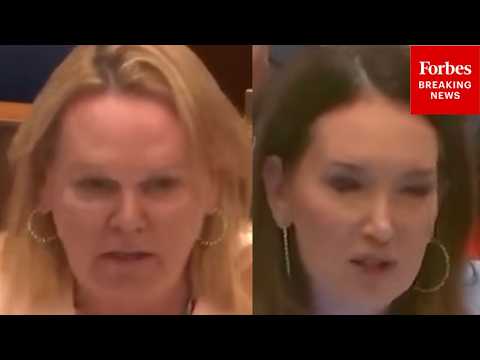
'They Are Really Suffering': McClain Delaney Presses Rollins For Aid To Maryland Farmers

Channel: Forbes Breaking News Published: 2026-06-06 21:00
Forbes Breaking News

This is a short congressional exchange focused on Maryland farm relief and USDA research facilities. Rep. April McClain Delaney argues that Maryland farmers are under severe stress from tariffs, workforce issues, USDA cuts, and weather-related losses, and presses Secretary Rollins for a disaster designation and support for local agricultural research infrastructure.

Watch on YouTube ›

Get the market thesis, key claims, assets, contradictions, and follow-up questions from any financial video — then unlock a version personalized to your portfolio, watchlist, and favorite speakers.

Detailed summary

Rep. April McClain Delaney uses her five minutes to make a strongly local, farm-focused case for federal relief. She says she represents Maryland’s 6th District, is the daughter of a potato farmer, and is in constant contact with the state’s five farm bureaus. Her core argument is that Maryland agriculture is being squeezed from multiple directions: farm bankruptcies are up, tariffs and farm input costs are destabilizing markets, immigration-related workforce issues are constraining labor, and USDA cuts are adding pressure. She frames the problem as both economic and public-interest driven, arguing that aid should not depend on party or zip code. A major part of her comments is a push for disaster assistance. …

🔒 The full detailed summary continues — read all of it free with an account. Read the full summary →

Main takeaways

  1. Maryland’s farm sector is described as being under pressure from tariffs, labor issues, USDA cuts, and weather losses.
  2. Delaney is pushing for a Maryland disaster designation and equitable FEMA/USDA treatment versus other states.
  3. She warns that USDA relocations can trigger large staff losses and weaken long-running research capabilities.
  4. The speaker ties farm policy to local economic viability, public interest, and fairness across states.
  5. The exchange is more about federal agriculture policy than about financial markets or investable assets.

Market read by horizon

Short term

Tactically, the setup is about whether Maryland gets disaster relief and whether USDA avoids further disruption to local research teams. The immediate risk is continued policy delay, not a tradable market catalyst.

  • Immediate focus is whether Maryland gets the requested secretarial disaster designation.
Show more
  • The practical near-term catalyst is the administration’s response to flood and crop-loss relief requests.
  • USDA staffing and facility decisions could spark local backlash if research teams are moved or disrupted.
Mid term

Over the next few months, the key path is whether federal aid and USDA staffing decisions stabilize Maryland agriculture or deepen stress. A more constructive read would require actual disaster designation and evidence that research capacity is being preserved.

  • Over the next several weeks or months, the key question is whether federal relief narrows the gap between Maryland and other states receiving assistance.
Show more
  • If disaster aid is approved, the pressure narrative may shift from emergency survival to rebuilding and stabilization.
  • If USDA proceeds with relocations, staffing attrition could become a bigger issue and weaken research output.
Long term

Structurally, the transcript points to a durable tension between centralizing USDA operations and preserving regional agricultural knowledge. The lasting issue is whether policy can support farm resilience without eroding the research infrastructure that underpins it.

  • Structurally, the transcript argues for preserving agricultural research capacity close to production regions.
Show more
  • It also frames agricultural policy as a fairness-and-resilience issue, not just a partisan one.
  • A lasting implication is that recurring staff loss at research institutions can erode institutional knowledge and competitiveness.
Unlock the full horizon read See the full short-term, mid-term, and long-term implications with confirmation and invalidation signals. Unlock horizon read

Key claims (6)

BEARISH farm policy stress Maryland agriculture

Maryland farmers are being squeezed by tariffs, labor issues, and USDA cuts.

She directly identifies the main sources of farm stress.

BULLISH disaster aid Maryland farmers

Maryland should receive disaster relief because it met the thresholds and deserves treatment similar to other states.

She argues the state qualifies for FEMA/secretarial assistance and should not be treated differently based on politics.

BEARISH agricultural research capacity USDA research facilities

Relocating USDA research without preserving staff risks losing decades of knowledge and hurting farmers.

She warns that moving labs can replicate prior staff attrition and undermine research continuity.

Unlock 3 more claims See the full bullish, bearish, and counter-consensus argument map extracted from the transcript. Unlock all claims

Assets discussed (4)

USDA
NEUTRAL other

Mentioned as the agency controlling farm support, disaster designations, and research facilities; policy relevance rather than tradable asset.

FEMA
NEUTRAL other

Referenced in the context of disaster aid denial and allocation.

Unlock the full asset map (2 more) See all assets mentioned, their directional bias, and the exact reasoning. Unlock asset map

Speakers

GUEST Rollins SPEAKER April McClain Delaney

Interview (2 Q&A)

disaster relief

Can you commit to offering the same disaster relief for Maryland's farmers that you just granted Pennsylvania, and ensure that politics do not impact the economic viability or safety of our farmers?

The Secretary agreed fully, saying 'Of course, 100%' and committed to following up.

USDA research relocation

Is there a way to keep current research facilities in Maryland with experienced staff while also setting up other labs across the country, so as not to lose decades of research and institutional knowledge?

The Secretary acknowledged this is a much longer conversation they've been analyzing from every angle, and welcomed the opportunity to sit down and meet the USDA career staff who have given decades of service.

Where this transcript pushes against consensus

  • The speaker asserts tariffs and USDA cuts are materially driving bankruptcies, but provides no direct data linkage beyond broad claims.
  • The comparison between Maryland being denied aid and West Virginia receiving it is emotionally powerful, but the transcript does not establish full situational equivalence.
  • Concerns about relocations causing large staff exits are plausible, but the transcript relies on prior examples and fears rather than current verified attrition figures.
  • The discussion stays at the level of advocacy; no concrete criteria or timeline are given for relief decisions.

Topics

Maryland farm reliefUSDA disaster designationtariffs and farm inputsfarm labor issuesFEMA aid fairnessagricultural research facilitiesBARCUSDA staffing retentioncrop lossesstate-level agricultural policy

Create your free research agent

Unlock the full claims, asset map, scores, related transcripts, follow-up questions, and AI chat — shaped around your portfolio, watchlist, favorite speakers, and risks.

  • Full claims and asset map
  • Personalized relevance to your watchlist
  • Follow-up questions you can track
  • Related transcripts from your workspace
  • AI chat about this video
Create your free research agent
TRANSCRIPTAGENT.AI