
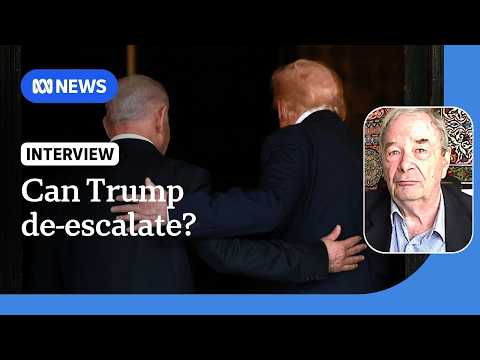
ABC News Australia interviewed Arab and Islamic studies expert Bob Baler about escalating Israel-Iran strikes and what they mean for Trump. Baler’s core view is that Trump wants an early deal with Iran, sees no viable military solution, and is trying to keep the conflict contained because a prolonged war would create political and energy-market damage in the US.
Watch on YouTube ›Get the market thesis, key claims, assets, contradictions, and follow-up questions from any financial video — then unlock a version personalized to your portfolio, watchlist, and favorite speakers.
The segment is a geopolitical interview framed around live reports of Iranian and Israeli strikes and the risk of escalation. Bob Baler argues that the key issue is not whether Israel can keep striking, but whether those strikes are the beginning of a wider regional escalation or simply a minimum response for Netanyahu to satisfy domestic politics. He repeatedly stresses uncertainty because the reporting was still coming from Iranian media and the exact targets were unclear. Baler’s central thesis is that Trump’s real objective is a deal with Iran, not a military confrontation. He says Trump likely did not consult in advance on Israel’s actions, and that Trump had already signaled to Netanyahu not to retaliate. …
Tactically, the setup is an escalation-watch trade: any sign of Iranian retaliation against US assets or of US military backing for Israel would raise near-term risk fast. The base assumption in the clip is that Trump will try to prevent a broader move higher in conflict intensity.
Over the next few weeks, the likely path is pressure toward containment and a negotiated exit if markets and politics tighten. That view weakens if Israel sustains the offensive without US resistance or if Iran chooses a more forceful retaliation cycle.
Structurally, the transcript argues for a regime where US policy is constrained by the lack of a clean military solution and by domestic energy/political costs. That implies diplomacy, not force, remains the durable lever in the Iran file.
It is not yet clear whether the Israeli strikes are the start of a wider escalation or just a limited response for domestic political purposes.
Baler says the strikes could be either escalation or minimum retaliation and that the exact targets are still unclear.
Trump’s priority is a deal with Iran, and he likely did not want Israel’s retaliation to jeopardize that.
He says Trump has made his priority clear and hoped his advice to Netanyahu not to retaliate would be absorbed.
Israel cannot sustain an enduring bombing campaign against Iran without American support and active support at that.
Baler argues Israel lacks the capacity to mount a strategic campaign alone.
Do you expect that the United States would have been consulted about Israel's strikes on Iran?
No, Bob says Trump has made clear his priority is a deal with Iran. The Iranian attacks on Israel were quite limited and caused no significant damage, and Trump was hoping Netanyahu would absorb his advice not to retaliate so a deal would still be salvageable.
How difficult is this all becoming for President Trump, who wants a peace deal with Iran?
Trump can still deny Israel the facilities it would need to escalate against Iran. Israel cannot mount an enduring bombing campaign with strategic impact without active American support. The Americans realize there is no military solution and the Israel-Iran interaction is a sideshow to removing themselves from an unwinnable conflict with least political damage.
What are the domestic political pressures playing into Trump's decision-making on the war?
Trump is becoming more attuned to the risks of the war dragging on, with a major energy crunch likely in 3-4 weeks coinciding with Fourth of July and the World Cup. He needs to be seen in control, which is hard if gas prices rise and employment tanks. He's looking for a way out despite hawkish Israel supporters. Netanyahu must choose whether to face an election having defied Trump or having complied with US strategic interests.
Unlock the full claims, asset map, scores, related transcripts, follow-up questions, and AI chat — shaped around your portfolio, watchlist, favorite speakers, and risks.
