
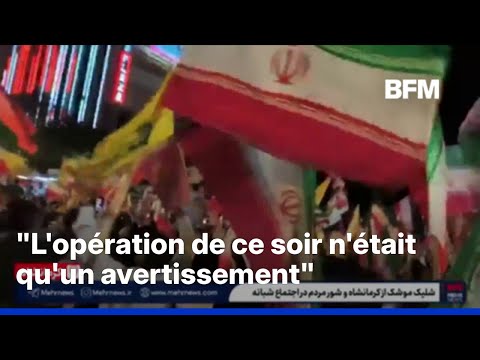
BFMTV frames the evening as a fresh escalation between Iran and Israel after Iranian ballistic missiles were launched toward northern Israel, following Israeli strikes on Beirut’s southern suburbs. The panel agrees the immediate risk is an Israeli retaliation, but the deeper story is the breakdown of U.S.-Iran negotiations and the widening linkage between the Lebanon front, Hezbollah, and Iran’s own deterrence posture.
Watch on YouTube ›Get the market thesis, key claims, assets, contradictions, and follow-up questions from any financial video — then unlock a version personalized to your portfolio, watchlist, and favorite speakers.
The broadcast is built around a single urgent breaking-news thesis: Iran’s missile fire toward Israel is both a warning and a tactical escalation, but it is also part of a wider strategic contest involving Israel, Hezbollah, and the United States. The live field report from Tel Aviv says the Israeli army counted three waves of missiles from Iran, with the first two intercepted and no injuries reported at that time, while the third wave was still being assessed. The same reporter says schools across Israel will close the next morning, and Israeli political figures are already signaling a response within hours or days. On the Israeli side, the rhetoric is maximalist, with Itamar Ben Gvir quoted as saying “Téhéran doit brûler cette nuit.” The guests then interpret the exchange as a deliberate widening of the conflict, not just a single retaliation cycle. …
Immediate setup is binary: if Israel retaliates strongly, the escalation likely widens fast; if Trump successfully presses Netanyahu to hold back, the market gets a brief de-escalation window. Near-term risk is that missile exchanges and counterstrikes outrun diplomacy.
Over the next several weeks, the base case is continued pressure and intermittent retaliation unless the U.S. can restart talks and separate the Lebanon and Iran tracks. Confirmation would be a cooling of Israeli response rhetoric and a revived negotiation channel; failure would mean a broader regional exchange.
Structurally, the segment suggests a shift from proxy containment toward direct Iran-Israel confrontation, with Hezbollah’s ‘depth’ strategy under stress. If that regime change persists, regional security will be organized less around buffers and more around direct deterrence between states.
Iran launched three waves of missiles toward northern Israel, with the first two intercepted and no injuries reported at that point.
Directly reported from the live Tel Aviv update.
Israel will likely retaliate in the coming hours or days, and officials are already saying a strong response is being prepared.
Stated by the host and correspondent with reference to Israeli officials and CNN reporting.
The Israeli strike on Beirut’s southern suburbs was the trigger that activated Iran’s stated red line.
The speakers repeatedly connect Iran’s retaliation to the Beirut strike.
Quelle est la situation précisément à Tel Aviv après ces tirs iraniens?
L'armée israélienne fait état de trois salves de missiles iraniens tirés vers le nord du pays. Sur les deux premières salves, tous les missiles ont été interceptés et il n'y a pas eu de blessés. Le bilan de la troisième salve n'est pas encore connu. Les écoles fermeront demain matin dans tout Israël.
Est-ce que c'est l'Iran qui redéclenche la guerre ce soir ou Israël qui avait déjà préparé le terrain?
Netanyahou fait son meilleur pour faire dérailler les négociations entre les États-Unis et les Gardiens de la Révolution en Iran. Les Gardiens de la Révolution agressent Israël tous les jours alors qu'ils savent pertinemment qu'ils n'ont pas les moyens de les mettre en difficulté. C'est un jeu cynique entre Netanyahou qui sait qu'en agissant trop puissamment contre le Liban il risque de redéclencher les hostilités, et l'Iran qui agite le Hezbollah au quotidien.
Est-ce que ces représailles sont un avertissement de la part des Gardiens de la Révolution?
L'Iran veut démontrer qu'il a des moyens à sa disposition pour frapper Israël et que le dôme de fer n'est pas 100% efficace contre les missiles balistiques. L'Iran n'a pas nécessairement envie de conclure un accord de paix et fait durer le jeu, étant une sorte d'allié objectif de Netanyahou. Israël essaye de montrer à sa population et à Trump qu'il faut aller plus loin dans l'opération contre l'Iran.
Unlock the full claims, asset map, scores, related transcripts, follow-up questions, and AI chat — shaped around your portfolio, watchlist, favorite speakers, and risks.
