TranscriptAgent
Try it free
TRANSCRIPTAGENT.AI · transcript analysis

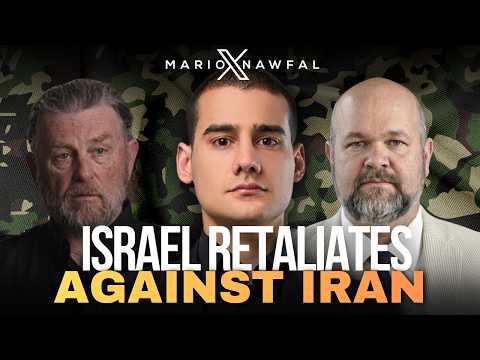
đź”´ BREAKING: ISRAEL BEGINS RETALIATION STRIKES AGAINST IRAN - w/ Fmr. CIA Larry Johnson & Others...

Channel: Mario Nawfal Published: 2026-06-08 00:24
Mario Nawfal

A live breaking-news panel on Israel’s strikes against Iran, the Iranian counterstrike, and whether the spiral will widen into a regional war. The speakers broadly agree that retaliation was likely and that the key tactical question is whether the next phase stays bilateral or drags in the U.S. and Gulf states.

Watch on YouTube ›

Get the market thesis, key claims, assets, contradictions, and follow-up questions from any financial video — then unlock a version personalized to your portfolio, watchlist, and favorite speakers.

Detailed summary

This is a long live panel centered on the immediate military and diplomatic fallout from Israel’s retaliation strikes against Iran and Iran’s subsequent response. The core thesis repeated throughout is that Israel’s strike was a deliberate deterrence move, Iran was compelled to answer to preserve credibility, and the real risk lies in whether either side expands the fight beyond a controlled tit-for-tat. The speakers frame the conflict as a series of signaling moves: Israel wants to prove it can still hit Iran despite U.S. public caution, while Iran wants to prove it can retaliate without being boxed in. A recurring line is that “the balls in Israel’s court,” but the panel also repeatedly warns that the U.S. …

🔒 The full detailed summary continues — read all of it free with an account. Read the full summary →

Main takeaways

  1. Israel’s strike was framed as deterrence and signal-setting, not a full-scale opening blow.
  2. Iran was expected to answer, and the panel treats retaliation as necessary for credibility.
  3. The Houthis’ entry is interpreted as solidarity and as pressure on the wider regional system.
  4. The U.S. publicly wants to stay out, but any American casualties would change the calculus fast.
  5. Oil, shipping lanes, air defenses, and refueling capacity are the tactical choke points the panel watches.
  6. Trump is portrayed as wanting a deal and trying to avoid being pulled into Netanyahu’s decision-making.
  7. The speakers are skeptical of all early reports and repeatedly warn against overconfidence in the live feed.

Market read by horizon

Short term

Near term, this is an event-risk tape: if the retaliation stays contained, markets may quickly price de-escalation; if energy assets or U.S. personnel are hit, the setup turns sharply risk-off. The immediate danger is another missile exchange before any diplomatic off-ramp can be re-established.

  • Watch whether Iran’s next launches stay small and symbolic or widen into heavier salvos.
Show more
  • Monitor whether Israel responds again within hours or pauses to consult Washington.
  • Track any confirmed damage to energy infrastructure; that would sharply raise escalation risk.
Mid term

Over the next few weeks, the base case is a tit-for-tat cycle that either settles into a brittle ceasefire or expands if one side hits energy infrastructure or Gulf targets. The key validation signal is whether both sides can claim they answered without crossing the U.S. casualty threshold; if not, escalation broadens.

  • If the exchange remains bilateral, the base case is a few days of tit-for-tat followed by an attempted reset.
Show more
  • A durable ceasefire would likely require Israel to stop striking Lebanon and for the U.S. to keep pressure on Netanyahu.
  • Iran’s willingness to keep the conflict inside a controlled response framework is a key confirmation signal.
Long term

Structurally, the transcript argues for a Middle East regime where deterrence is increasingly missile- and proxy-based, with the U.S. less able or willing to act as a clean guarantor. That implies persistent tail risk for oil, shipping, and regional alliances even if the current flare-up fades.

  • The transcript implies a shifting regional order where deterrence is increasingly exercised through proxies, missiles, and standoff strikes.
Show more
  • Iran’s posture is described as more confident and networked than in prior cycles, with Russia/China support implicitly strengthening it.
  • The U.S. is portrayed as structurally constrained by oil dependence, debt, and munitions stockpiles, limiting its appetite for prolonged regional war.
Unlock the full horizon read See the full short-term, mid-term, and long-term implications with confirmation and invalidation signals. Unlock horizon read

Key claims (10)

BEARISH Israel-Iran conflict Israel

Israel retaliated against Iran despite Trump publicly asking Netanyahu not to do it immediately.

Repeatedly stated by speakers using Axios/other reports and their own reading of the timing.

MIXED U.S.-Israel relations Israel

The Israeli attack was likely coordinated at least in part with U.S. awareness, even if not fully approved.

Guests infer U.S. awareness from the scale, timing, and logistics of the strike.

NEUTRAL air defense / standoff strike Israel

Israel used standoff weapons from outside Iranian airspace to reduce risk from Iranian air defenses.

The panel explicitly notes cruise missiles and air-launched ballistic missiles fired from outside the airspace.

Unlock 7 more claims See the full bullish, bearish, and counter-consensus argument map extracted from the transcript. Unlock all claims

Assets discussed (10)

Iran
BEARISH other

Discussed as the target of Israeli strikes and as likely to retaliate; repeated focus on its military posture and regional leverage.

Israel
MIXED other

Presented as both the attacker and a state trying to preserve deterrence and avoid appearing weak.

Unlock the full asset map (8 more) See all assets mentioned, their directional bias, and the exact reasoning. Unlock asset map

Speakers

HOST Mario Nawfal GUEST Robert Barnes GUEST Larry Johnson GUEST Stefano GUEST Lieutenant Colonel Anthony Aguilar HOST KK

Interview (68 Q&A)

initial strikes

What do you make of the initial reports of the retaliation so far?

He says it is still too early to know how widespread or extensive the strikes are. He notes the reported attacks look expansive and suggests Israel is signaling it will not tolerate Iranian strikes without responding.

targets

What do you make of the targets that were hit in Iran?

He says it is hard to know whether some reported sites were truly the target or just the launch area, but a possible assassination attempt would be significant. He also says strikes on drone and missile-related facilities fit a broader retaliatory message.

standoff strike

Why do you think the jets stayed outside Iranian airspace?

He frames the attacks as standoff operations and says the weapon choice shows Israel was not conducting direct strikes. The implication is that the capabilities used allowed Israel to hit from outside Iranian airspace.

Unlock the full interview (65 more Q&A) Every question, answer summary, and YouTube timestamp. Unlock full Q&A

Where this transcript pushes against consensus

  • Whether Trump actually had leverage over Netanyahu or merely the appearance of it.
  • Whether the Israeli strike was coordinated with the U.S. in any meaningful sense.
  • Whether the Saudi Prince Sultan incident was a real strike, a Houthi strike, or a misread alert.
  • Whether Iran will stop after a limited response or keep escalating to preserve deterrence.
  • Whether the U.S. can sustain a regional conflict given munitions and energy constraints; Stefan is more skeptical of the depletion narrative than Larry.
  • Whether Israel can meaningfully maintain escalation dominance without further U.S. involvement.

Topics

Israel-Iran conflictretaliation strikesHouthi involvementU.S.-Israel relationsoil and shipping riskGulf state securitydeterrence and escalationTrump-Netanyahu politicsair defense and missile strikesregional ceasefire negotiations

Create your free research agent

Unlock the full claims, asset map, scores, related transcripts, follow-up questions, and AI chat — shaped around your portfolio, watchlist, favorite speakers, and risks.

  • Full claims and asset map
  • Personalized relevance to your watchlist
  • Follow-up questions you can track
  • Related transcripts from your workspace
  • AI chat about this video
Create your free research agent
TRANSCRIPTAGENT.AI