
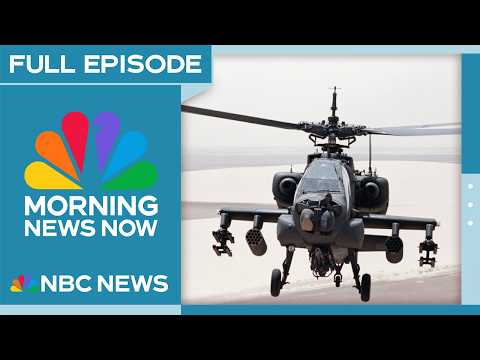
NBC News’ Morning News NOW spent most of the episode on geopolitics and U.S. domestic politics: a U.S. Apache helicopter crashed near the Strait of Hormuz, Trump again projected confidence that a deal with Iran was near despite renewed Iran-Israel exchanges, and Washington continued to churn through major nominations and spending fights. The rest of the show mixed in severe weather coverage, the California and Maine election battlegrounds, an unusual White House UFC event lawsuit, and several lighter segments on health, travel, EVs, and NASA’s Artemis program.
Watch on YouTube ›Get the market thesis, key claims, assets, contradictions, and follow-up questions from any financial video — then unlock a version personalized to your portfolio, watchlist, and favorite speakers.
This episode is a broad morning-news wrap, but the market-relevant core is the Middle East and the knock-on effects for oil, risk sentiment, and U.S. policy credibility. The show opens with a U.S. Army Apache helicopter going down near the Strait of Hormuz, with the two pilots rescued in stable condition. That incident is framed against an ongoing standoff in which the Strait is treated as a critical choke point for global oil flows and, on NBC’s telling, part of a broader U.S.-Iran blockade dynamic. Trump repeatedly insists a deal with Iran is close and says it could happen within days, but the report offers no substantive explanation for why he is confident. …
The immediate setup is a geopolitically fragile one: any further incident near the Strait of Hormuz can quickly revive oil and risk-premium bids, while Trump’s Iran-deal talk is not yet backed by visible proof. In the same window, severe weather and election-count noise are headline risks, not tradable theses.
Over the next several weeks, the market will care less about the rhetoric and more about whether the Iran channel produces a real de-escalation or just intermittent volatility. If the conflict stays contained and oil logistics remain intact, the episode’s tactical shock fades; if not, energy and defensives become the more obvious beneficiaries.
The durable implication is that energy security and geopolitical chokepoints remain structurally important to markets. Separately, the transcript points to a broader regime of higher policy uncertainty, heavier election noise, and more consumer caution around cost-sensitive purchases and digital-life effects.
A U.S. Army Apache helicopter went down near the Strait of Hormuz, but the two pilots were rescued and are in stable condition.
This is the central incident that opens the geopolitical coverage and frames the immediate risk backdrop.
The Strait of Hormuz remains a critical choke point for the world’s oil supply and is central to the U.S.-Iran standoff.
The episode repeatedly connects the waterway to oil supply risk and the broader conflict.
Trump says negotiations with Iran are ongoing and claims a deal could be reached within days, but NBC presents no supporting evidence for that optimism.
The transcript emphasizes the claim but also implicitly signals its unsupported nature.
With so much emotion and issues of race, jury makeup, and discrimination surrounding this case, how do jurors tune all that out and just focus on the evidence?
The jury will be instructed that the only things they can consider are what came in during the trial. The judge will spend time giving those instructions. Because of all the outside activity, the jury is sequestered through deliberations, keeping them in a controlled environment.
How do you go about weighing the credibility of the witnesses when so much of the case comes down to whose version of events the jurors believe?
The case has grainy footage of the altercation that is difficult to see, so witnesses who were there had to describe what they saw. In a self-defense case, there is a specific subjective and objective standard: first, whether Carmelo Anthony truly felt in his mind there was a threat of grave bodily injury or death, and second, whether that belief was reasonable. The jury also must consider whether Anthony was the initial aggressor or provoked the incident, which would prevent a self-defense argument. It's common for defendants not to testify, but in self-defense cases it's more challenging because you need to understand what they perceived the threat to be.
With closing arguments today, what do jurors need to hear to maybe tip the scales that they haven't already heard through the evidence?
Jurors will hear closing arguments that wrap up and put all the evidence together for both sides, but they'll also hear the jury instructions — the legal requirements that need to be proved by the prosecutors beyond a reasonable doubt. Today will be a very consequential day in court.
Unlock the full claims, asset map, scores, related transcripts, follow-up questions, and AI chat — shaped around your portfolio, watchlist, favorite speakers, and risks.
