
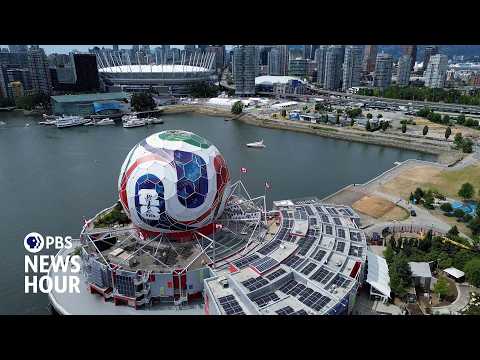
Roger Bennett argues the 2026 FIFA World Cup could be the biggest ever, but its expanded format, ticketing backlash, travel/logistics issues, and geopolitical friction make the buildup unusually messy. He sees the soccer favorites as the usual elite group — Argentina, Spain, France, and England — while highlighting Iran’s forced base-camp move to Mexico as a vivid example of how politics is already shaping the tournament.
Watch on YouTube ›Get the market thesis, key claims, assets, contradictions, and follow-up questions from any financial video — then unlock a version personalized to your portfolio, watchlist, and favorite speakers.
Roger Bennett frames the 2026 World Cup as a historic but complicated event: 48 teams, 104 matches, 39 days, and three host countries. His core soccer thesis is that the title picture still likely runs through the established powers rather than a surprise entrant. He explicitly names Argentina, Spain, France, and England as the main contenders, with Lionel Messi’s Argentina favored to try to repeat, Spain praised for its style and youth, and France described as exceptionally deep. He also notes England’s recurring pattern of promise followed by self-sabotage. He then explains why the expanded tournament may be both more chaotic and more revealing. In his view, the 48-team format will make the opening round less decisive, allow more teams to advance, and turn the event into a kind of “ultra marathon” rather than a sprint. …
Tactically, the biggest near-term risk is that World Cup hype is already colliding with backlash on pricing, logistics, and geopolitics before kickoff. Once the first matches start, sentiment could flip quickly if the opener and early games are entertaining.
Over the coming weeks, the base case is that attention shifts from pre-event complaints to match quality and knockout drama, with the expanded format testing depth and endurance. The setup improves if the early schedule is smooth and the favorites advance cleanly; it weakens if heat, travel, or protests repeatedly disrupt the event.
Structurally, the 2026 World Cup looks like a bigger, more commercial, more politically entangled version of the tournament, where scale creates both spectacle and friction. The lasting implication is that global sports events increasingly reflect cross-border tensions, pricing power, and host-country complexity rather than standing apart from them.
The 2026 World Cup will be the biggest in the tournament’s history because it expands to 48 teams across three countries.
The speaker cites the new size and footprint as the defining structural change.
Argentina, Spain, France, and England are the main contenders to win the World Cup.
He explicitly names these four as the favorites.
The expanded format will make the opening round less selective and turn the event into a marathon requiring stamina, cohesion, and luck.
He says many teams will advance and the winner will need tenacity and collective culture.
Which countries are the genuine contenders to win the World Cup?
He says the main favorites are Argentina, Spain, France, and England, while noting the United States is an obligatory but less realistic pick. He emphasizes that World Cups are hard to win and that only a small set of teams usually have a real chance.
How does the expanded 48-team format change the tournament dynamic?
He says the tournament will be much bigger and harder to predict, with more matches across three countries and a longer path to the knockout rounds. He adds that heat, travel, and overall stamina will matter more, making the event feel like an ultra-marathon.
What problems does the Iran situation create for FIFA?
He calls it unprecedented because a host nation and a participant are in conflict, and says FIFA has had to manage a highly complex situation. Iran has had to move its base camp to Mexico, and there may be protest from Iranian-American fans who feel the team represents the regime rather than the country.
Unlock the full claims, asset map, scores, related transcripts, follow-up questions, and AI chat — shaped around your portfolio, watchlist, favorite speakers, and risks.
