TranscriptAgent
Try it free
TRANSCRIPTAGENT.AI · transcript analysis

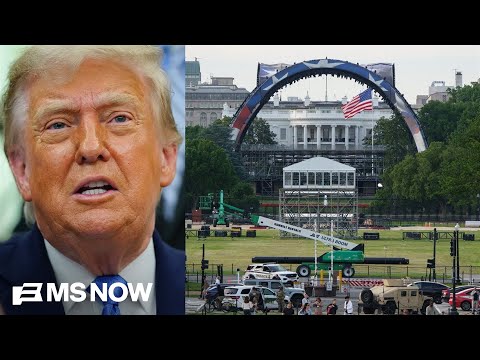
Is this what the Founding Fathers had in mind? Trump hosts UFC fight at the WH

Channel: MS NOW Published: 2026-06-12 11:23
MS NOW

This is a political/media segment rather than a market call. The guests argue that Trump hosting a UFC event at the White House is a costly, ego-driven spectacle that symbolizes poor priorities, especially alongside higher prices and the Iran war. Justin Wolfers also ties the discussion to markets by saying Trump’s repeated claims that he is close to an Iran deal have repeatedly moved sentiment, while the administration’s initial war timeline was badly wrong.

Watch on YouTube ›

Get the market thesis, key claims, assets, contradictions, and follow-up questions from any financial video — then unlock a version personalized to your portfolio, watchlist, and favorite speakers.

Detailed summary

The segment centers on Trump’s plan to host a UFC fight at the White House and uses it as a critique of his priorities and symbolism. Will Sommer calls the event a “crazy situation,” says the $60 million figure makes it a “huge mess,” and argues that if people say “this isn’t what america is about,” they would be correct. The discussion emphasizes the optics of a billionaire-style birthday spectacle taking place on the White House lawn while ordinary people face higher prices. Justin Wolfers frames the event as “absolutely berserk” and a “ridiculous moment,” stressing the contrast between the president’s celebration and public concern about the economy. He says people are “deeply worried” about the cost of living and argues that, if the goal was to project being out of touch, spending public money on a birthday party would be the way to do it. …

🔒 The full detailed summary continues — read all of it free with an account. Read the full summary →

Main takeaways

  1. The segment is primarily a critique of Trump’s White House UFC event, not a substantive market forecast.
  2. Will Sommer calls the event a costly, self-serving spectacle and says the White House lawn is not meant for this use.
  3. Justin Wolfers says the optics are awful at a time when people are worried about prices and the cost of living.
  4. Wolfers links the Iran war to market uncertainty, saying Trump’s repeated “close to a deal” claims have been a recurring message to markets.
  5. The administration’s initial war-duration forecast is described as badly wrong, which undermines confidence in its broader claims.
  6. The discussion treats the UFC event and Kennedy Center fight as examples of Trump trying to leave personal marks on public institutions.

Market read by horizon

Short term

Near term, the key risk is headline-driven volatility from Iran commentary; the guests imply markets can still react sharply to any claim of progress even without real confirmation.

  • Immediate setup is headline risk: Trump’s Iran messaging and the White House UFC event are driving attention more than fundamentals.
Show more
  • Any new claim that the U.S. is close to an Iran deal could quickly sway sentiment, based on the guests’ view of repeated market-reactive messaging.
  • The event itself is framed as an optics problem, not a tradable positive catalyst.
Mid term

Over the next few weeks, the likeliest path is continued chop until an actual ceasefire or deal changes the narrative; repeated “close to a deal” claims are treated as noise unless backed by action.

  • Over the next several weeks, the base case in this discussion is continued volatility from Iran-related headlines rather than a clean resolution.
Show more
  • The guests think the administration’s prior timeline has already proved unreliable, so confirmation would require an actual durable ceasefire or agreement, not repeated statements about being close.
  • If the war drags on, the commentary expects continued pressure on global confidence, food costs, and energy-linked inflation channels.
Long term

The longer-run issue is credibility: when presidential foreign-policy messaging becomes repetitive and unreliable, markets may price a more persistent premium for geopolitical uncertainty and policy noise.

  • Structurally, the segment argues that executive spectacle and institutional personalization are becoming more central to the Trump era.
Show more
  • The lasting market implication is that geopolitical communication can become a recurring source of volatility when investors treat presidential statements as actionable signals.
  • The broader regime concern is that policy credibility matters: if war timelines and deal claims are repeatedly wrong, confidence in official guidance erodes.
Unlock the full horizon read See the full short-term, mid-term, and long-term implications with confirmation and invalidation signals. Unlock horizon read

Key claims (7)

BEARISH political optics UFC

The White House UFC event is a bizarre and inappropriate spectacle that does not fit what America is about.

Sommer argues the event is a huge mess and that criticism of it as un-American would be justified.

BEARISH cost of living UFC

The event’s $60 million cost makes it an absurd use of money while people are struggling with living costs.

Wolfers directly contrasts the event expense with public worries about the economy.

BEARISH conflict of interest UFC

Trump is likely to personally profit from the UFC event because he owns stock in the company that owns UFC.

Sommer says Trump bought stock in the UFC parent and is promoting the company.

Unlock 4 more claims See the full bullish, bearish, and counter-consensus argument map extracted from the transcript. Unlock all claims

Assets discussed (5)

UFC
MIXED other

Mentioned as the event being hosted and as a source of advertising/branding value, but the discussion is political rather than an investment thesis.

Morgan & Morgan
NEUTRAL other

Named only as a sponsor logo on the cage.

Unlock the full asset map (3 more) See all assets mentioned, their directional bias, and the exact reasoning. Unlock asset map

Interview (5 Q&A)

UFC fight optics

How is hosting a UFC fight at the White House to commemorate the 250th signing of the Declaration of Independence honoring what the Founding Fathers had in mind?

Will Sommer says he hasn't figured that out, calling it a crazy situation. He notes that $60 million is being spent, Donald Trump has bought stock in the company that owns UFC and stands to personally profit, the State Department is making deals with UFC, and it's a huge mess. He agrees that people saying this isn't what the White House lawn is supposed to be used for would be correct.

UFC optics

What do you make of the optics of the White House hosting this UFC birthday party as normal people struggle with higher prices?

Justin Wolfers says the metaphor is absolutely berserk and ridiculous. He points out that people care a lot about the economy and are deeply worried. He highlights the absurdity of a $60 million price tag, arguing that while the UFC claims to pay, they get $60 million worth of advertising. He says if you wanted to project being out of touch, you'd spend money on a birthday party while failing to do anything about the cost of living.

presidential messaging

With the president attending the UFC fight and NBA Finals instead of focusing on global economic issues and the war in Iran, what message is the president sending?

Will Sommer says it has a bread and circuses feeling. He notes it's not even a main American sport like baseball on the White House lawn. He calls it essentially a handout to Dana White, the founder of UFC, and a spectacle of a blood sport that he doesn't think a lot of Americans want to see — an elite spectacle.

Unlock the full interview (2 more Q&A) Every question, answer summary, and YouTube timestamp. Unlock full Q&A

Where this transcript pushes against consensus

  • The segment largely asserts that the UFC event is a misuse of the White House without presenting evidence beyond outrage and the quoted cost figure.
  • Wolfers says the UFC is effectively receiving $60 million of advertising value, but that is an estimate rather than a demonstrated accounting fact.
  • The market impact of Trump’s Iran comments is described qualitatively; no concrete market moves, asset reactions, or data are shown.
  • The claim that the war’s initial forecast was wrong by hundreds of percent is rhetorically strong but not analytically unpacked.

Topics

Trump White House UFC eventpolitical opticsIran warmarket sentimentcost of livingKennedy Centerpresidential messagingpublic institutions

Create your free research agent

Unlock the full claims, asset map, scores, related transcripts, follow-up questions, and AI chat — shaped around your portfolio, watchlist, favorite speakers, and risks.

  • Full claims and asset map
  • Personalized relevance to your watchlist
  • Follow-up questions you can track
  • Related transcripts from your workspace
  • AI chat about this video
Create your free research agent
TRANSCRIPTAGENT.AI