
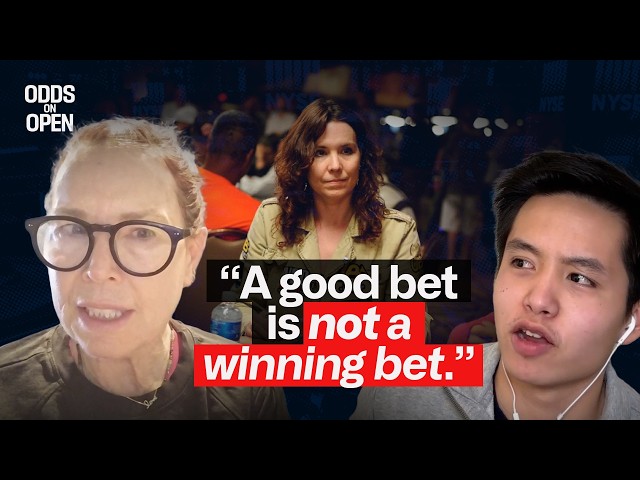
Annie Duke argues that every decision is a bet made under uncertainty, and that good decisions should be judged by expected value rather than outcome. She emphasizes explicit forecasting, base rates, and premortems for high-stakes choices, and says great risk-takers are comfortable with uncertainty and less distorted by loss aversion or gut feel.
Watch on YouTube ›Get the market thesis, key claims, assets, contradictions, and follow-up questions from any financial video — then unlock a version personalized to your portfolio, watchlist, and favorite speakers.
This conversation is a long-form decision-making framework centered on Annie Duke’s core thesis from poker and investing: every choice is a bet, because every choice allocates scarce resources under uncertainty. She defines a good bet as one with positive expectancy, not one that simply wins, and repeatedly distinguishes process quality from outcome quality using examples like green-light driving, lottery wins, poker hands, and trading. Duke argues that people implicitly calculate expected value in all major decisions, whether choosing a trade, a job, a career path, or a meal. Her recommendation is to make that calculation explicit for high-stakes decisions because explicit reasoning reduces bias and error, makes assumptions visible, and improves post-mortem learning. …
Tactically, the message is to slow down on high-stakes choices and force explicit EV thinking instead of reacting to recent wins, losses, or gut feelings. In markets and careers alike, the immediate risk is overconfidence in noisy outcomes.
Over the next several weeks or months, the framework points toward better decisions when people use base rates, premortems, and outside views to recalibrate forecasts. The likely evolution is less action on conviction alone and more emphasis on process, runway, and scenario planning.
Structurally, this is a probabilistic worldview: long-run success comes from repeatedly making slightly better bets, not from being right every time. The regime implication is that durable edge belongs to people and firms that can live with uncertainty without confusing luck for skill.
Every decision is a bet because every decision is made under uncertainty and carries opportunity cost.
Core framework statement repeated throughout the interview.
A good bet is one with positive expectancy, not one that simply wins.
Direct definition offered early and repeated later.
Outcome quality and decision quality are different; a bad decision can win and a good decision can lose.
Repeated with driving, poker, and trade examples.
What makes a great bet?
Annie defines a bet as investing resources (time, money, attention) into an option under uncertainty, with some expected value. A good bet carries positive expectancy given available options and risk tolerance. A good bet is not defined by whether it wins or loses, because luck plays a role. She gives examples including financial instruments, choosing a job, and ordering a meal.
Can you break down focusing on the process of the bet rather than the outcome?
Annie explains that because any option has a range of possible outcomes and which one actually occurs is governed by luck (not under your control), a good outcome doesn't mean it was a good decision and vice versa. She uses the green light/red light analogy: going through a green light and getting t-boned doesn't make it a bad decision, and going through a red light safely doesn't make it a good decision. The decision determines the probabilities of outcomes, not which outcome you observe.
Why doesn't a great outcome automatically imply a good decision?
Annie explains that luck is the reason. Even a good decision (like going through a green light) has a distribution of possible outcomes, and which one occurs is luck. She uses the LeBron James height example — being tall wasn't a decision, it was luck. Similarly, winning a lottery with a bad number pick doesn't make it a good decision. The decision only sets the probabilities, not the observed outcome.
Unlock the full claims, asset map, scores, related transcripts, follow-up questions, and AI chat — shaped around your portfolio, watchlist, favorite speakers, and risks.
