TranscriptAgent
Try it free
TRANSCRIPTAGENT.AI · transcript analysis

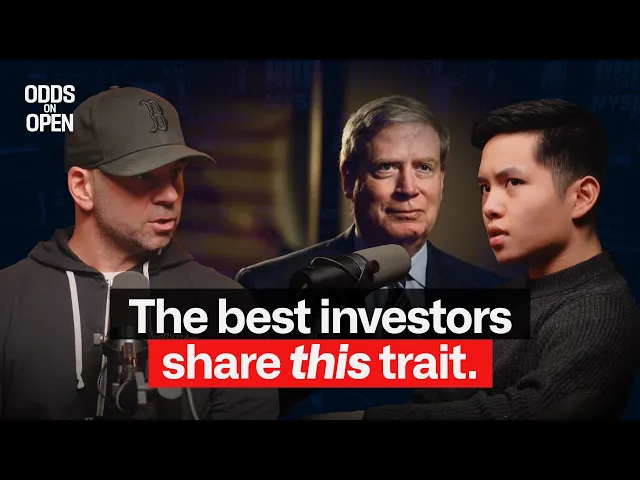
Alpha Comes From a Differentiated View - Ex-Point72 Prop Research Head Kirk McKeown on Edge in 2026

Channel: Odds on Open Podcast Published: 2026-02-26 10:01
Odds on Open Podcast

Kirk McKeown argues that alpha is a moving target and now comes from differentiated data, process, and historical pattern recognition rather than raw access alone. He uses his experiences at Tudor, Glenview, and Point72 to frame a broader thesis that Wall Street’s quantization and market-structure evolution are now coming to Main Street through data tokenization, factor frameworks, and AI-native decisioning.

Watch on YouTube ›

Get the market thesis, key claims, assets, contradictions, and follow-up questions from any financial video — then unlock a version personalized to your portfolio, watchlist, and favorite speakers.

Detailed summary

This interview is a wide-ranging framework conversation about edge, research, and the evolution of data-driven decision-making. Kirk McKeown, who says he spent the last 8.5 years at Point72 and earlier worked at Glenview Capital and Tudor Investments, argues that alpha is excess return from a differentiated view and that the source of edge changes across eras. He contrasts the operating models of Tudor, Glenview, and Point72: Tudor as a domain-knowledge and expertise shop, Glenview as a slower, high-conviction, two-year-horizon research business, and Point72 as a high-hit-rate, catalyst-driven multi-manager platform. A core part of his argument is that research edge comes from improving one of three things for a PM: number of ideas, hit rate, or conviction/sizing. …

🔒 The full detailed summary continues — read all of it free with an account. Read the full summary →

Main takeaways

  1. Alpha is not fixed; it shifts with the market structure and the tools available in each era.
  2. Research edge comes from process, historical context, and better questions, not just faster access to the same information.
  3. Point72-style multi-manager investing rewards high hit rate and repeatable catalyst work; Glenview rewarded deeper, lower-turnover conviction.
  4. The best research products create lift in ideas, hit rate, or conviction/sizing for PMs.
  5. McKeown’s thesis for Carbon Arc is that data will be tokenized/fragmented into smaller consumable units for AI and model-driven decisioning.
  6. He believes Wall Street’s evolution toward quant/model-driven trading will be mirrored on Main Street through data structure and enterprise tooling.
  7. He thinks the durable edge for young professionals is old-fashioned apprenticeship: reading, calls, field work, and compounding knowledge.
  8. He sees factor frameworks as a scalable way to decompose companies, industries, and even cultural assets into repeatable decision tools.

Market read by horizon

Short term

Near term, the actionable setup is around the AI/data-structure narrative: the trade is less about raw model quality and more about who can package data into usable, priced inputs. The immediate risk is that the theme is crowded and the practical adoption path may lag the hype.

  • Carbon Arc is positioned around the immediate opportunity in data packaging and consumption for AI and model users.
Show more
  • The tactical risk is that everyone is talking about data graphs/context graphs, so the space may get crowded quickly.
  • Near term, the pitch depends on proving that smaller, ratable data inputs are actually easier to buy, use, and monetize than legacy bulk data feeds.
Mid term

Over the next few months, the base case is that more firms will move toward structured, factorized, or tokenized data consumption if it improves decision quality and workflow speed. The setup strengthens if enterprises prove they can operationalize these inputs at scale; it weakens if the market decides raw datasets and generic LLM access are enough.

  • Over the next several quarters, his base case is that more enterprises will move from raw data acquisition to structured factor or signal consumption.
Show more
  • He expects Wall Street-style methods to diffuse into Main Street business decisioning, especially in demand, logistics, and supply-chain workflows.
  • Validation would come from more customers using Carbon Arc-style inputs to improve decision quality and from more institutions treating data as a utility-like input.
Long term

Structurally, he believes the economy is moving toward a model where data is a utility-like input and durable edge comes from domain expertise plus data architecture. If that regime holds, the long-run winners are institutions that can monetize deep expertise through products, not just through trading or advice.

  • His structural view is that data will be priced and consumed more like electricity or oil: granular, metered, and embedded into machine decisioning.
Show more
  • He thinks the long-run regime favors organizations that combine domain knowledge, structured data, and repeatable decision frameworks.
  • The lasting implication is that research, enterprise analytics, and even content businesses become more about data architecture and differentiated questions than simple access.
Unlock the full horizon read See the full short-term, mid-term, and long-term implications with confirmation and invalidation signals. Unlock horizon read

Key claims (9)

NEUTRAL

Alpha is excess return above beta, but the source of alpha changes over time.

He explicitly says alpha in 2006 differs from alpha in 2013 and alpha today, and that alpha moves around.

NEUTRAL Point72

At Point72, the dominant edge is high hit rate and catalyst-driven variant views rather than slow, concentrated sizing.

He contrasts Point72 with Glenview and says multi-manager is a hit-rate game driven by events and probabilities.

NEUTRAL

Research should be judged on whether it improves idea generation, hit rate, or conviction—not on stock P&L.

He repeatedly says PMs need lift in one of three buckets and that research businesses should not be evaluated on returns.

Unlock 6 more claims See the full bullish, bearish, and counter-consensus argument map extracted from the transcript. Unlock all claims

Assets discussed (10)

Carbon Arc
BULLISH other

Presented as the company building data market-structure tooling for AI/model-driven decisioning.

Lululemon — LULU
MIXED stock

Used as a turnaround example where one analyst could be bullish and another bearish depending on timing and framework.

Unlock the full asset map (8 more) See all assets mentioned, their directional bias, and the exact reasoning. Unlock asset map

Speakers

HOST Unspecified host GUEST Kirk McKeown

Interview (17 Q&A)

hedge fund experience

You've worked with some of the greatest hedge fund managers of our time. What was that like?

Kirk describes his 20-year career starting as an intern at Tutor Investments in 1999 under Jimmy Palada during the internet bubble, then working at Glen View Capital for Larry Robbins where he learned deep fundamental research, and finally spending 8.5 years at Point72 for Steve Cohen learning catalyst-driven variant view investing. He emphasizes that each firm was a reflection of its leader and taught him about different approaches to risk-taking, research, and deploying capital.

alpha creation

What were the differences in their approaches to finding edge and squeezing the juice out of it?

Kirk explains that alpha—excess return above market—evolves over time. At Tutor in 2000, competitive advantage came from domain expertise and being experts. At Glen View, it came from strong financial modeling, deep P&L analysis, and good management relationships. At Point72, the competitive advantage was about understanding when stories changed by one degree instead of ten—capturing nuance through a scaled, repeatable organizational process. He contrasts Point72 (multi-manager) as a 'hit rate game' taking many at-bats versus Glen View as a 'slugging game' taking fewer, bigger bets.

middle office alpha contribution

How did you tangibly assist the portfolio function or the PMs at Point72 to build out their edge and extract alpha?

The guest explains that in a middle office function, you need to help PMs generate more ideas, have a higher hit rate against their ideas, or improve their slugging percentage/conviction. The best place to play is the hit rate bucket (being right more than wrong) because it's measurable. They emphasize building research processes that are accessible and differentiated, tracking results maniacally with brutal intellectual honesty, and maintaining separation of church and state between research and P&L to avoid bias.

Unlock the full interview (14 more Q&A) Every question, answer summary, and YouTube timestamp. Unlock full Q&A

Where this transcript pushes against consensus

  • The claim that 'the fact that we're debating about a bubble means there's a bubble' is rhetorically strong but analytically thin; bubble debates can happen without an actual bubble.
  • His view that Wall Street outcomes will map onto Main Street is plausible, but the transcript offers more analogy than proof of direct equivalence.
  • The suggestion that data should broadly be priced per megabyte/token may be directionally interesting, but the transcript does not address customer adoption friction, licensing constraints, or governance issues in detail.
  • He treats factorization as broadly universal across assets and businesses, but the transcript does not fully test where that framework breaks down or becomes misleading.
  • Several claims about social media, AI, and youth development are opinionated and partially supported by examples, but not rigorously evidenced in the conversation.

Topics

alpha and edgePoint72 and multi-manager investingGlenview and concentrated researchTudor and early career lessonsresearch process and hit ratehistorical analogies and pattern recognitionCarbon Arc and data structureAI, LLMs, and model-driven decisioningfactor frameworkscareer discipline and personal edge

Create your free research agent

Unlock the full claims, asset map, scores, related transcripts, follow-up questions, and AI chat — shaped around your portfolio, watchlist, favorite speakers, and risks.

  • Full claims and asset map
  • Personalized relevance to your watchlist
  • Follow-up questions you can track
  • Related transcripts from your workspace
  • AI chat about this video
Create your free research agent
TRANSCRIPTAGENT.AI