
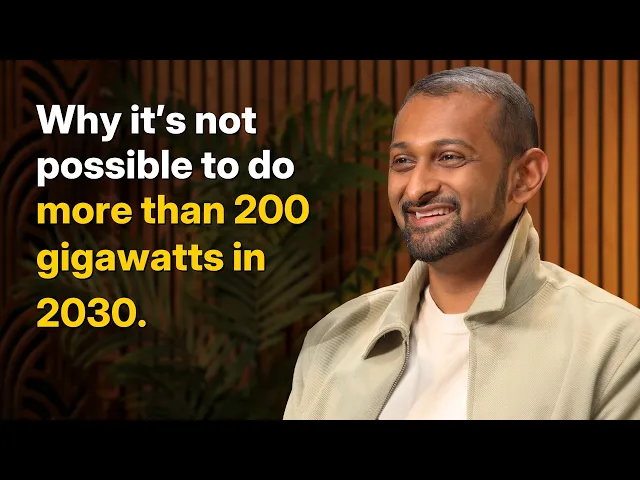
Dwarkesh Patel interviews Dylan Patel of SemiAnalysis about the single biggest bottleneck to scaling AI compute: not just chips, but the whole supply chain of capacity, contracts, power, memory, and fabrication. The core thesis is that AI demand is now so strong that long-term compute commitments, not spot prices, determine who gets margin and who gets left short.
Watch on YouTube ›Get the market thesis, key claims, assets, contradictions, and follow-up questions from any financial video — then unlock a version personalized to your portfolio, watchlist, and favorite speakers.
This episode is a compute-supply-chain deep dive centered on how hyperscalers, frontier labs, and infra providers are funding and allocating the buildout for AI. Dylan Patel argues that the large CapEx numbers from Amazon, Meta, Google, and Microsoft are not all spending for this year’s immediate usage; much of it is pre-buying future capacity through turbine deposits, power contracts, data center construction, and long-dated chip orders. He says Anthropic and OpenAI are now each around the low-single-digit-gigawatt range, with both likely heading toward roughly five to six gigawatts by year-end, though OpenAI has been more aggressive and better positioned because it secured more capacity earlier and more broadly across providers. A major theme is that the market for AI compute is now shaped by contract duration and willingness to pay for scarce supply. …
Tactically, the market is still in a scarcity regime: buyers with precommitted capacity look advantaged, while late buyers may pay up for whatever spare Hopper/Blackwell supply remains. Near-term upside remains concentrated in firms that can monetize the current shortage, but any delay or softening in demand would quickly expose expensive commitments.
Over the next few months, the base case is continued re-rating of compute and infrastructure as new capacity is absorbed almost as fast as it is built. The key validation is whether frontier labs can keep converting funding into usable gigawatts without a demand slowdown or supply-chain bottleneck.
Structurally, AI compute is being treated like a strategic industrial resource with durable scarcity, so early allocators may earn a lasting cost and margin advantage. If this regime persists, the biggest winners are likely to be the firms controlling access, upstream capacity, and long-duration contracts rather than only the firms with the best model.
The hyperscaler CapEx boom is only partly current-year spend; a large share is prepaid or committed for future capacity.
Dwarkesh and Dylan discuss Google’s turbine deposits for 2028–2029, data-center construction for 2027, and power purchase agreements, implying much of the CapEx is forward-loaded.
Anthropic and OpenAI are already at roughly two to two-and-a-half gigawatts of compute and are trying to scale much larger.
Dylan states current estimated capacity for both labs and indicates they are moving well beyond that.
Anthropic may need roughly four additional gigawatts of inference capacity just to support projected revenue growth.
Dylan extrapolates Anthropic revenue growth, applies gross margin assumptions, and translates that into compute spend and gigawatts required.
How should we think about the timeline for when the big hyperscaler and lab CapEx actually comes online, and what are the labs raising all this money for?
Dylan says CapEx is partly current-year and partly forward-loaded, with significant prior-year spending going into future capacity such as turbine deposits, data-center construction, and power agreements.
If Anthropic needs more compute to serve both revenue growth and model training, where is that capacity going to come from?
Dylan says Anthropic may need to rely on lower-quality or last-minute providers, while OpenAI has already been more aggressive in securing broad capacity across hyperscalers and neoclouds.
How many gigawatts of compute do Anthropic and OpenAI likely end up with by the end of this year?
Dylan estimates Anthropic can get to roughly five to six gigawatts, and OpenAI will be about the same or slightly higher.
Unlock the full claims, asset map, scores, related transcripts, follow-up questions, and AI chat — shaped around your portfolio, watchlist, favorite speakers, and risks.

