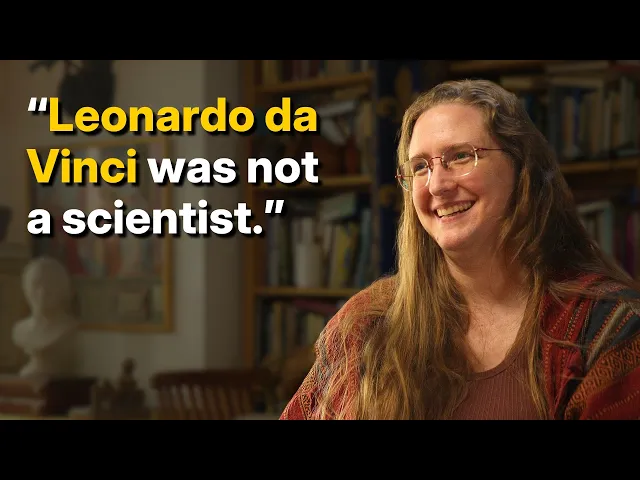
Ada Palmer argues that the Renaissance’s turn to classical texts was not just cultural cosplay but part of a long chain that helped create the scientific revolution: elites tried to model themselves on Rome, built libraries and information networks, and eventually those tools were repurposed into more empirical ways of thinking.
Watch on YouTube ›Get the market thesis, key claims, assets, contradictions, and follow-up questions from any financial video — then unlock a version personalized to your portfolio, watchlist, and favorite speakers.
This conversation centers on Ada Palmer’s interpretation of the Renaissance as a long, multi-step process in which Italian city-republics, classical revival, elite education, print culture, and expanding literacy all interacted. She explains why city republics persisted in Italy after the fall of Rome: larger, wealthier towns with good agricultural support could self-govern, while weaker towns drifted toward local lordship. From there, the discussion turns to Petrarch’s response to violence, banditry, and the Black Death. Palmer says Petrarch and his successors sought to restore Roman virtues by studying ancient writers, assembling manuscripts, and educating rulers through Greek, Latin, and classical exemplars. Palmer emphasizes that this first Renaissance project was partly idealistic and partly propagandistic. …
No immediate tradable setup is really present; the relevant near-term read is that this is a thesis about how historical narratives are built, not a market catalyst. If you were forcing a market lens, the only tactical takeaway is to be wary of one-cause stories and narrative overconfidence.
Over weeks to months, the useful lens is that major institutional or technological shifts usually require supporting infrastructure before the payoff appears. The transcript argues for watching ecosystems, distribution channels, and adoption pathways rather than headline intentions.
The structural message is that durable change comes from information infrastructure and method, not from the original intentions of reformers. That implies long-run winners are often the systems that broaden access to knowledge and repurpose elite projects into scalable institutions.
Italian city republics persisted because the collapse of Roman central authority forced cities to self-govern, and the wealthiest agriculturally supported towns were best able to do so.
Palmer explains the post-Roman breakdown of infrastructure and why some towns could remain republics while weaker ones fell to lordship.
Petrarch’s classical revival was driven by the violence of his age and a desire to imitate Roman civic virtue as a solution to corrupt leadership.
She links Petrarch’s reaction to banditry, civil war, and the Black Death to a program of learning from the ancients.
Renaissance elites used classical art and education as a legitimacy and propaganda tool, not just as a sincere moral project.
Palmer repeatedly contrasts the ideal of better rulers with the self-serving use of Roman imagery by upstart rulers and the Medici.
Why are there so many city republics clustered in Italy in the late 15th and early 16th century?
Ada explains that when the Roman Empire dissolved in the West, individual cities had to self-govern. Larger, wealthier towns with good agricultural land could sustain themselves and transition to republican governance (forming councils and senates like old Rome). Weaker towns tended to fall under the control of one wealthy family who could take over with goons, or their populations migrated out to the protection of noble villas, creating monarchal village structures. Italy had great agricultural land, so more of its cities could sustain themselves as republics.
What were the Roman virtues that allowed safety and good government, and how do they connect to science and technology?
Ada traces this through Petrarch, who lived through the Black Death and banditry, and concluded that the problem was selfish leaders. Petrarch advocated imitating the ancients by recreating their educational environment — reading Plato, Homer, Cicero — in the hopes that exposure to these values would produce leaders like Brutus (who executed his own sons for treason) rather than selfish ones like Lord Montague. The uptake was strong because upstart rulers used classical trappings propagandistically to gain legitimacy. Ada describes how Florence used art, sculpture, architecture, and classical learning to transform itself from a despised city into an impressive destination, making Renaissance culture a tool of social and political advancement.
What exactly is the connection between reading Cicero and contemplating the virtues of a great emperor and science and technology?
Ada answers that the connection involves multiple steps and that some steps involved realizing earlier steps didn't work. She then reframes the question through Petrarch's actual concerns — not science but leadership and education — and traces how the humanist project of reviving classical education was driven by the practical goal of producing better rulers, which then created the intellectual infrastructure that later enabled scientific and technological developments.
Unlock the full claims, asset map, scores, related transcripts, follow-up questions, and AI chat — shaped around your portfolio, watchlist, favorite speakers, and risks.