
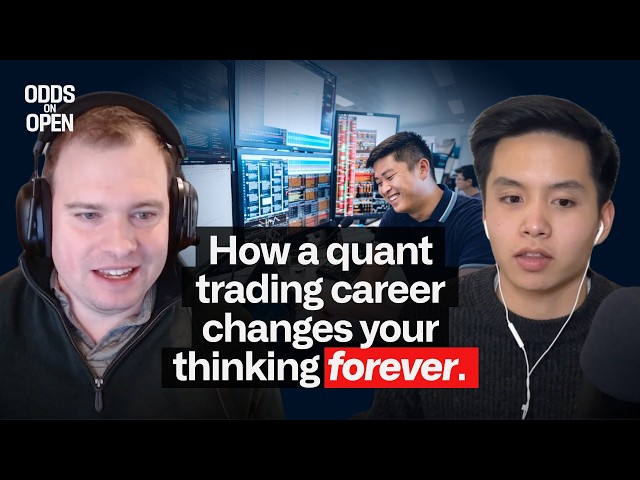
Andrew Courtney, an ex-SIG quant trader and market maker, explains how trading at a top quant shop is mentally demanding, highly collaborative internally, and best understood as decision-making under uncertainty. The conversation then shifts to prediction markets: where they’re inefficient, how liquidity and incentives matter, why he’s skeptical of insider trading as a norm, and why he sees prediction markets as useful mainly for calibrated probabilities and risk transfer rather than gambling.
Watch on YouTube ›Get the market thesis, key claims, assets, contradictions, and follow-up questions from any financial video — then unlock a version personalized to your portfolio, watchlist, and favorite speakers.
The interview is built around Courtney’s transition from SIG quant trading to prediction markets and the mindset that connects both. He describes the day-to-day reality of trading as long hours in front of multiple monitors, constant monitoring, no real lunch break, and a persistent need to split attention between current work and market events. He contrasts floor trading in Chicago with upstairs electronic trading, saying the electronic environment fit him better because it emphasized quantitative work, information density, and peer discussion rather than pit presence and physical networking. He also explains that quant trading produced a tight, concentrated professional network rather than a broad one. A major theme is the role of poker in SIG’s culture. …
Near term, the actionable setup is in thin or hype-driven prediction markets where quote quality is poor and crowd positioning may be skewed. The main risk is mistaking noise or liquidity incentives for genuine informational edge.
Over the next few months, the base case is continued growth in prediction markets alongside faster crowding by smarter participants and more specialized tooling. Edge should persist only where information is fragmented, market design is imperfect, or execution is still crude.
Long term, prediction markets may become a meaningful public probability layer and a small alternative risk-transfer venue, but only if they avoid degenerating into pure gambling products. The durable regime question is whether they improve calibration and hedging or become another retail casino wrapped in financial language.
Most trading work is repetitive monitoring of screens and requires constant attention to market events, not just moments of excitement.
He describes staring at multiple monitors all day, no lunch break, and always watching for things going off the rails.
The transition from floor trading to electronic trading suited Courtney better than floor trading would have.
He explicitly says he likely would not have lasted long as a floor trader and that the upstairs environment fit him better.
SIG’s poker-based training emphasized process discipline, decision review, and making quantitatively and qualitatively defensible choices under uncertainty.
He describes reviewing every hand and justifying calls, raises, and level thinking after each hand.
Who's the type of person that shouldn't be a trader?
Courtney says trading may not fit people who dislike sustained screen-watching, repetitive monitoring, uncertainty, and the lack of normal breaks. He contrasts the work with more network-heavy elite careers.
What were the differences between the way you expected the job to be versus the way it actually was?
He says the job was a better fit than expected, especially because he transitioned during the shift from floor trading to electronic trading and preferred the upstairs environment.
What aspects of that switch fit your skill set?
He preferred the information-rich, peer-based office environment to the physical pit, where awareness and relationships mattered differently.
Unlock the full claims, asset map, scores, related transcripts, follow-up questions, and AI chat — shaped around your portfolio, watchlist, favorite speakers, and risks.
