TranscriptAgent
Try it free
TRANSCRIPTAGENT.AI · transcript analysis

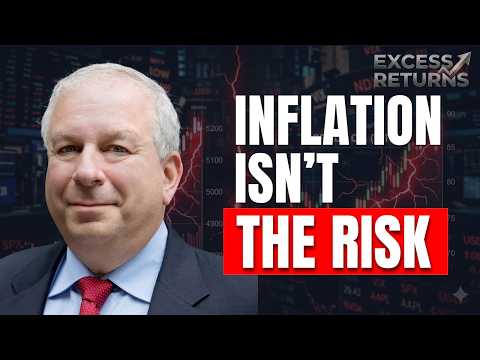
We Asked David Rosenberg Why He Owns Almost No US Stocks — and What He Holds Instead

Channel: Excess Returns Published: 2026-04-18 07:31
Excess Returns

David Rosenberg argues that U.S. equities are in a valuation mania, with investor behavior—not technology itself—forming the bubble. He says the economy is being held up by AI-related capex, equity wealth effects, and fiscal support, but sees weak underlying labor conditions, fading inflation pressures, and lower forward return prospects for U.S. stocks.

Watch on YouTube ›

Get the market thesis, key claims, assets, contradictions, and follow-up questions from any financial video — then unlock a version personalized to your portfolio, watchlist, and favorite speakers.

Detailed summary

This is an interview with David Rosenberg, founder and president of Rosenberg Research, on Excess Returns. He opens by explaining his career-long framework: identify where consensus is wrong, assign probabilities to multiple scenarios, and focus on left-tail risk without becoming a simple perma-bear. He says his reputation was shaped by starting his career on Black Monday in 1987 and by repeatedly warning about housing and other excesses before they became obvious. The core market thesis is that the U.S. stock market is in a bubble or mania, but the bubble is in investor behavior and valuation, not in the underlying technology theme. He argues that generative AI is real, similar to the internet, railroads, or electricity, but the market has priced it as if it were riskless. …

🔒 The full detailed summary continues — read all of it free with an account. Read the full summary →

Main takeaways

  1. Rosenberg’s main call is that U.S. equities are priced for perfection and offer poor forward returns from current levels.
  2. He sees a bubble in valuation and investor behavior, not necessarily in AI as a technology theme.
  3. Current economic strength looks narrow and low quality, driven by AI capex, fiscal support, and stock-market wealth effects.
  4. He thinks the labor market is softer than headline data suggest, which limits inflation persistence.
  5. He prefers diversified, global, low-beta portfolios with hard assets, fixed income, and selective thematic exposure rather than concentrated U.S. equity risk.

Market read by horizon

Short term

Tactically, U.S. equities look crowded and vulnerable because the market is priced for strong earnings, easy policy, and continued AI-fueled momentum all at once. Near-term upside may persist, but the risk/reward favors caution rather than chasing strength.

  • Near term, he expects inflation prints to look ugly for a few months because of tariffs and energy, even though he thinks the effect is temporary.
Show more
  • He thinks the Fed is likely to stay hawkish in the short run because it does not want to repeat the 2021 mistake.
  • The immediate risk for U.S. equities is that investors are paying peak multiples while the market is already extremely crowded and sentiment-driven.
Mid term

Over the next few quarters, the key question is whether AI spending and fiscal support keep offsetting soft labor and fading savings effects. My read is that growth likely disappoints relative to what is priced in, which should pressure multiples even without a clean recession.

  • Over the next several months, he expects AI capex and fiscal support to remain the main supports for GDP and earnings, but both may be nearing peak incremental impact.
Show more
  • His base case is not necessarily a recession, but a slower, more disappointing path than what is currently priced into stocks.
  • If the savings rate normalizes higher, or if fiscal support fades, GDP growth could fall close to stall speed and pressure earnings expectations.
Long term

Structurally, this is a regime where the U.S. stock market has become a major macro transmission mechanism and where expensive risk assets can distort the real economy. If valuations mean-revert, the lasting implication is lower real returns for U.S. equities and a stronger case for global diversification and hard assets.

  • Structurally, he believes the U.S. has moved into a regime where the stock market has an outsized impact on the economy through wealth effects.
Show more
  • He sees investor behavior, not innovation itself, as the recurring source of “mania” and eventual mean reversion.
  • He expects the market regime to favor global diversification, hard assets, and income-generating balance-sheet strength over concentrated U.S. equity exposure.
Unlock the full horizon read See the full short-term, mid-term, and long-term implications with confirmation and invalidation signals. Unlock horizon read

Key claims (9)

MIXED AI and valuations U.S. stock market

Investor behavior, not AI technology itself, is the bubble.

He says the technology is real, but the bubble is in how investors price it as if it were riskless.

BEARISH valuations S&P 500

The U.S. equity market is one of the most expensive in recorded history and expected returns from here are poor.

He cites CAPE around 40 and says nominal returns over 1, 3, 5, and 10 years look close to zero or negative.

MIXED

The stock market now drives the economy more than the housing market does.

He argues households watch portfolios constantly and spend more when their equity wealth rises.

Unlock 6 more claims See the full bullish, bearish, and counter-consensus argument map extracted from the transcript. Unlock all claims

Assets discussed (16)

S&P 500 — SPX
BEARISH index

Used as the benchmark for extreme valuation and poor forward return expectations.

U.S. stock market
BEARISH index

He says it is in a valuation mania and one of the most expensive markets in recorded history.

Unlock the full asset map (14 more) See all assets mentioned, their directional bias, and the exact reasoning. Unlock asset map

Interview (16 Q&A)

cycle view

How would you describe your role as a cycle watcher and navigator?

Rosenberg says his job is to identify when the market or business cycle differs from consensus and explain the trade. He frames his work as spotting where the cycle is, early/mid/late, and helping investors stay out of trouble by identifying tail risk.

tail risk

Do you focus more on left-tail risk because of your start in the 1987 crash, or do you think about all tail risks equally?

He says the issue is really which tail is fatter or thinner, and that his experience taught him how institutional investors think in probabilities. He explains that his work now centers on constructing forecasts with a base case plus alternate scenarios, because investors need plan A, B, C, D, or E.

housing bubble

What did you learn from being told to stop using the phrase housing bubble?

He says that episode showed him the sell-side economist largely functions as a marketing tool with limited independence. It also reinforced for him that firms often care more about internal discomfort and deal flow than saying uncomfortable truths.

Unlock the full interview (13 more Q&A) Every question, answer summary, and YouTube timestamp. Unlock full Q&A

Where this transcript pushes against consensus

  • The claim that AI-related spending and productivity are supporting most of GDP growth may overstate how durable those contributions are, especially if capex rolls over.
  • His recession skepticism is plausible, but the line between “stall speed” growth and an outright recession is thin and may be more fragile than presented.
  • The assertion that inflation will clearly fade later in the year depends heavily on shelter disinflation and weak labor transmission, which could prove slower or less linear than he implies.
  • He treats very elevated valuation as strong evidence of poor returns, but valuation is an imperfect timing tool and the persistence of extreme multiples can last longer than expected.
  • The idea that the stock market now drives the economy more than the housing market is directionally persuasive, but the magnitude of that dominance is hard to verify cleanly.

Topics

U.S. equity valuationAI capexCAPE ratiowealth effectslabor market weaknessinflation outlookfiscal deficitsportfolio constructionglobal diversificationmarket regime

Create your free research agent

Unlock the full claims, asset map, scores, related transcripts, follow-up questions, and AI chat — shaped around your portfolio, watchlist, favorite speakers, and risks.

  • Full claims and asset map
  • Personalized relevance to your watchlist
  • Follow-up questions you can track
  • Related transcripts from your workspace
  • AI chat about this video
Create your free research agent
TRANSCRIPTAGENT.AI